AI can create articles in seconds. But here’s the truth: speed is not enough. Google wants content that people can trust.
This is why Google introduced the helpful content system. At the heart of this system is the “Who, How, Why” framework. It pushes creators to be transparent:
- Who made the content?
- How was it
- Why was it created?
These questions connect directly to EEAT signals (Experience, Expertise, Authoritativeness and Trustworthiness). If your content cannot answer these, it risks being ignored by both Google and readers.
What is Google’s “who, how, why” framework?
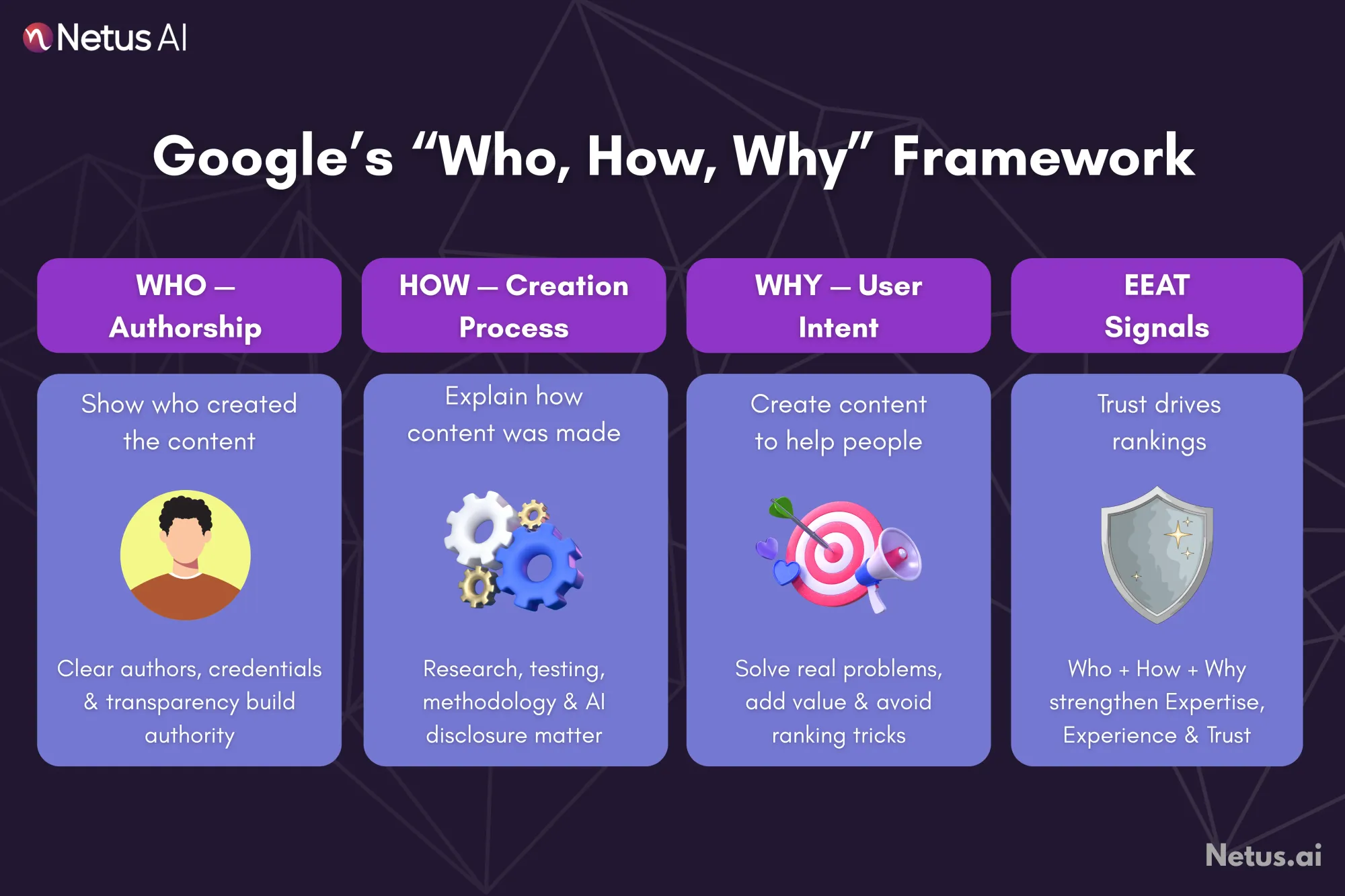
Google’s framework is simple but powerful. It’s designed to help Google (and your readers) understand the credibility and purpose behind your content. It helps decide if content is helpful or unhelpful.
Who: the face behind the words
The “Who” in this framework is all about transparency and responsibility. It asks, “Who created this content?” “Who is responsible for the information shared?”
- Clear Authorship: This means having identifiable author names, not just generic company accounts. Like through social media accounts.
- Credentials and Notes: If the author has expertise, show it. Are they a doctor, an engineer or a seasoned chef? Let readers know.
- Transparency: Be open about the source of the information. If it’s a team effort, acknowledge the team.
How: the journey of your content
The “How” aspect goes deeper into the creation process. It’s about being open about how your content came into existence.
- Content Creation Process: Did you conduct original research? Interview experts? Perform hands-on testing? Share these details.
- Methodology: Explain the steps you took to gather information, analyze data or form conclusions.
- Disclosure of AI Use: If AI played a role in drafting or assisting with your content, it’s good practice to disclose it. Google understands AI is a tool, but transparency builds trust.
- Testing and Validation: If your content offers advice or reviews products, show that you’ve tested or validated the information.
Why: the heart and purpose of your content
Perhaps the most critical and often overlooked part of the framework is the “Why.” This isn’t just about keywords or local SEO; it’s about your true intent.
- Solving User Needs: Is your primary goal to genuinely help your readers? Are you answering their questions thoroughly and clearly?
- Adding Value: Does your content offer unique insights, fresh perspectives or practical solutions that aren’t easily found elsewhere?
- Not Gaming Rankings: Is your purpose to serve your audience or simply to manipulate search engine results?
How “who, how, why” strengthens EEAT
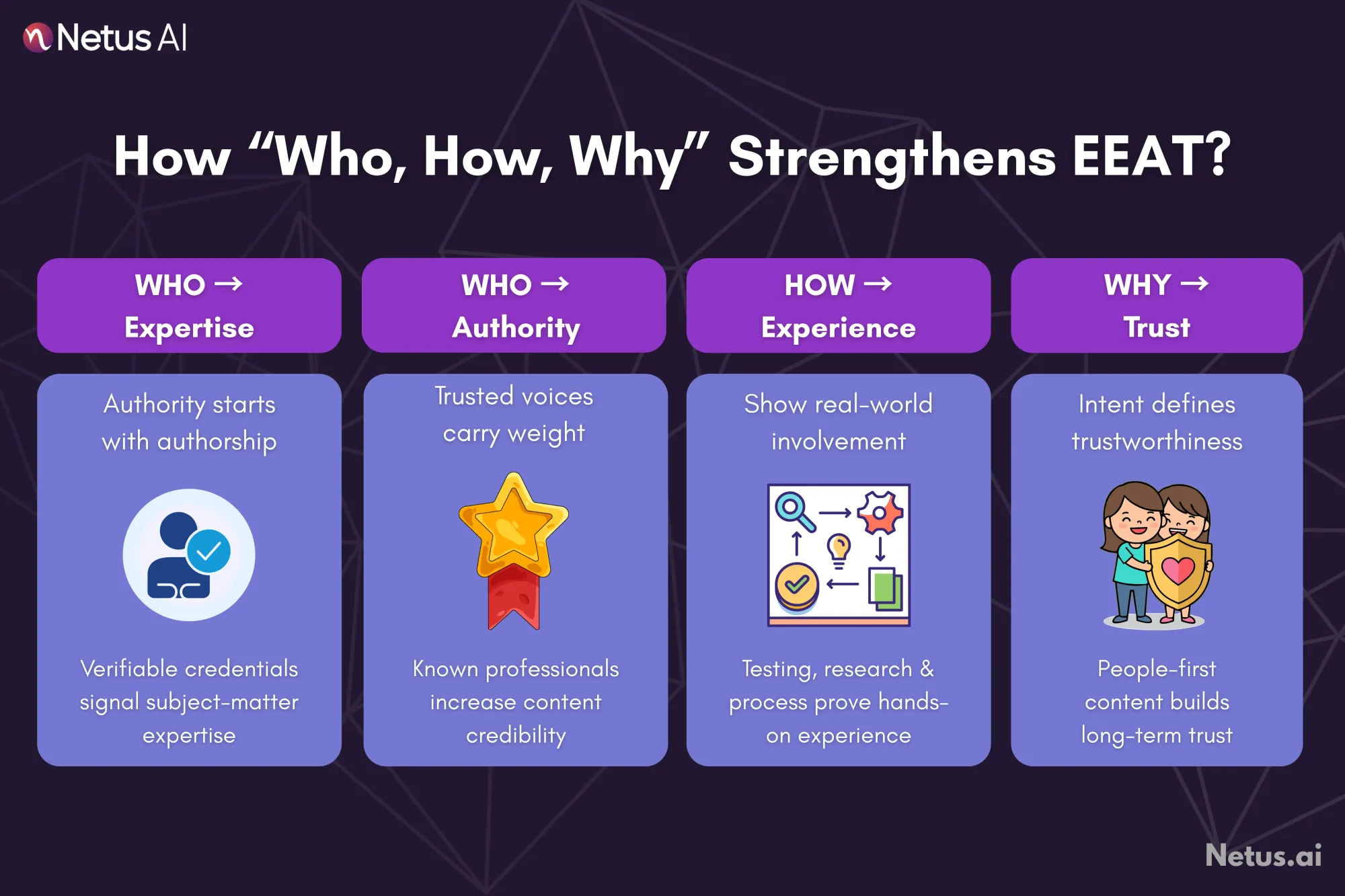
The “Who, How, Why” framework isn’t separate from EEAT; it’s the practical application of it. Let’s look at how each element directly contributes to stronger EEAT signals.
Who → Expertise & authority
When an author with verifiable credentials writes an article, their expertise can be seen. If a financial expert provides investment advice or a certified nutritionist discusses healthy eating, their “Who” immediately establishes them as an authority on the subject.
How → Experience
Detailing how you create content, like the actual process behind it, gives this sense of real experience that stands out.
For something like a product review, you could talk about your testing, say using a smartphone over a month and checking the battery in different situations. That kind of thing shows you actually did it, not just read about it somewhere.
Why → Trustworthiness
Trust is really built on the why behind what you create. Like, if the stuff you're putting out there keeps trying to help people with their issues and gives straight up correct info without any sneaky motives, then it starts to feel reliable over time.
Google's whole thing is about handing out the best info possible, so this fits right in with what they want.
Practical steps to pass “who, how, why” + EEAT
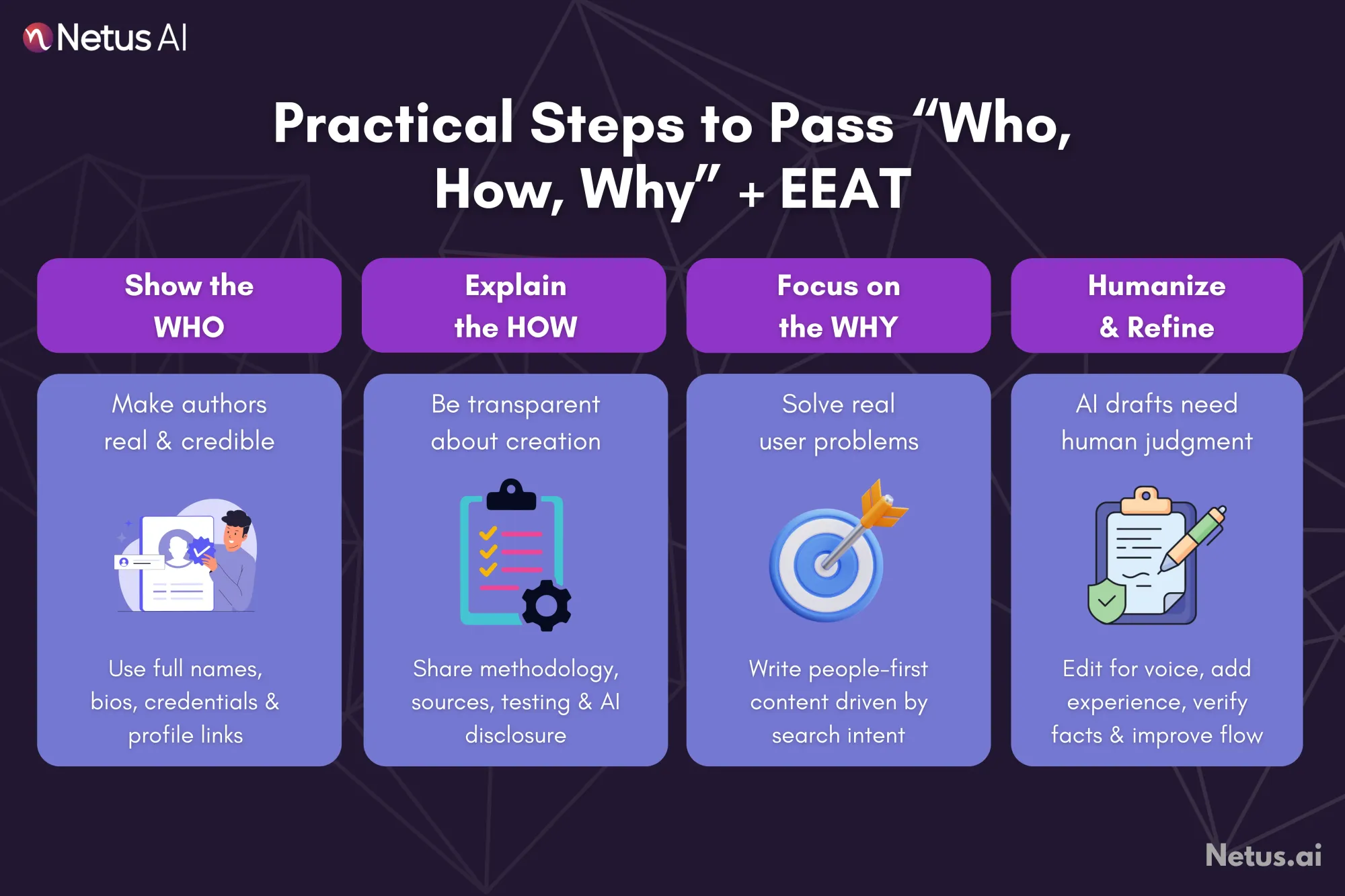
The good news is that you do not have to be some big SEO expert to get your content up to those standards. Just a few small changes can help it pass Google's checks and make readers trust it more.
For the process of making the content, you should disclose how it all happened. Add sections like our methodology for tricky topics or reviews, explaining the research or what was tested.
Focusing on what users really want is another big part. Do not just sell stuff, solve actual problems your audience has. Before writing, figure out the problem and how to fix it. Do keyword research but think about intent, what people are really searching for or trying to do.
Using AI drafts, treat them as starting points only. Edit to add your brand's voice, make it sound human. Throw in personal examples or stories, they connect better and show real experience. Always check facts because AI messes up sometimes with old info or made up stuff.
When you do all this, content turns into something people focus on, with good EEAT and it fits Google's rules. It might take some trial and error, but it works.
Where Netus fits in the framework
Applying Google’s Who, How, Why framework can feel like extra work, especially when starting with raw AI drafts. That’s where Netus makes the process easier.
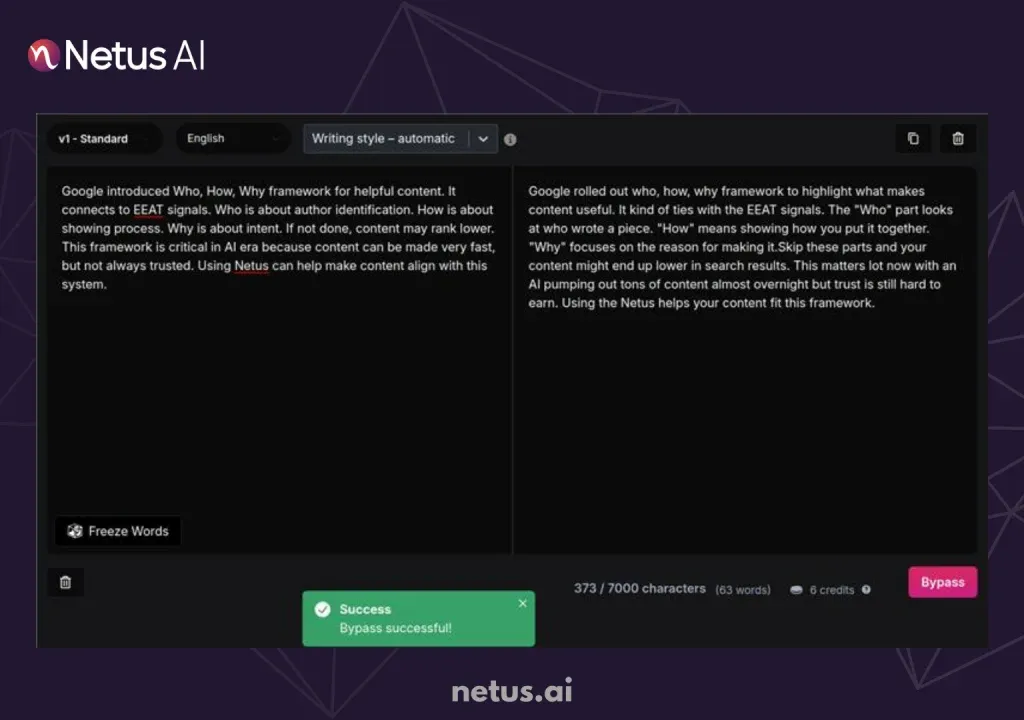
Who → Adding a human voice
Netus AI bypasser isn’t about hiding AI use; it’s about refining AI-generated text to sound authentically human.
By polishing the language and flow, it helps content reflect a genuine human voice, making it easier for readers to connect with the author’s expertise and build trust.
How → Structured, SEO-friendly process
Netus’s SEO Article generator is designed to create well-structured, logical content drafts that inherently align with Google’s quality expectations.
This structured approach makes it easier to inject the necessary transparency about your content creation process, supporting the “Experience” aspect of EEAT.
Why → People-first purpose
Netus ensures AI content remains focused on user intent (the "why") for SEO. This pushes the AI to address user needs and provide utility, instead of just keyword-stuffing.
This aligns with Google's guidelines, bridging fast AI creation with the human element required for higher search rankings.
Netus is essential for creating Google's desired "Helpful Content" that resonates with people.
Final thoughts
Google's 'Who, How, Why' framework guides content creation for better search visibility, focusing on EEAT (Experience, Expertise, Authoritativeness, Trustworthiness). Ignoring these elements, especially with AI-generated content, risks poor ranking.
Post-helpful content update, Google prioritizes useful, trustworthy content from credible sources, rejecting low-quality or inauthentic material.
But if you use tools like Netus it helps fill in the gaps between AI doing the work and what Google expects for trust. By putting in the human side like who is behind it, the process used and the real reason for making it you end up with content that ranks okay and actually helps people out.
FAQs
What is Google's 'Who, How, Why' framework?
Google's Who, How, Why thing seems like these basic questions they use in their Helpful Content setup. It's right there in the middle of how they check if stuff online is solid or not, you know, for credibility and all that purpose behind it.
How do the 'Who, How, Why' questions connect to EEAT?
So, this framework basically puts EEAT into real use, you know, Experience, Expertise, Authoritativeness, and Trustworthiness. Then there's the 'How', which shows off the Experience side of things. And the 'Why' seems like it builds trustworthiness, or at least that's the main idea. It feels a bit straightforward when you break it down like that.
What is required for the 'Who' component?
The Who part is about making sure there's actual people behind it, like real names you can identify instead of some vague account.
That stands out because without that, it's hard to trust. Then there's the credentials, which should show what the author actually knows about the subject, you know, relevant expertise.
What is required for the 'How' component?
When it comes to the How part, you really need to be open about how the thing was made. Like, tell people about the methods you used, stuff such as doing your own research or talking to folks in interviews, or even trying things out yourself.
What is the 'Why' component focused on?
The why part is really about what the content creator actually means to do. It has to center on helping users for real, like finding ways to solve their problems and giving something extra that stands out. Not just trying to game the search engines or anything.
How can tools like Netus help with this framework?
Tools like Netus assist by refining AI drafts to sound authentically human ('Who'), creating well-structured content that is easy to add methodology to ('How'), and ensuring the content remains focused on user intent and utility for SEO ('Why').