Social media, used by millions, isn’t protected by the First Amendment or freedom of speech. Each platform has its own content posting guidelines, despite their widespread popularity.
However, some states are trying to pass laws that would limit content moderation on these platforms. Therefore, changes may be on the horizon.
This document examines the concept of freedom of speech and the First Amendment in the context of social media. It delves into current content moderation policies and explores potential future developments.
The scope of free speech on social media

While many believe the First Amendment grants unlimited freedom of speech, this isn’t entirely accurate. Social media platforms, being private entities, are not obligated to adhere to its provisions.
First Amendment rights permit social media platforms to moderate user content.
Currently, social media companies are not in violation of free speech due to their content moderation policies. Additionally, they are generally not liable for posts made by their users.
Section 230 of the Communications Decency Act protects interactive computer service providers from liability for user-generated content.
Social media: Permitted and prohibited content
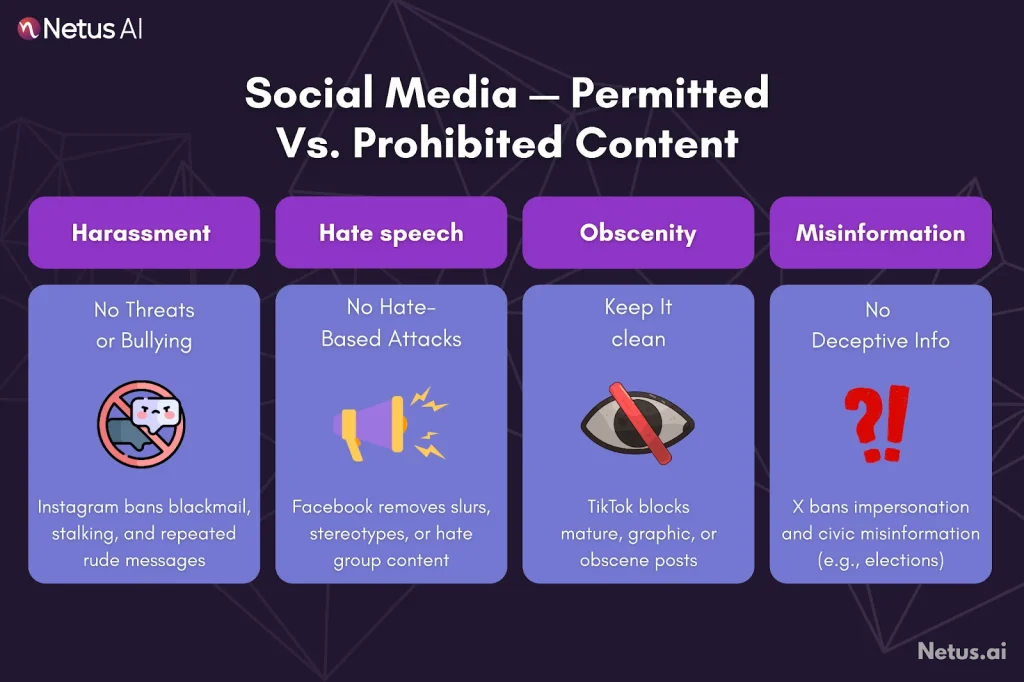
The regulations concerning speech on social media are not uniform; they vary depending on the specific circumstances.
Social media platforms often implement content moderation policies to address issues like harassment, hate speech, obscenity and misinformation. However, the specific details of these policies can differ from one platform to another.
Always check each platform’s policies, terms of service and guidelines to ensure your content is acceptable.
Below are examples of policies implemented by various social media platforms to moderate speech deemed unacceptable.
Harassment
Unwanted rude, offensive or degrading comments constitute harassment.
Instagram’s policy prohibits content that includes blackmail and ongoing unwelcome messages.
For more information, refer to Instagram’s Community Guidelines and Terms of Use.
Hate speech
Hate speech is defined as threatening or offending an individual based on their religion, gender identity or ethnicity.
Facebook bans hate speech, including slurs and stereotypes. The platform also prohibits organizations that promote hatred.
For further details on this and other policies, please refer to Facebook’s Community Standards.
Obscenity
On social media, obscenity generally denotes content that violates public decency standards.
TikTok’s policy and community guidelines prohibit sensitive and mature themes.
For more policy details, refer to TikTok’s Terms of Service and Community Guidelines.
Misinformation
The World Economic Forum’s Global Risks Report highlights misinformation and disinformation as a paramount short-term global risk. This includes various forms such as false rumors, hoaxes, pranks and propaganda.
Consider X (formerly Twitter) as an illustration. Their misinformation policy prohibits users from impersonating individuals or groups to deceive others. Additionally, they have a policy against content that could mislead people regarding participation in civic processes, such as elections.
For detailed information regarding policies, refer to The X Rules.
AI in social media content moderation: Advantages and disadvantages
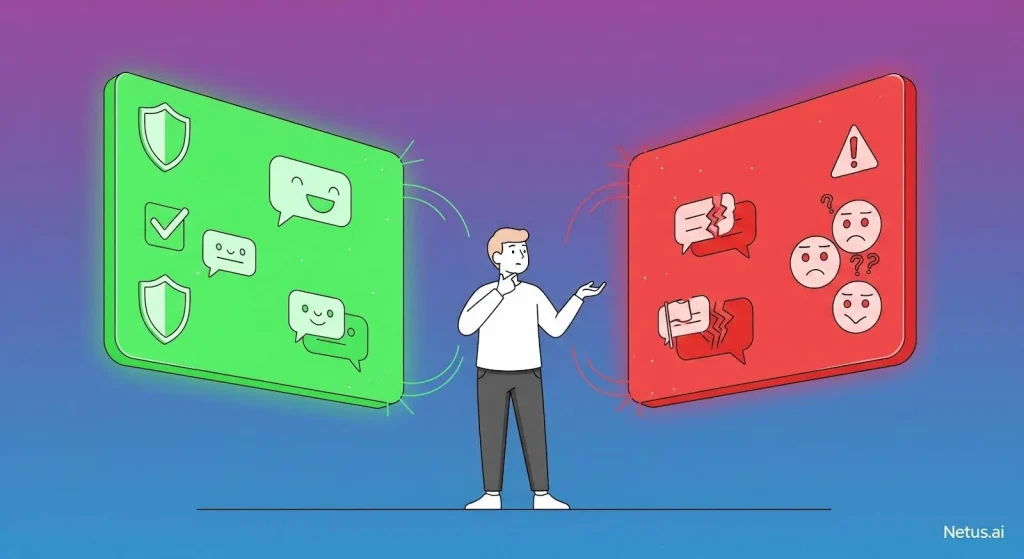
With approximately 1,099 posts shared every second on Instagram, it’s understandable that social media platforms rely on artificial intelligence for content moderation.
Advantages
Facebook uses AI to preemptively remove content violating Community Standards. This approach has notable benefits.
- Social media companies utilize AI for large-scale content moderation.
- This accelerates the removal of harmful content.
Disadvantages
AI-powered social media content moderation, like content creation, has limitations that need addressing.
- A major concern is algorithmic bias, as AI’s intelligence is directly limited by the data it’s trained on.
- Biased data can lead to skewed outcomes when replicated by technology.
Mitigate algorithmic bias in published content by using an AI content detector and fact-checking AI generated text.
AI content moderation, however, presents a more complex challenge. While Facebook’s technology occasionally flags content for human review, what happens to the content removed before it’s even seen?
This question becomes increasingly relevant as AI and social media platforms continue to evolve with technological advancements.
The push to limit social media moderation: Understanding state-level restrictions
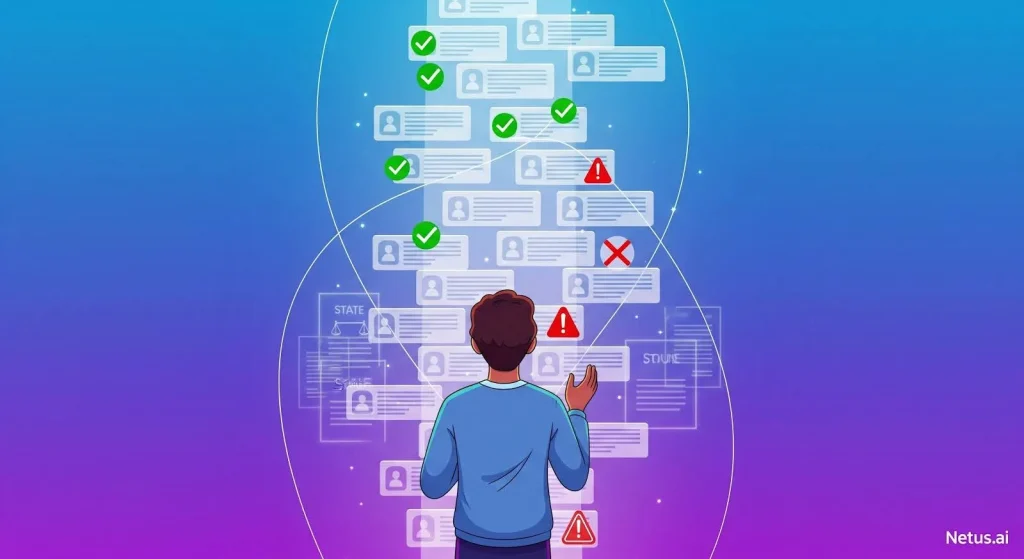
Social media laws are supported in those states who believe that these platforms are biased against conservative content.
Both laws, though specific details may vary, would restrict social media companies’ discretion in curating content on their platforms.
Social media companies argue these laws violate their First Amendment rights to moderate content. A Supreme Court ruling upholding these laws could significantly change their operations and create new liabilities for hosted content.
Final thoughts
Social media platforms aren’t legally bound by the First Amendment. This creates tension between platform autonomy and user free speech, prompting debates and potential state legislation.
AI content moderation, though efficient, introduces complex algorithmic biases, complicating online expression. As technology advances, ensuring content authenticity and combating misinformation will become even more critical.
NetusAI helps manage AI generated content challenges. Free speech on social media is shaped by legal precedents, technological advancements and changing user and platform expectations.
FAQs
Is freedom of speech on social media protected by the First Amendment?
No, social media platforms are private entities and are not legally bound by the First Amendment. They have their own content posting guidelines and moderation policies.
Can social media platforms moderate user content?
Yes, First Amendment rights permit social media platforms to moderate user content. They are generally not in violation of free speech due to their content moderation policies.
What is Section 230 of the Communications Decency Act?
Section 230 protects interactive computer service providers from liability for user-generated content.
What types of content do social media platforms moderate?
Platforms often implement policies to address issues like harassment, hate speech, obscenity and misinformation. The specific details vary by platform.
How do social media platforms handle harassment?
Policies vary, but generally, platforms prohibit unwanted rude, offensive or degrading comments, including blackmail and unwelcome messages. For example, Instagram prohibits such content.
What is considered hate speech on social media?
Hate speech is defined as threatening or offending an individual based on their religion, gender identity or ethnicity. Facebook, for instance, bans slurs, stereotypes and organizations promoting hatred.
What does obscenity mean in the context of social media?
Obscenity generally denotes content that violates public decency standards. TikTok, for example, prohibits sensitive and mature themes.
How do social media platforms address misinformation?
Platforms have policies against false rumors, hoaxes, pranks and propaganda. X (formerly Twitter) prohibits impersonating individuals to deceive and content that misleads people regarding civic processes.
Do social media platforms use AI for content moderation?
AI enables social media to moderate vast content, swiftly removing harmful material.
What are the disadvantages of AI in content moderation?
Algorithmic bias is a major concern, as AI’s limited training data can lead to skewed outcomes. There’s also the question of what happens to content removed by AI before human review.
Are there efforts to limit social media moderation?
Some states are attempting to pass laws restricting social media companies’ content curation, often due to perceived bias.
How could a Supreme Court ruling on these state laws impact social media?
Enforcing these laws could alter social media operations, making platforms accountable for content. However, companies contend this infringes upon their First Amendment rights to moderate content.