Is using an AI humanizer cheating or not? Nowadays, because of generative AI, content creation has been dramatically changed.
Tools such as ChatGPT and Gemini now make it possible for people to receive high-quality writing instantly, so the web is filled with text made by AI. This new kind of efficiency is amazing, but people are also questioning: Is using an AI humanizer actually cheating, or is it fine to do that?
When thinking about this, it is important first to explain the role of an AI humanizer. Basically, an AI humanizer takes writing that was first produced by AI, which is sometimes easy to recognize because of similar sentence patterns and repetitions, and rewrites the text so that it sounds more like a real person, with subtle tone changes and added human-like qualities.
The point of this is to hide it from “AI content detectors” that teachers, publishers, or even search platforms employ more often these days.
Where do AI content ethics stand?
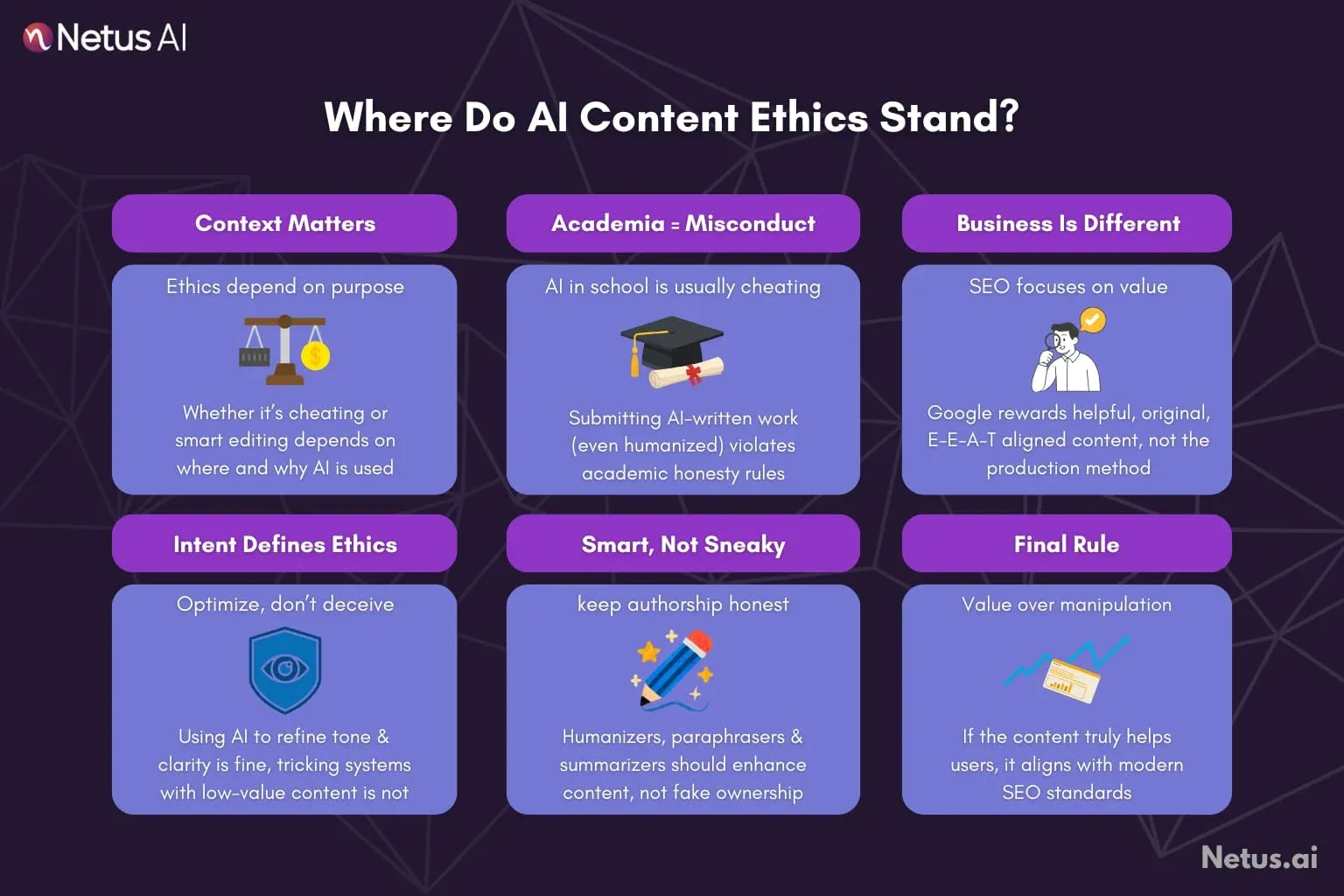
If using a humanizer is cheating or not depends mainly on why and where someone is using it.
Is it cheating in school?
Most of the time in academics, yes, it actually is cheating. Teachers and universities give assignments so they can check each student’s own thinking, writing, and knowledge.
When a student sends in an assignment mostly written by AI, even if run through a humanizer, it goes against the meaning of academic honesty. It means the AI humanizer is used as a trick, as if it changes who did the work, but really, it is still not the genuine words of the student.
Is it considered cheating at work in SEO or content production?
In the business world, especially in the fields of Search Engine Optimization (SEO) and digital marketing, things are not as easy to judge. Marketing people mostly want to create great, interesting work that gets a good ranking on the internet. According to Google, what the company cares about is usefulness and the overall quality of writing, not exactly whether a computer or a human wrote it.
Google search is interested in content, no matter how it was produced, as long as it is high-quality, helpful, original, and meets E-E-A-T (Experience, Expertise, Authoritativeness, and Trustworthiness).
So, in this case, when someone uses an AI humanizer, it is more about making things optimal and avoiding problems, not exactly cheating. For instance, when a group working in SEO uses an article generator to create around 80 percent of the text, then brings in an AI humanizer, or what is called an AI bypasser, mainly to rewrite it so it matches the needed style or company voice and to verify that it fits in-house checking rules, then this is mostly for working faster.
If, at the end, the article adds real value, then there is no intent to cheat people reading it. The biggest possible cheating is to try to trick the systems that check for low-quality or unoriginal work, which can lower rankings.
If you have some fear your writing might be detected, using an AI detector before you make your work public is a smart way to know if you need an AI humanizer step or not.
When is humanizing AI text clever, not cheating?
Turning to an AI humanizer can be considered a smart step for content work, as long as the focus is on making what is written better, not lying about authorship.
For better style and tone
Texts written by AI can have perfect grammar but seem boring. By using a humanizer or even just a paraphrasing tool designed for good language, you can make the work interesting to read and suitable for your brand. Just like an editor improving someone’s article, this is about polishing writing.
To be more unique than the initial AI draft
If you create your first draft with AI tools and then use another advanced paraphrasing service, you reduce the chance that your writing will accidentally resemble someone else’s AI-generated text.
For making work fast
Big teams use AI for speed. To get important ideas from large sets of information, an AI summarizer helps, and from there, you can use a humanizer for final touches.
All of these steps mean you can work quickly and produce unique work. Google and other search sites mainly care if users gain value from what you wrote. In this kind of situation, that is not considered cheating.
NetusAI: A unified system to keep content honest
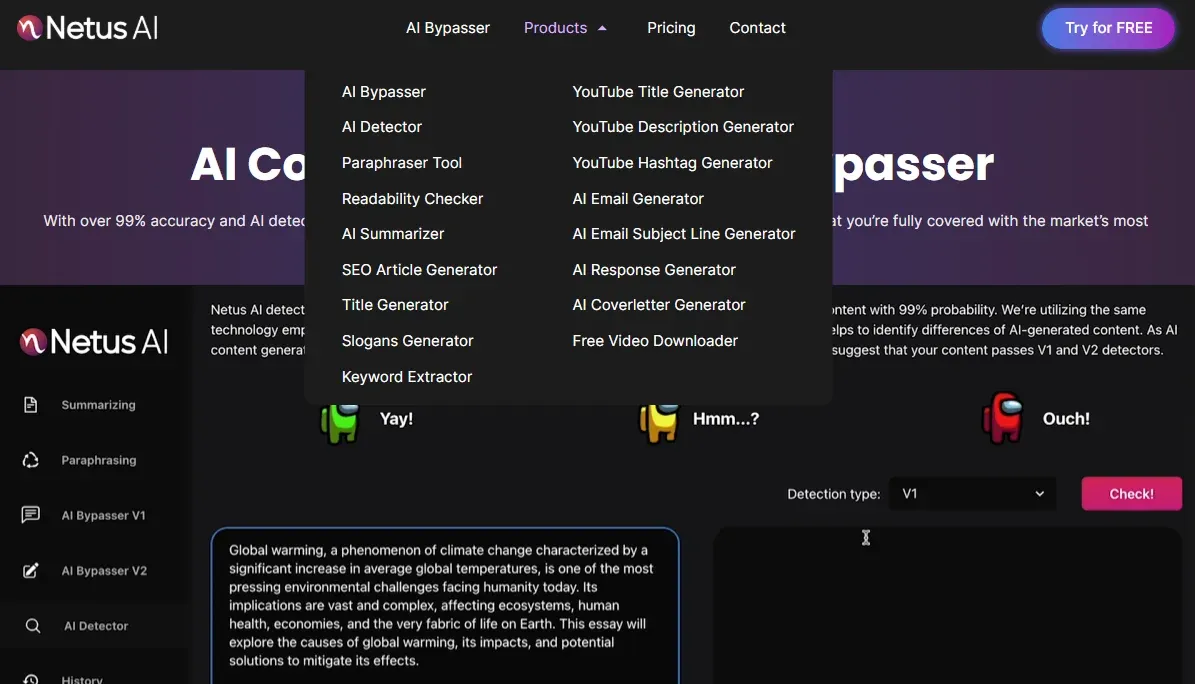
When moving around in the world of AI content creation, you cannot just depend on a single tool. There is a need for a combination of solutions, with quality, speed, and honesty being top priorities.
NetusAI provides this complete stack of tools, changing the way professionals control their content work routines. Various AI tools serve distinct purposes in content creation. Other tools focus on content refinement and efficiency.
For instance, for the initial stages of writing, the SEO article generator accelerates the first draft by centering the content around specific keywords, which is useful for generating initial concepts and multiple drafts.
To improve marketing and click-through rates, the title generator & slogan generator crafts inventive and enhanced titles or branding slogans.
Finally, the keyword extractor identifies important search terms within existing text or drafts, which is crucial for maintaining and refining the overall SEO strategy.
Some final ideas
If you want to use an AI humanizer, the core decision depends on what the use is for. In schools or universities, it can be seen as trickery (i.e., cheating). But in jobs, especially SEO writing, it is most often for quality checking and following rules, a method to make sure AI support is still giving content that is new, trusted, and has value for real people reading.
In the end, the strongest way to avoid people saying "cheating" is being open and doing good work. Try to use tools like those from NetusAI to make text serve the needs of people, not just escape AI detection systems.
FAQs
What is the biggest difference between AI humanizer and paraphrase tool?
An AI humanizer is made just for changing and altering words so it does not have normal AI writing signals, making it look like a person wrote it and trying to get past algorithms for detecting AI. A paraphrase tool works in a broader way. It changes how text reads, adjusts how it sounds, and creates uniqueness, not really minding if the original was by a real person or AI. Even though they do some of the same things, a humanizer has a very specific, technical use for tricking detection.
When I use an AI humanizer, does it definitely push my material to rank highly on Google?
In reality, no. AI humanizer helps your writing look real and meet quality checks needed for language and not being found as AI, which is an important part. Still, Google ranking comes from many things like E-E-A-T, link building, website speed, and much more, such as the usefulness and freshness of your content. You also need an SEO article generator and need to pay attention to putting keywords in correctly so you can have a better shot at ranking.
Are the results from AI detectors always trustworthy, or can they be deceived?
AI detectors are high-level, but no detector is perfect. They check for special patterns in language, how complex sentences are, and other things like perplexity. When you use an AI bypasser or humanizer, it aims to disrupt these signs, but new detection methods are always developing. Because of this, you should use the AI Detector first before you post, which gives you the chance to check for risk and fix the text if you find a problem.
Can the AI summarizer tool help with writing research papers?
Yes, the AI summarizer can be used so you can see the main topics and results from different research articles and better understand the literature quickly. However, you should always properly cite the original sources, and when you do your own writing and synthesize ideas, it should be done by yourself to maintain academic integrity.