Nowadays, artificial intelligence is developing very fast, and ChatGPT and GPT have become important instruments for people making content. However, because AI detectors are getting smarter, makers now have a different type of issue. They should try to be authentic and try not to get noticed by these detectors. AI text usually has a mark, such as using expected structures, machine-like sentences, or missing proper human feeling, so this can make it simple to catch.
Making your AI content sound more like it was written by a person is not just about avoiding penalties; it is also about connecting with real people. If you understand what makes AI writing obvious and use techniques like rewriting by hand, advanced prompting, or humanizing software, you can transform boring AI text into interesting, hard-to-detect content. This guide explains how AI detectors function, lists phrases to avoid, and provides a workflow for humanizing ChatGPT writing quickly so your text remains high-quality and feels more like you wrote it.
Why does ChatGPT output get caught?
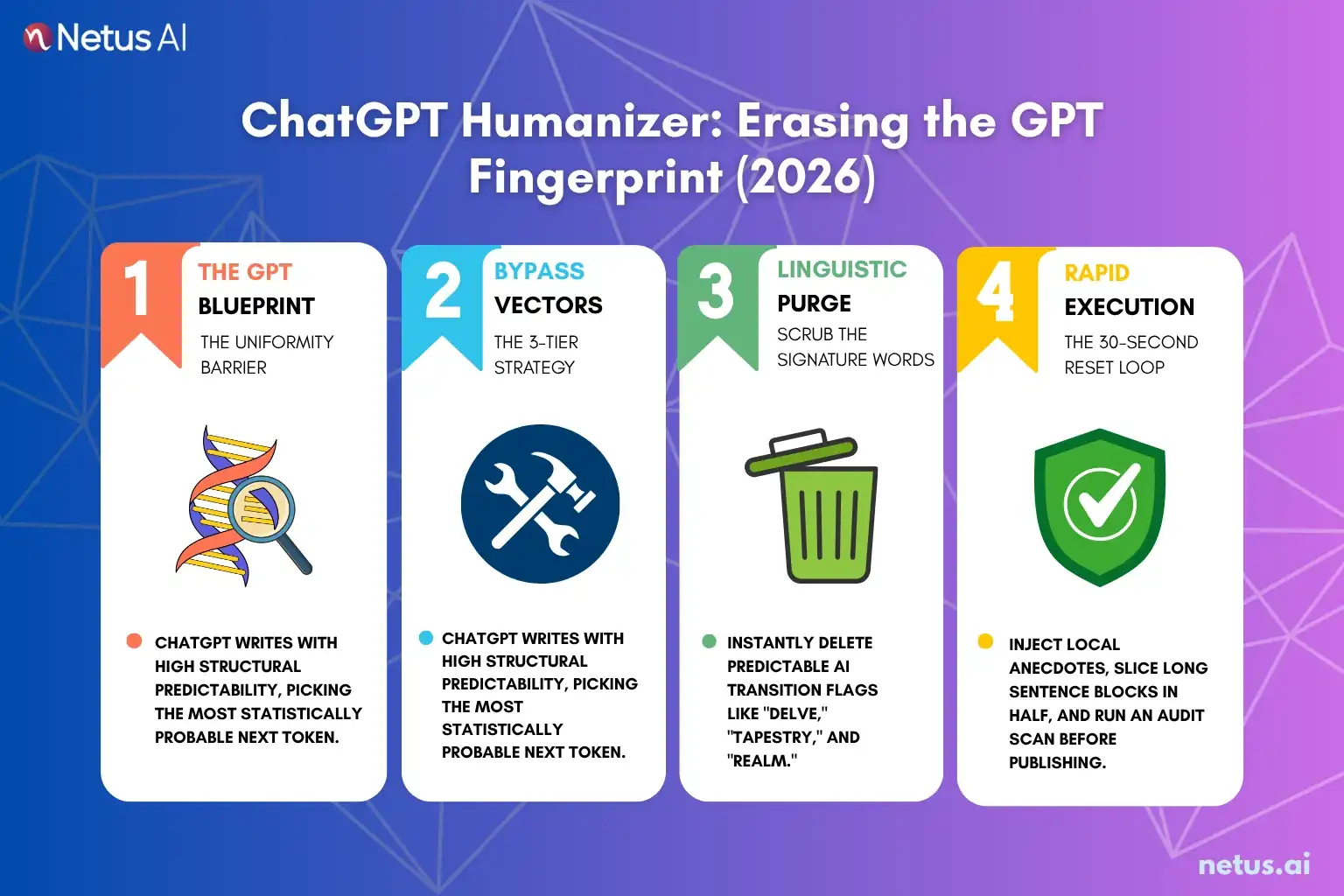
Artificial Intelligence, especially things like Large Language Models (LLMs) such as GPT, does not actually write in the same way that humans do. What happens is that it tries to guess what the next most probable token or word in a row should be, and it uses giant collections of data to do that. This method brings about what some experts call a "GPT fingerprint." A lot of uniform and predictable patterns mark this fingerprint, which AI detection programs are designed to detect.
A big sign is how logical connectors are so predictable. Human beings usually move between ideas using quite random or personal ways. ChatGPT, though, uses certain regular words like "On top of that," "To sum up," and "Also" too much, so it can sound a bit fake to a reader. The sentences themselves from AI are mostly the same length, and repeated patterns show up. When a person writes, sometimes sentences are short and exciting, and sometimes long and more detailed, which creates variety called "burstiness"; however, AI mainly sticks to medium-sized sentences, and the structure does not change a lot.
One clear thing is the "signature" kind of phrases which appear to keep returning in AI text. Words such as "delve," "mix," "area," and the word "situation" come up in content quite a lot, so there is a much bigger chance it was made by a machine. While using these words is not exactly wrong, ChatGPT uses them so much that they sound like all-purpose filler. Detectors are hunting for those very usual patterns and can flag them as made by an AI. What is happening is that the computer is almost too regular, and lacks the creative or confusing mistakes that are present in human thought.
3 ways to humanize ChatGPT
If you want AI content to be not easy to spot and more enjoyable for the readers, breaking up the way machines write is kind of important. There are basically three levels for making progress on this:
Manual rewriting
People say this is the best way to make your writing sound more like a person. You take the AI’s main ideas and totally rewrite them using your own style. You can add personal stories, change the flow of paragraphs, and trade out general examples for ones based on real life or real numbers. It takes a lot of time, but doing so ensures the quality is top-notch and nobody can detect it because a human did all the work for the output.
Prompt engineering
You might be able to tell ChatGPT how you want it to sound more like people from the beginning. It’s not just giving a prompt, but giving instructions based on a “persona.” For example, tell the AI: “Pretend you are a journalist who is cynical and has been working for twenty years. Use sentences that are not long, avoid decorative language, and use phrases people in that job use.” This limits the AI’s style, makes it use a unique voice, and so the output is less predictable, which is harder for detectors to spot as GPT.
Dedicated humanizers
Nowadays, humanizers are made especially for getting past AI detectors. These tools take AI text and run algorithms, introducing noise, making sentences different, and picking odd synonyms instead of common AI words. They work quickly for masses of content, but sometimes fast manual review is needed so the original meaning does not get changed too much during rewording.
Test results: Humanizing ChatGPT through 5 detectors
To find out how well these humanization methods work, we conducted a careful examination with the main AI detection tools in the industry, such as Originality.ai, Copyleaks, Sapling, Winston AI, and GPTZero. In our approach, we created unedited GPT texts and then used the three humanization strategies described earlier.
Results gave us important facts. The normal GPT results were being shown as "100% AI" by almost all these checkers. After we put in persona-focused prompt ideas, the "Human Score" got much higher and sometimes it got to 60 or 70 percent with GPTZero, though Originality.ai, which is stricter, still found plenty of patterns. The dedicated humanizing tools, when used, made the content able to pass by most detection systems, getting "Human" marks everywhere. Manual rewriting, as we thought, always resulted in human scores of 100 percent.
There is an ongoing battle here. When checkers improve, humanizing ways also need to change. Remember that machines do not have perfect hiding skills; a smart detector using new GPT models information can still notice stuff. Still, for most publishing and SEO work, they protect you with a strong defense from basic flags.
ChatGPT phrases to always remove
If you want to quickly improve your AI text, start by deleting these "dead giveaways." These phrases are the linguistic equivalent of a robot's metallic voice:
"Delve into"
Humans rarely use "delve" in casual or professional writing. It sounds overly dramatic and academic. Replace it with "explore," "look at," or "examine."
"Tapestry"
AI loves to describe complex situations as a "rich tapestry." This is a cliché that immediately screams "machine-generated." Use "complexity," "network," or "combination" instead.
"Testament to"
This is a formal phrase that AI overuses to show significance. "Proof of" or "shows that" is much more natural.
"Unlock the potential"
Marketing-speak that ChatGPT relies on heavily. It feels empty. Be specific about what the benefit is instead of using this vague metaphor.
"In the ever-evolving landscape"
This is the classic AI intro. It is wordy and generic. Start with a direct statement about the current state of things instead.
Step-by-step: Humanizing ChatGPT in 30 seconds
You don't need hours to fix AI text. Follow this rapid workflow:
Generate
Get your raw draft from ChatGPT.
Personalize
Immediately insert one sentence that AI couldn't know, a personal opinion, a recent news event, or a specific internal company data point.
Vary Rhythm
Find three long sentences and cut them in half. Find two short sentences and combine them. Replace "Additionally" with "Also" or "Plus."
Final Scan
Read it out loud. If you stumble on a phrase, a human reader will too. Smooth it out and you're done.
Humanizing for different content types
Different formats require different human touches:
Blogs
Prioritize narrative flow. Use "I" and "we" to establish expertise and authority. Break up walls of text with subheadings that have personality.
Emails
Be direct. AI tends to be overly polite and wordy in emails. Strip away the "I hope this email finds you well" and get straight to the point.
Social
Focus on the hook. Social media thrives on strong opinions and engagement. Use emojis, slang (where appropriate), and ask questions to spark conversation.
Scripts
Write for the ear, not the eye. Include "um," "so," and contractions. Natural speech is full of pauses and informal structures that ChatGPT often ignores.
FAQs
Is it ethical to humanize AI content?
Yes, as long as you are providing accurate information and not using it for deceptive purposes (like academic fraud). It is a tool for better communication.
Will this improve SEO?
Yes. Google prioritizes "Helpful Content" (E-E-A-T). Humanized content is generally more engaging and useful, which leads to better rankings.
Do I need to pay for a tool?
Not necessarily. Manual rewriting and smart prompting are free. Paid tools just save time for large-scale operations.
Can Google detect humanized content?
Google's focus is on quality rather than the method of production. If content is high-quality and helpful, it doesn't matter if AI helped write it.
How does humanization affect accuracy?
Automated humanizers can sometimes change the meaning of technical facts. Always fact-check the output after humanizing.
Are AI detectors reliable?
They are prone to "false positives," sometimes flagging actual human writing as AI. They should be used as a guide, not a definitive verdict.
Should I always use a humanizer?
For internal notes or first drafts, it's not needed. For anything public-facing (blogs, client emails), it is highly recommended.
How can I practice writing more human-like content?
Read more fiction and creative non-fiction. Notice how authors use rhythm, voice, and specific details to bring ideas to life.