In digital marketing, which is changing really fast, being able to create more content is a huge advantage compared to others. Artificial Intelligence (AI) is now a strong factor in the field, and AI article rewriters are especially important here. Such tools help people make use of old content again, update pieces that are no longer current, or create new versions for various social networks at a speed that was not possible before.
But now, because search engines and schools are using more AI detection programs, new problems have arisen, such as using AI without getting caught. This guide will discuss the benefits, best practices, and the ethical implications of using AI rewriters while ensuring content remains fresh.
The benefits of AI article rewriters
AI rewriters are mainly attractive because of how fast they can work. Creating content in the normal way needs a lot of time for digging for facts, writing it out, and checking. AI programs take the text you give and quickly make a new version, which can really cut down the total time for the articles to be ready. Being able to do this on a big scale is key for companies that try to keep messaging in many places.
These AI rewriter systems also help if you have trouble starting to write and can make language more varied. They sometimes offer other ways to say things, fix sentence structure, and make the tone fit different types of readers. People working in SEO, especially, find AI rewriters very helpful for creating new descriptions or blog texts from the same data, so they have no problem with duplicate content.
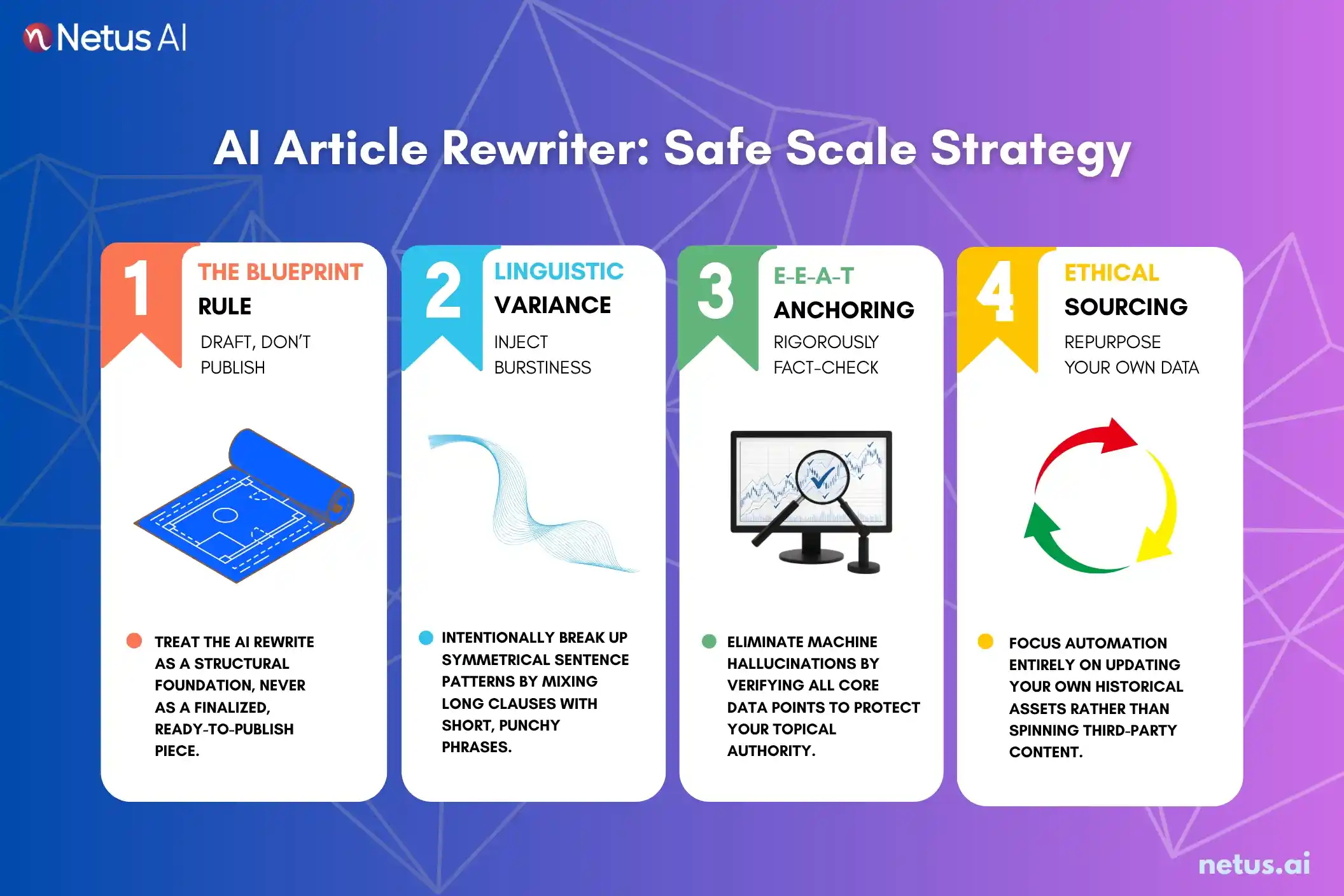
Best practices to avoid AI detection
If a person wants to use AI rewriters in a way that does not get noticed as "content made by automation," there must be a strategy that mixes the computer’s speed with ideas made by humans.
1. Make AI your sketcher, but humans finish it
It is not a good idea to post anything that is only rewritten by AI with nobody checking it. One should get a first draft from the AI tools, but then go edit it yourself. If you add your own stories, things you think, or very detailed industry knowledge, people and algorithms find it difficult to call it not human-made.
2. Think about "perplexity" and "burstiness"
What AI detectors try to find are simple, repeating sentences. "Perplexity" means how complicated text is, and "burstiness" is about strange differences in sentence lengths or the way sentences are formed. AI usually keeps things very regular. To avoid being caught, break big sentences into smaller ones or put smaller ones together. Use some vocabulary that is still correct, but not the typical choice.
3. Always check your facts deeply
Sometimes AI rewriters can “imagine” data or mix up information from what was really in the original. Double-checking makes your work look higher quality, and it also shows you know your subject. Search engines want content with E-E-A-T values. Wrong facts are signs of trouble for readers and for search engines too.
Ethical considerations
Scaling matters quite a lot, but keeping ethics first is even more necessary. Plagiarism stands out as the biggest issue. An AI rewriter must not be involved in spinning other people's copyrighted material to make it seem like one's own work. If using it ethically, you rewrite your own work or apply AI to express your own concepts in a clearer way.
Being transparent is essential. In some industry sectors, saying that you used AI support is getting more common. Sticking to integrity maintains brand loyalty for a long time, and this helps you avoid possible legal troubles.
Maintaining content quality
Scaling should not suddenly become a quick way to lower quality. To maintain strong standards:
- Make sure the main message does not lose its meaning and remains important to the people reading.
- Use only high-quality prompts that address the right tone, the target audience, and any constraints.
- Include items such as images, videos, or even graphs to increase the value.
Final thoughts
AI article rewriters can be very effective when you want to create more content, yet these are not really tools you can turn on and ignore. The best results come from combining the quickness of AI with human judgment. If you practice careful editing, focus on adding new details, and keep guidelines in mind, your content will grow, and flags or penalties will be avoided.
FAQs
Will Google penalize AI-rewritten content?
Google penalizes low-quality, unoriginal content designed solely to manipulate search rankings. If your rewritten content provides value and is high-quality, it is unlikely to be penalized.
What is the best AI rewriter tool?
The "best" tool depends on your needs. Popular options include Quillbot for phrasing, Jasper for marketing copy, and OpenAI’s GPT models for general versatility.
Can AI detectors be 100% accurate?
No, AI detectors often produce false positives and negatives. However, they are constantly improving, which is why human editing remains essential.