Nowadays, in the digital environment, content made with AI is no longer just something new; instead, it has become an important part of how SEO is done. AI helps produce content on a large scale, but there is also a major issue. The machine-made writing usually has a “patterned” style that sets off AI detection tools.
Such tools look for predictable language and structure, which search engines use to identify content as either useful for people or just fast automatic work. For good SEO over time, people have to start moving from only using basic AI to making content with more care and a human touch.
The problem: How does AI detection sabotage your rankings?
AI detection is more than only trying not to get a penalty. It actually connects with important quality signals that create good results in search engines. When what you write appears to be automatic or is marked as such, several main SEO elements are affected.
- More Bounce Rate: Usually, people click away when they see an odd style or when your writing seems too plain. This makes visits very short.
- Google Quality Systems: Helpful Content System and similar updates are made to find articles written by robots and not intended for human reading.
- YMYL Risks: Your Money or Your Life subjects, for example finance or medical, are watched more closely. AI-made material can cause rankings to fall significantly as people lose trust.
- Topical Power Reduction: Long guides or SEO pillar pieces lose their credibility if they don’t provide a real voice and strong knowledge for search engines.
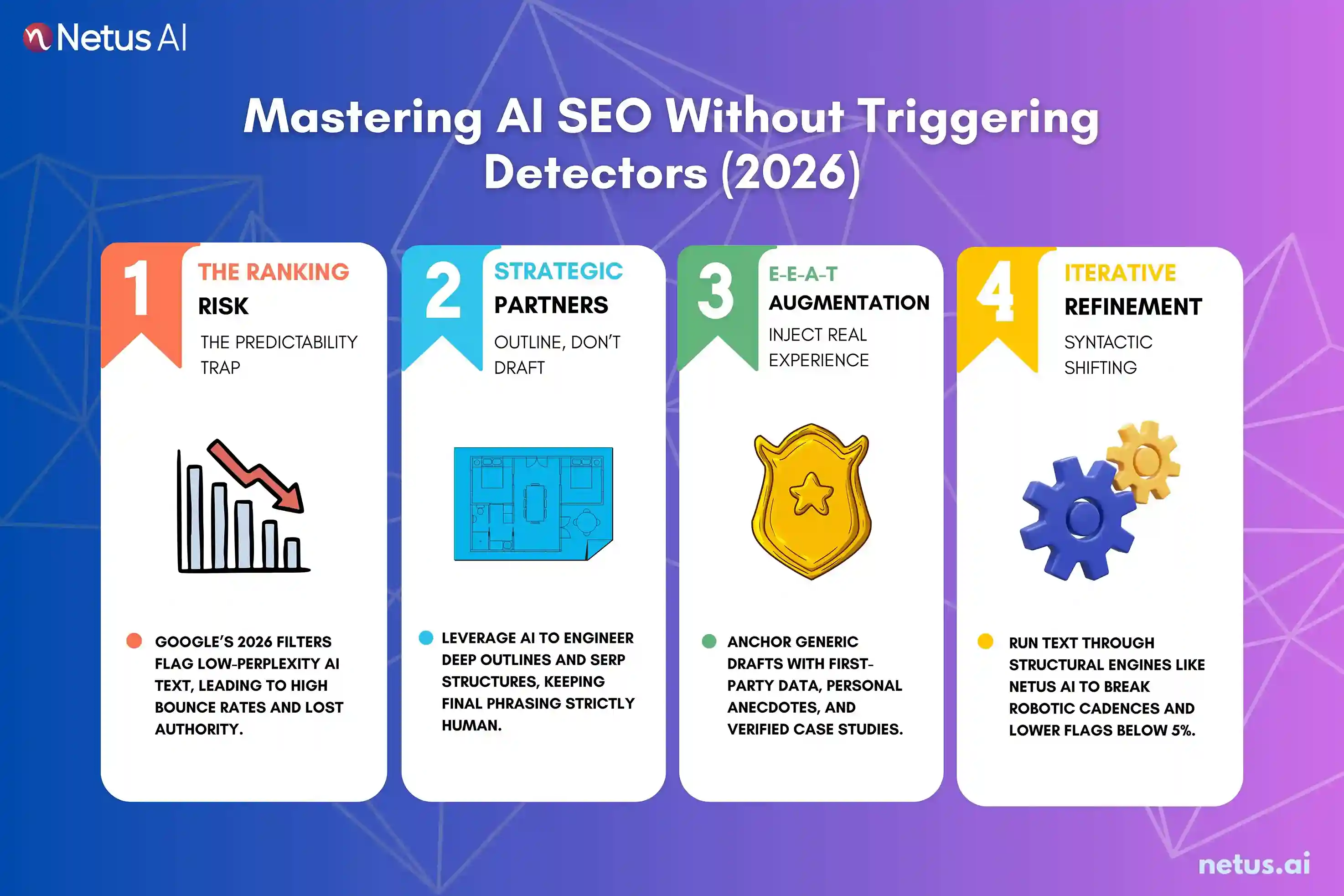
Strategic AI usage: Brainstorming, not drafting
The best method for using AI is to see it as a helper for both research and structuring rather than one that writes whole texts. Rather than requesting the AI to produce a finished article, users can make the AI generate complete outlines, find smaller areas you probably did not notice, or summarize complicated technical information. Keeping the main draft with humans keeps the important logic natural, and you still get the advantages of quick, automated research.
Humanizing content: Injecting personality and rhythm
Usually, raw AI writing has a flat feeling, as if every sentence is similar in length and stays in a neutral style. To make it more human, break up big, complicated sentences with ones that are short and more aggressive.
Bringing in things about your own life works well, since AI is not able to use stories or knowledge from actual, real life, making the text sound more authentic. Lastly, it is important for you to pick words and phrases that fit the audience’s specific goals or the language of their field, not just go for whatever words most likely follow in English.
The E-E-A-T factor: The human advantage
Experience, Expertise, Authoritativeness, and Trustworthiness (E-E-A-T) play a big role in how modern SEO is understood. AI cannot have a real "Experience" since it never actually tries products or performs services. Content should show personal insights that an LLM does not replicate well without human assistance. Because of this, content from experts usually performs better than exclusively machine-generated writing.
Workflow optimization: Real-time feedback loops
Instead of making a draft and just waiting on luck, try to work step by step. Use scanners like Netus AI for your drafts to find riskier parts at the beginning. Rather than doing everything again, change only the paragraphs which have the biggest AI detection score. You can use what these tools tell you to update how you write prompts. This will train the AI to sound less robotic and more in your style as time goes on.
Final thoughts: The balanced path
The future of SEO will not be without artificial intelligence; it is actually using AI support. Using automation to handle the major workload of structure and research, while letting humans stay in charge of the final story and E-E-A-T signals, lets content makers reach better results and higher search rankings without worrying about penalties for being detected.
FAQs
Does Google penalize AI content?
No, Google rewards high-quality, helpful content regardless of how it's produced, but it heavily penalizes low-value content created primarily for search rankings.
What are humanizing tools?
These are specialized tools designed to adjust the tone, syntax, and rhythm of AI text to mimic natural human speech patterns.
How do I future-proof my content?
Focus on original research, unique viewpoints, and building topical authority that goes deeper than surface-level AI summaries.