Advanced Large Language Models (LLMs) have been developed, a big issue has also arisen: the AI watermark. It is a hidden sign, usually not visible to the average person, that is embedded in text generated by an AI to show a human being did not write it. For students, professional content creators, or business organizations wanting their texts to sound natural, spotting and removing these AI marks, or “watermarks”, is now important.
This article will explain in detail the technology behind AI watermarks, why originality is facing problems, and especially the useful ways and tools people can use for removing watermarks from text efficiently.
Learning about an AI watermark
AI watermarking means developers (like Google or OpenAI) use some way to change the chance that the LLM will pick certain words. So, instead of just letting the model pick all words with totally normal probabilities, it gives a small push for using certain “okay” or “not-okay” words via a key that is not made public.
How it is done (in short):
Key is chosen
For the text process, a special key (short one) is picked.
Words sorted out
With this key, all words are split into two sides; “green list” words (which are picked more) plus “red list” words (AI will use them less).
Changing the results
So, when AI makes the text, the chance of “green list” words appearing is a bit higher.
Finding out
Some tools can check a text to see if too many “green list” words are occurring more often than is likely. If so, this text is marked as written by AI.
For creators, the main problem is clear: when AI detectors flag content, this can make search engines push it lower in results, make schools or universities reject the work, or just make people think the text is not so good. Because of this, a reliable solution is needed so that writing no longer looks AI-generated.
Real ways to remove an AI watermark from text
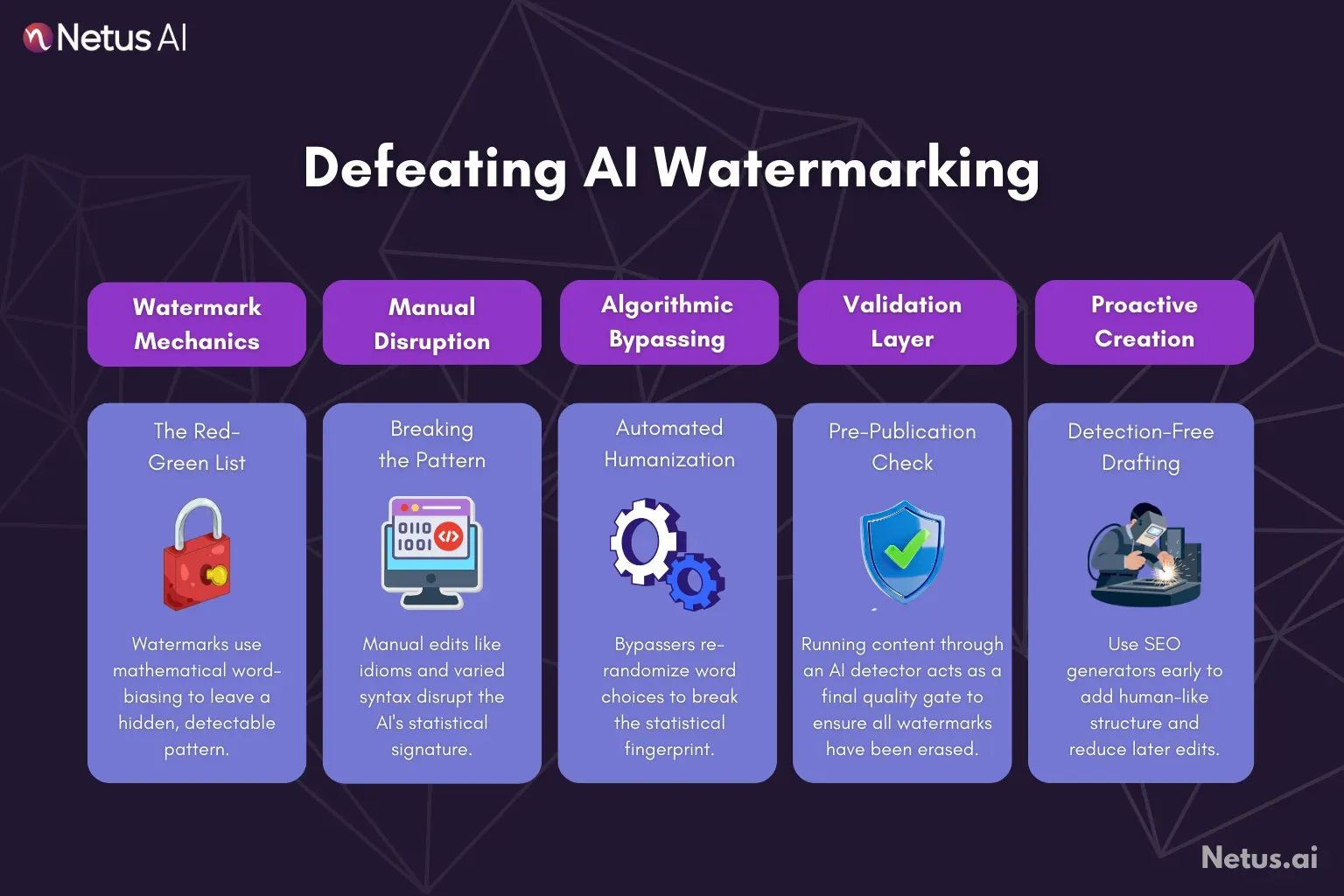
Deleting an AI watermark is not simply undoing it; it means changing your text so the special word pattern (the green/red word groups) is broken apart.
Manual editing and making it more human-like
The main way to break the watermark is editing it by hand. If you put in things that AI will almost never use, like some idioms, personal stories, feelings that change, or weird sentence types, you will make the pattern go away in a natural way.
You should focus on:
Changing sentence length
AI usually makes sentences roughly the same length throughout the text.
Making mistakes or odd stylistics
You are not really supposed to make mistakes, but it is fine to use run-on sentences, unfinished sentences (fragments), and strange words that AI “thinks” are not common.
Adding deeper things
You can put examples from the real world or something more emotional.
But this is hard if you have to work with a lot of pages or articles, because it takes a lot of time and effort for each one.
Using tools meant for breaking watermarks
Here, new software can really help. The goal is to change many things in the text (how it sounds, the words used) but keep the main meaning, so the pattern of the “green” or “red” lists is all mixed up.
Using an AI bypasser
Some tools exist called AI bypassers. Their job is to take AI-written content and change it so much, by using new words or structures, that AI detectors can no longer find any signs. This method removes key watermark marks so the writing becomes much more human.
Paraphrasing tools
A tool for paraphrasing works similarly to the above but can also do more. Usually, people use it to rewrite content, but some better ones really change AI text totally. If the paraphraser is forced to switch synonyms, move clauses, and make totally new sentences, the old LLM watermark will be gone. Picking modes like “creative” or “human style” can be really good for this reason.
Checking with an AI detector
Before you put your writing in a public place or submit it to teachers, you have to check it. Run your article or paper through an AI detector after you have used a bypasser or paraphraser. This is like a quality check. It proves the watermark is gone and the text cannot be detected as an AI creation.
How to write content not spotted by AI in the first place
Even though it is useful to know how to erase watermarks, it is smart to make content from the start that almost needs no removal steps.
If you are creating articles from scratch, then setting up an SEO article generator or something similar for a more human style can make them much harder to detect as AI-written from the beginning.
Plus, tools like a keyword extractor can be used, so while you are paraphrasing or trying to pass AI rules, you will keep important topics and SEO points. If a quick title is needed for a text you just “humanized”, a title generator is able to generate lots of ideas very quickly.
NetusAI: your solution for all content challenges
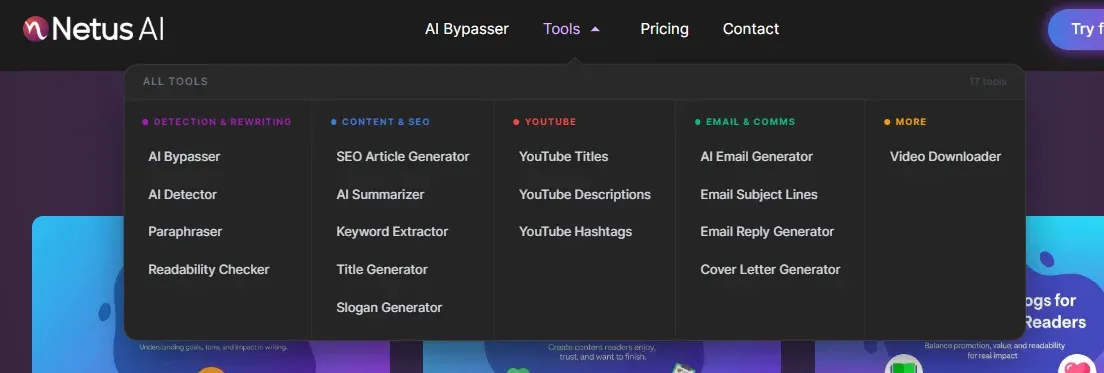
For those in the content industry who must quickly create quality writing while making sure originality is maintained, using one platform is very important. NetusAI presents a full set of tools that help with every step of content creation.
By using this group of tools, users can easily move from writing with AI to checking it for problems to making it seem more natural, which solves the so-called “watermark problem” and also helps maintain original, high-quality writing.
Conclusion
The ongoing conflict between AI-made text and tools that detect such writing keeps growing. As use of Large Language Models (LLMs) keeps spreading, it will become even more important to find out how to remove AI watermarks.
It is not about running from AI use, but learning the methods that let you adjust, humanize, and check your final product. When creators carefully use strategies along with new tools like AI bypasser and paraphrase tool, they can produce writing that is both quickly written and much closer to how people usually sound.
FAQs
What really is an AI watermark put into writing?
An AI watermark in writing is a small, mathematical pattern placed in the text by a Large Language Model when generating. This has a preference or non-preference for some words (“green list” kinds) in a repeatable way that AI detectors can spot by analysis but humans do not see easily.
Why must I take the AI watermark off my writing?
Getting rid of AI watermarks matters so your text can pass checking systems in schools, controlling organizations, and even search engine filters. If content is found to be AI-made, it can be penalized, rejected, or seem less original and valuable to people.
Is an AI bypasser tool fine to use regarding ethics?
Whether using an AI bypasser is okay or not depends on why you use it. If the main plan is to deceive an institution about who wrote it, such as submitting an AI paper as your own, that is mostly unethical. But if the purpose is changing and humanizing business texts so they sound natural and are not penalized by algorithms, it is often seen as just editing.
Can someone fully erase an AI watermark by hand?
Yes, editing by hand can get rid of an AI watermark, but only if the editor makes really large style, structure, and vocabulary changes. The aim has to be to change the word patterns AI prefers. Still, this way is much slower and often less certain than letting an AI bypasser or a strong paraphrase tool do the job.