There is no denying the big benefits of AI writing: it is fast, can create things at a big scale, and works efficiently. Where writers used to need days, content shows up now in hardly any time.
But this quickness brings a tradeoff, which is content that somehow sounds not alive, a bit like a robot wrote it. This sort of thing can push readers away, and sometimes AI detectors might even notice. Because the web now wants realness and people need to feel connected, just quick content is not enough. You need it to feel like it was written by a real person.
The main issue: Why does AI sound so generic?
AI is great at gathering facts and shaping them into arguments, but it struggles when it comes to things like subtle meanings, personal stories, or the style of a writer.
What often happens is that the AI sticks to plain, similar sentence patterns, using overused linking phrases, and has a tendency to sound too much the same everywhere, which makes it easy to guess a machine wrote it.
Readers might get bored quickly, and search engines can tell something is off, especially as detectors get more trained. Keeping away from this issue is very important, or else the main status and natural rankings of your website can fall.
Adding a human touch: Improving AI text
Making AI writing feel real again is less about rewriting every sentence and more about making smart changes and edits.
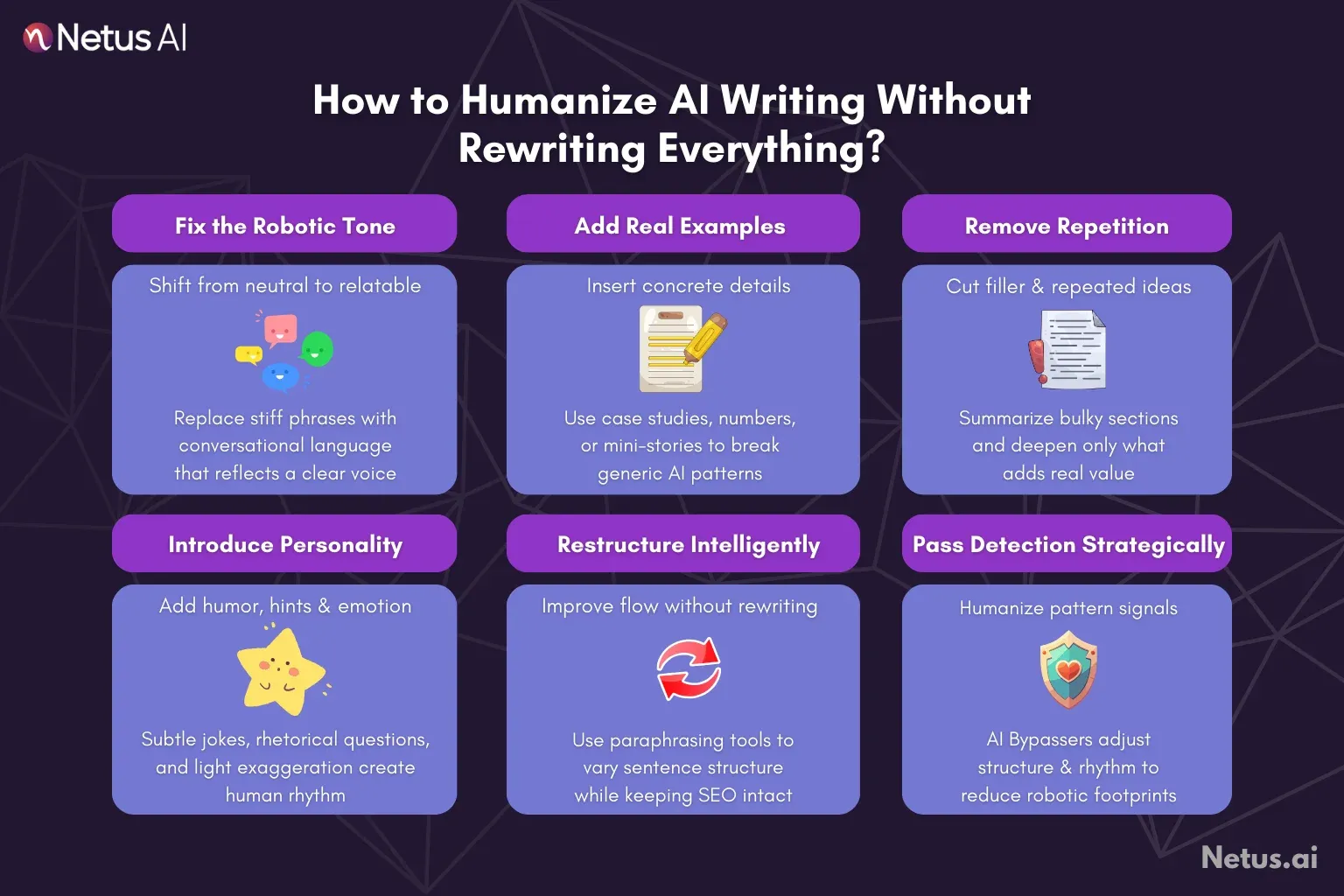
Upgrade voice and tone
Many times, the AI comes out neutral, sounding like it’s giving instructions. To sound more relatable, give the text some variety. Ask questions to yourself like: Who is talking in this text? An expert, your best buddy, a doubter, or a person who just likes storytelling? What feelings do you want the audience to take away? Is it excitement, knowledge, or maybe just a quick smile?
Try changing normal phrases into friendly everyday talk. Say, in place of "It is necessary to implement these measures," write something like "You should try these steps for yourself." If your content ends up like a dry guidebook, try a paraphrase tool with “creative” or “friendly” options. That way, you will get phrases you can use, without typing everything again.
Add detailed personal examples
AI often talks in broad statements. What really builds trust with readers are small, clear facts or stories. When you get the first idea out of AI, go in right after with a real or made-up example or tell a personal story.
For example: “One time, with a startup client, their 24/7 chat helped a lot, even though it cost more at first, it dropped their customer loss by 15 percent each month." Little direct details break up boring patterns and help people relate right away.
Use subtext, hints, and jokes where possible
AI can be too direct. People use hints, jokes, and sometimes exaggerate a bit. Read your work and look for places where a joke or clever statement or even a slight overstatement would sound good. It is also important to look for repeating ideas in your AI writing.
If your draft says the same thing in new ways again and again, it just fills space. Try using an AI summarizer for main points, then build deeper just on the most helpful things. This way, every paragraph has something genuine and not just filler.
Pass AI Detectors the clever way
If people must believe that your piece is all your own and not by AI, just editing words might not work, because AI has a tendency to lean on common types of sentence patterns, which can get spotted.
Here, an AI bypasser tool makes sense. Rather than making everything new, these tools change and shuffle how sentences are built, giving the text a more mixed, natural feel. This method helps you clear AI detector tests but keeps the meaning you wanted.
Using NetusAI suite to make humanizing faster
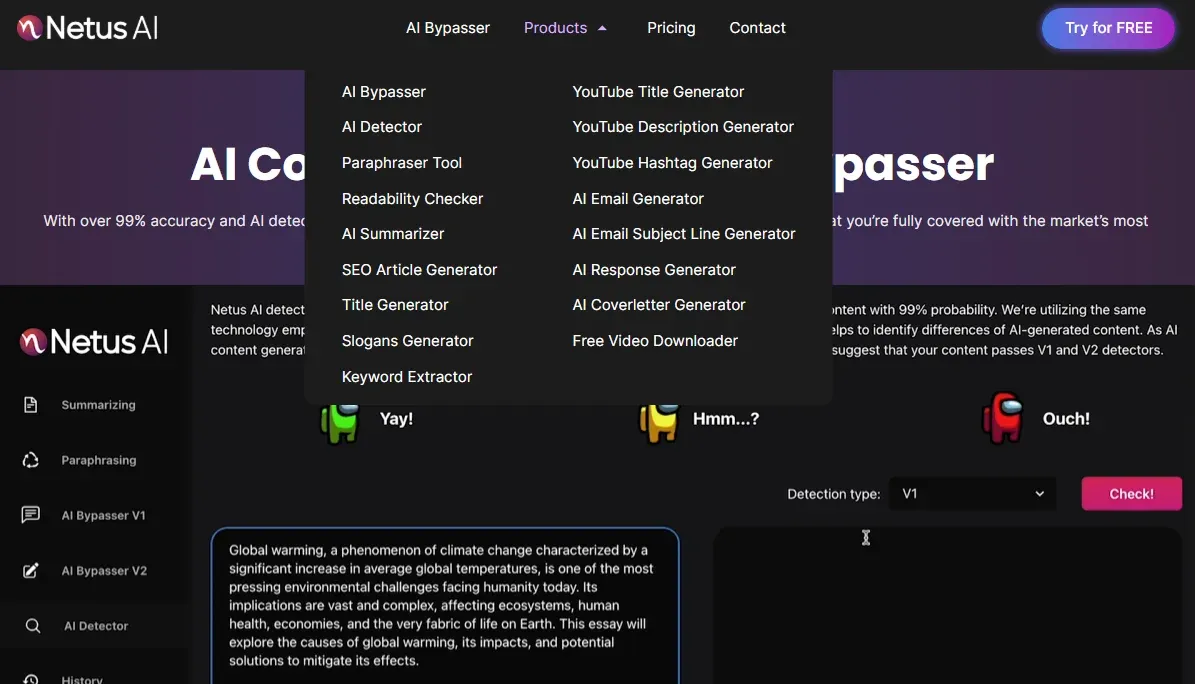
In the past, managing quality and volume for all your site content needed a huge team. Now, SEO writers and those involved in content planning can keep a balance by smartly using a set of linked tools. NetusAI gives you a stack of tools supporting the whole content chain, from idea to clean final version. There is no need to jump all over the place.
All your content issues are solved on one platform.
Planning and collecting ideas
Tools like the SEO article generator and title generator get you started on well-formed drafts that hit the keywords you need. The Slogans Generator and Keyword Extractor can help with smaller content and target the right market.
When you already have your AI text, use the AI bypasser and paraphrase tool for that key step of adding a human layer and for changing the flow and variety so it does not sound machine-made or easily detected.
Staying on track and being brief
The AI detector checks if your work still needs a human touch, and the AI Summarizer makes it easy to chop away unneeded sentences, making sure every idea counts.
With all these tools used together, NetusAI changes what used to be a messy, slow process into a smooth, all-in-one answer. You use AI to make things fast and big, then add other tools for human touches that search engines and people like. That smart way keeps your work fast but does not lose its real feeling or value.
Final thoughts
AI acts as a strong assistant and is not a substitute for human originality. Making AI writing more human is not so much about deceiving readers as about delivering content that serves their needs well. Content needs to be clear, optimized for search, and written to connect emotionally.
When you put in edits that focus on people and employ tools like an AI bypasser and the paraphrase tool, which clear up usual AI habits, it is possible to benefit from the fast pace of AI output and also earn reader confidence and loyalty that only authentic content by humans is able to provide.
FAQs
How frequently should an AI Detector be used on your content?
The AI Detector should be employed only at the end phase of your content process, especially before launching important articles or posts that will go to major platforms. This works as a last quality check so that your attempts to humanize content are effective and the text is truly original.
Is manual content humanization superior compared to using an AI bypasser?
For special or smaller content that needs high value, working manually gives it the most personal touch. However, for bigger tasks, such as blog articles, product features, or wide-scale SEO projects, an AI bypasser is necessary. It quickly applies format changes and removes regular patterns from AI writing, reducing time spent and raising the level of human quality.
Can a paraphrase tool actually change how your AI content sounds?
It can. A decent paraphrasing tool has multiple settings, for example: creative, polite, and friendly. When you put your AI-made text through the tool and choose a mode that is not neutral, it replaces boring words and shifts sentences to fit a new style, making the text more lively and diverse than only manual changes might do.
What ways exist to make the AI SEO articles much more actionable?
After creating the basic article with an SEO tool, rethink the conclusion and the advice section. Ensure the phrasing is direct and energetic. Make use of an AI summarizer to shrink the main argument, then employ that summary to make a straightforward and focused suggestion for readers, guiding them on what to do next.