The right prompt can drop your AI detection score by 30–40%. However, no prompt alone will pass GPTZero or Turnitin reliably in 2026. Here are the 7 best prompts we tested this year, plus what to do when they aren't enough.
Why do prompts alone often fail to bypass AI detection?
AI detectors analyze sentence rhythm and statistical patterns rather than simple vocabulary. Even if you utilize sophisticated prompts, large language models (LLMs) often default to predictable structures. If a sentence follows high-probability token sequences, the detector flags it. Detectors specifically latch onto low perplexity and uniform burstiness.
What are the 7 best prompts to bypass AI detection in 2026?
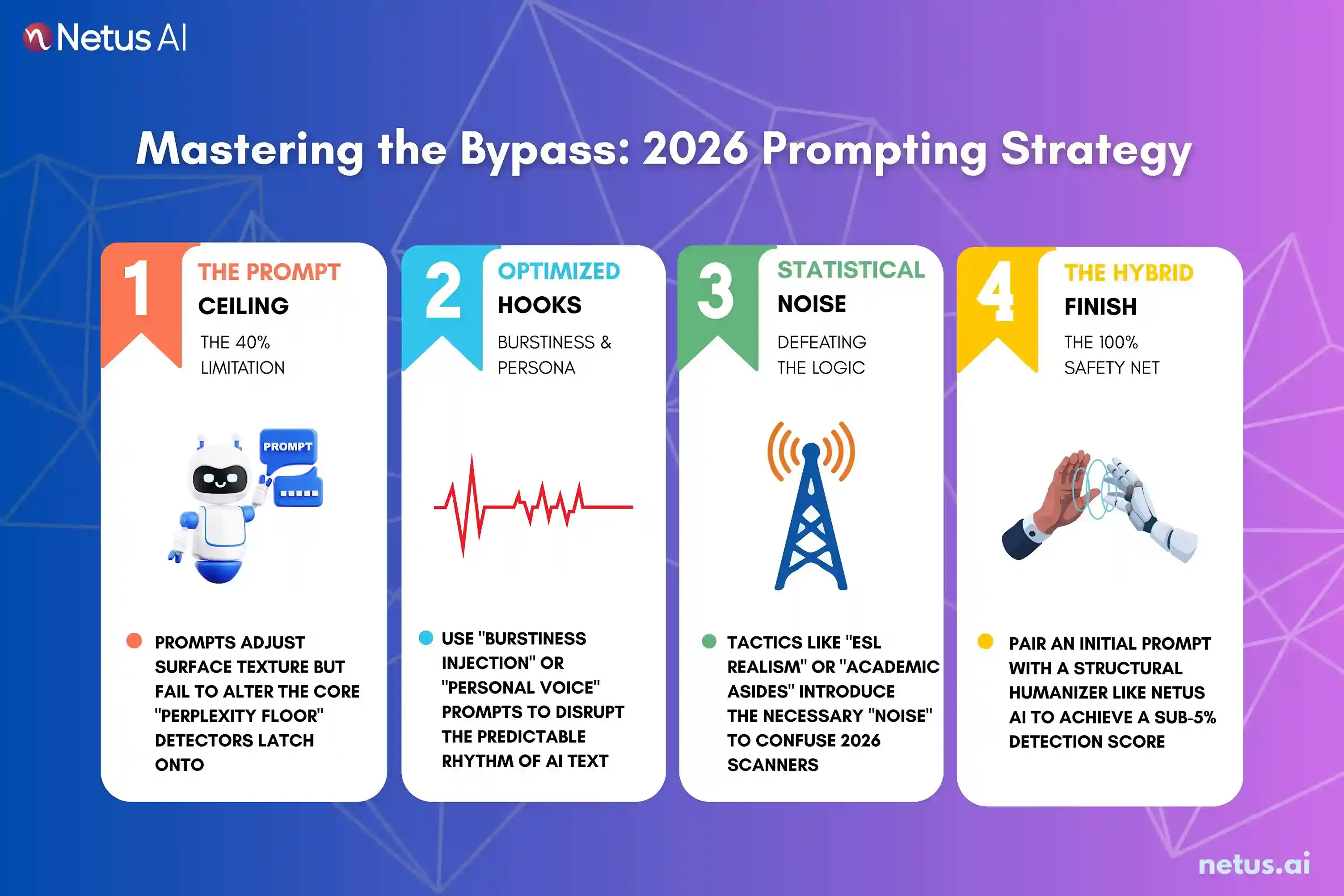
Below are the most effective configurations for various use cases.
1. The "burstiness injection" prompt
"Rewrite the following text. Vary the sentence length significantly. Use a mix of very short, punchy sentences and long, complex ones. Avoid starting consecutive sentences with the same word."
Burstiness Injection directly targets the burstiness metric detectors measure. Alternating short and long sentences breaks the uniform rhythm LLMs default to, raising perplexity score artificially.
2. The "personal voice" prompt
"Rewrite this content as if you are telling a friend a story. Use first-person pronouns and include one specific, hypothetical personal anecdote that illustrates the main point."
First-person pronouns and hypothetical anecdotes introduce token sequences statistically rare in LLM outputs. Detectors score these patterns as human-authored.
3. The "one-line transitions" prompt
"Insert informal, one-line transitions between paragraphs. Use phrases like "But here is the kicker," or "It gets better." Remove all academic transition words like "furthermore" or "Moreover."
One-Line Transitions replaces high-probability academic connectors ("furthermore," "moreover") with informal transitions. These phrases fall outside the training distribution detectors flag most aggressively.
4. The "ESL realism" prompt
"Rewrite this text with the slight stylistic inconsistencies of a highly proficient non-native English speaker. Avoid perfect symmetry in grammar."
ESL Realism Slight mimics non-native speaker patterns. Modern detectors are calibrated against native-fluency LLM outputs, so minor stylistic inconsistency lowers the flag probability.
5. The "academic but human" prompt
"Maintain the formal tone but use active voice exclusively. Replace 3 abstract nouns with concrete examples in every paragraph."
Academic but human voice reduces abstract noun density, which is a strong LLM signal. Concrete examples in every paragraph increase token unpredictability without sacrificing formal tone.
6. The "analogy + anecdote" prompt
"Explain the core concept using an unusual analogy related to gardening or space travel. Ensure the tone remains professional."
Domain-specific analogies (gardening, space travel) force the model into lower-frequency vocabulary paths. Unusual conceptual pairings push output further from the statistical center detectors target.
7. The "rewrite-as-tired-grad-student" prompt
"Rewrite this with a sense of urgency and slight cynicism. Use occasional colloquialisms common in 2026 academic circles."
Urgency and cynicism introduce register inconsistency. Colloquialisms from a specific year anchor the text in a temporal context LLMs rarely produce naturally, lowering detection confidence.
Why do these prompts still get caught sometimes?
There is a "30–40% score drop ceiling" when using prompts. Detectors still identify token probability and the "perplexity floor" inherent in LLM outputs. In 2 real-world failure scenarios, prompts that passed initial tests failed when the total word count exceeded 1,000 words.
How does the prompt-plus-humanizer workflow ensure success?
If you want a 95%+ pass rate, you must combine techniques. First, generate text with one of the prompts above. Second, run that output through NetusAI Humanizer. Third, verify the result with a detector. This combination is the only reliable way to bypass Turnitin in 2026.
Which prompts should you avoid completely?
Never use "Make it sound human" by itself, as it leads to generic output. Prompts like "Add typos and grammar errors" or "Write like a 12-year-old" often backfire because modern detectors are trained to spot intentional "obfuscation" patterns.
FAQs
Can a prompt alone make AI text undetectable?
No, it typically only reduces the probability score.
What is the best ChatGPT prompt for GPTZero?
The "Burstiness Injection" prompt is currently the most effective for that specific detector.
Will OpenAI patch these prompts?
It is highly likely that as models evolve, these specific linguistic patterns will be mapped by detection companies.