The whole SEO area is changing a lot because of Generative Engine Optimization that decides which content appears first. When companies like Google increase their use of Generative AI, a not-so-obvious factor now matters much more: "burstiness".
But what does burstiness even mean for content writers, and why does this matter for people who want their SEO to work well?
What does “burstiness” actually mean?
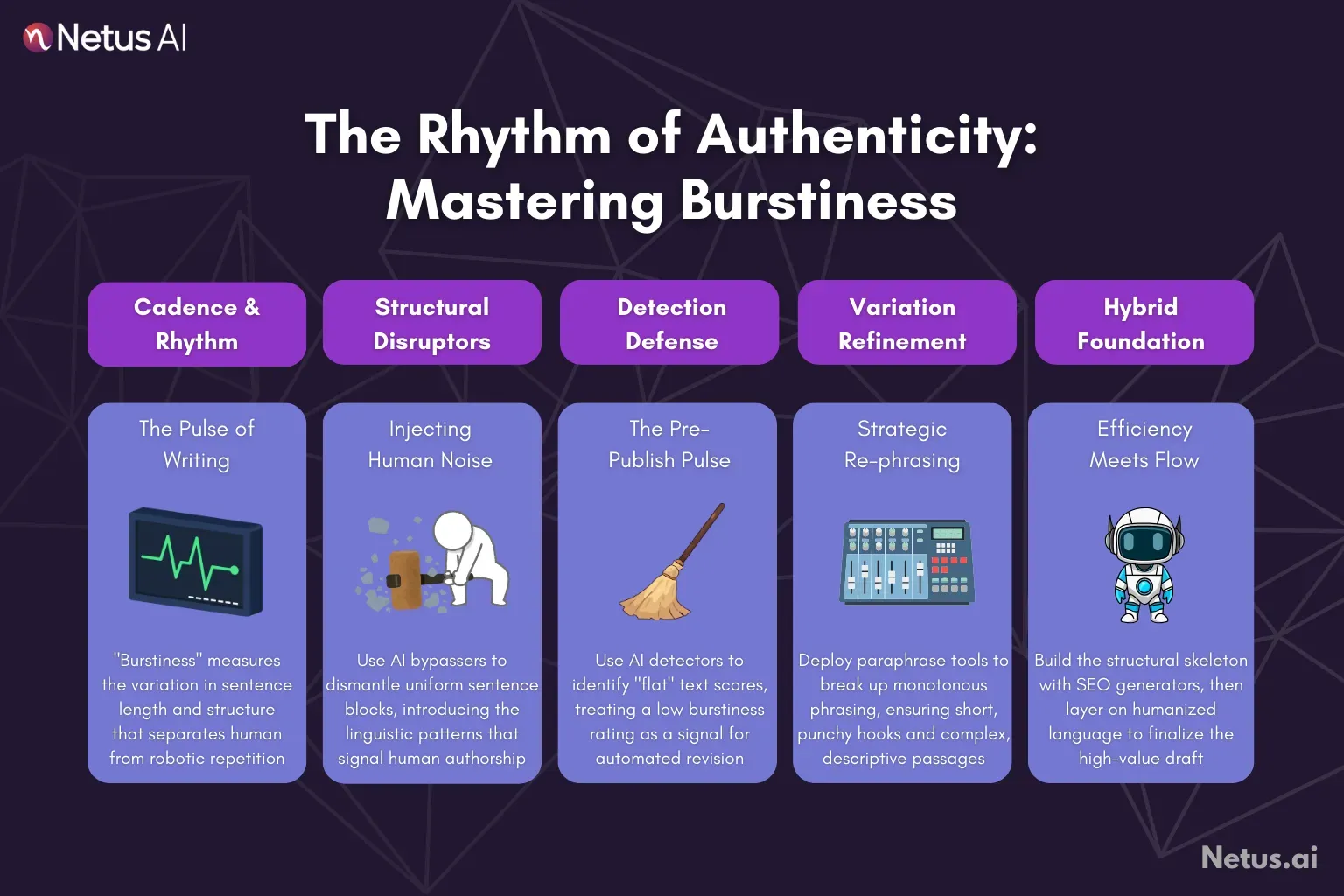
Burstiness is when a text has diverse sentence shapes and doesn’t always sound the same. Early AI writing programs made text really boring, where every sentence almost looked like the other. With burstiness, that kind of dull style is not present.
When content has a high burstiness score, it means sentences are sometimes long and sometimes short, which almost sounds like how someone talks or writes naturally in real life. Let’s look at the comparison:
- Low Burstiness (typical AI example): When you produce content, your first goal is to give the best value to the reader. This should include checking keywords, writing a detailed plan and making sure everything is accurate. You get something that is structured and provides information. (Sentences mostly look alike in form and size.)
- High Burstiness (normal for humans): The end goal? To catch someone’s attention! Now and then, there is just a small sentence. Other times, a passage goes on and on, telling a story or giving details with complicated sentences, all so the user gets the most value. (This time, there are sentences of different lengths, like how people often talk.)
The smarter AI search engines become, the easier it is for them to separate these styles. They want content that sounds more real and gives off a “human” feeling, which is mostly unpredictable in the sentence style. That’s what burstiness really is.
Why must SEO people care about human variation?
If you need your AI writing to get better ranking, it has to tick two important boxes. First, it has to be relevant for the searchers (like old-school SEO) and seem like it was made by a real person (the new rule, checked by things like burstiness and perplexity).
If what you write only uses perfect grammar and a steady structure, it is not enough to be ranked high. That kind of text will lose to writing that feels more “alive.”
Making content that feels alive
The first thing to do is to really try making content that stands out and isn’t copied from other places. AI can help with ideas or fast research, but it’s easy for the writing to sound “robotic” or always the same.
That’s why using an AI bypasser is good before you finish the article. With this tool, AI-generated lines are changed just a bit: it adds new ways to organize the sentences so there is more burstiness. The text is not flat anymore, so the AI ranking engines notice the work as high-quality and possibly made by humans, which gives it a better chance of being shown first.
Avoiding problems with AI detectors
Now that the search systems want only “real” stuff, tools that spot fake or AI-only writing are getting advanced. Your page could get a lower spot if detectors think it’s just computer-created content.
Because of that, you should always check your article with an AI detector before posting it online. If you see that the score is high, meaning very likely made by AI, your writing could be missing the unpredictable touch and the interesting word mix of a human. Use this clue to fix the draft or, better, try a tool that changes the text to sound more original, so that the risk will drop.
Fixing the language and how sentences flow
Your ideas can be good, but if the way the words flow is very stiff, that is because of too much AI use for text. The way to solve this is by mixing up language more.
A good paraphrase tool helps here. Not the basic ones, but a better one can restructure whole paragraphs, making sure human-like “burstiness” is added. You should not just use this to avoid copying, but to break apart too many similar sentences. Try both simple and long sentence types like humans use. Such language mixing is a main part of burstiness.
Smarter use of AI for initial drafts
Although burstiness is needed for final quality, being quick matters for people who do a lot of content. AI is still very strong for basic steps.
If you want lots of keyword-heavy and researched drafts fast, the SEO article generator is helpful. It arranges clear headings, keeps the keyword amount right, and checks for facts. Most of the time, you’ll have a text with little burstiness, but that’s all right, you can update it with more lively writing later with the tools and methods above.
A great article always begins with the right headline. Use a title generator focused just on SEO to make many options, so you cover keywords and improve the chance that readers click. Having a strong title pulls people in, no matter how the rest of the writing is built.
NetusAI: Combined toolbox for SEO in the AI era
As ranking metrics have shifted to focus more on “burstiness,” SEO experts cannot depend on tools with just single functions any longer. Finding success within an AI-driven search environment needs a tactical collection of software that handles the whole content cycle, starting from base content up to the point where it becomes more human.
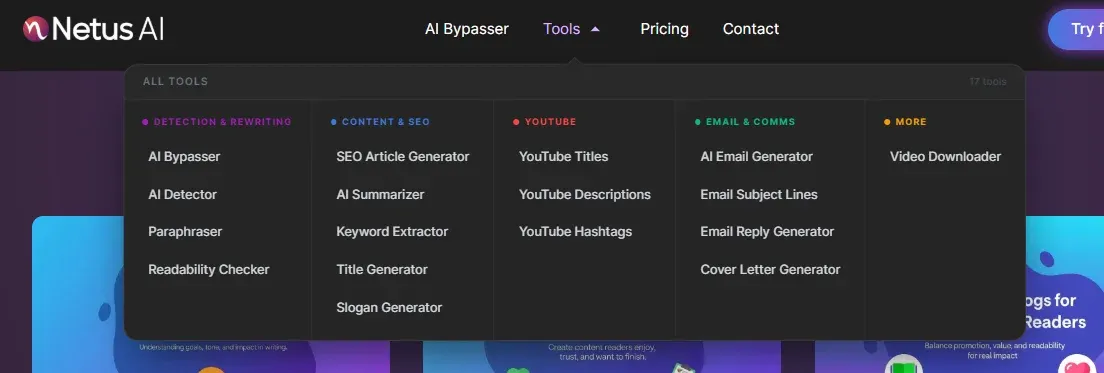
NetusAI offers several tools which are designed in a way that they are compatible and used together, giving users an all-in-one resource for today’s SEO needs.
Using them, creators gain the advantages of AI speed and capability but also make sure content has “burstiness” plus proper authenticity that high-level search engines now reward. By bringing all these tools into your process, you build a strong routine that uses AI for fast content creation and then adds in human-like elements that algorithms want.
Final opinion
AI getting more attention in search does not mean SEO will disappear. It just means SEO is improving. “Burstiness” is now showing that search algorithms are favoring articles or content that seems really made by humans, is not just repetitive, and gets people interested.
Using NetusAI to help you keep a balance between the benefits of AI tools and human appeal, such as AI Bypasser, AI Detector, Paraphrase Tool, and SEO Article Generator, puts your content plan in a place where it can do well in this advanced ranking environment. SEO in the future will go to people who become skilled at making content that has a human sound but uses machines in the background.
FAQs
How do burstiness and perplexity differ when checking content quality?
Burstiness, which refers to differences in sentence length and structure, shows the unevenness that is normal in how humans talk. Perplexity is a measure of how complicated and unusual the language is, meaning how much a language model is surprised by what it reads. Both are factors that AI search engines look at when deciding if content sounds like it was made by humans and assessing its overall quality.
When is the best time to use an AI detector for top ranking?
It is always recommended to use an AI detector just before you publish anything where any piece, even just an outline or early draft, was made or assisted by AI. Getting a high score from the detector is a signal that your text does not have enough burstiness or human-like differences, meaning you should do more work by hand or with an AI bypasser.
Can burstiness be high without using an AI bypasser?
Sure, you can get high burstiness if you write carefully as a human, making differences with sentence length, mixing complicated and easier parts, and using rhetorical questions or things like “wow.” But an AI bypasser is a big help to put this variation in content made by AI much faster.
Is it a mistake to use an SEO article generator when wanting high burstiness?
Actually, it is part of a strategy. SEO article generator serves as a way to create a basic setup for your content, spread keywords, and build a true base. Then you should use a paraphrase tool or AI bypasser to adjust and add burstiness so your article seems more human before putting it online.