Generative Artificial Intelligence has significantly changed content creation. With ChatGPT and similar programs able to write human-level text very quickly, reliable AI detectors have become very important for teachers, publishers, and SEO professionals. Choosing a good AI detector is no longer a luxury; it has become a necessity for maintaining academic integrity, protecting your brand, and ensuring high-quality writing.
But as more and more tools say they have better accuracy, what is the best way to choose with full knowledge? This guide gives you important things to think about if you want to select an AI detector that meets your needs.
Accuracy and reliability: the most important parts
The main job of an AI detector is to tell human writing and machine writing apart. If it cannot do this well, it does not help you.
False positives and false negatives
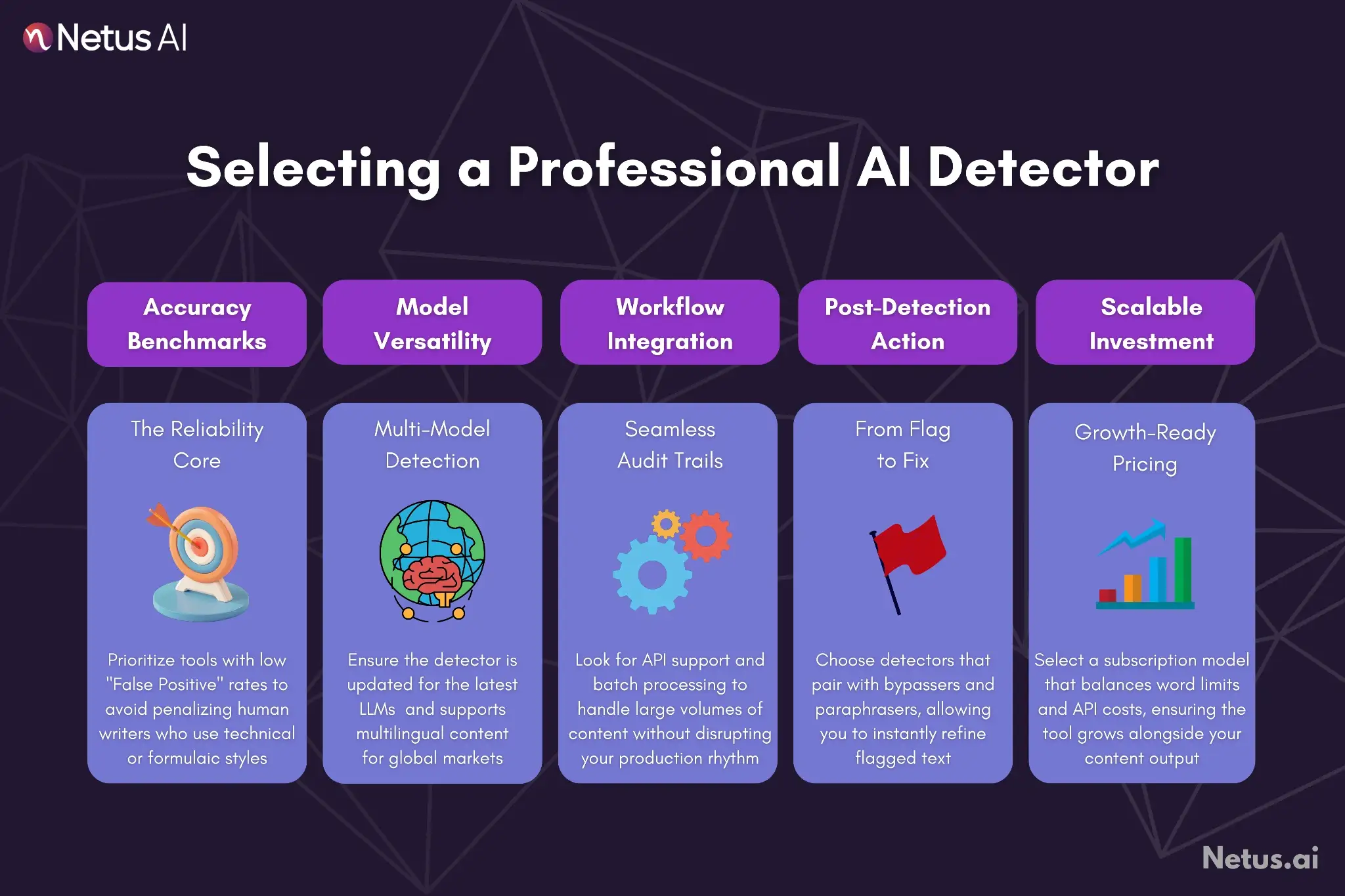
False positives happen when a detector wrongly identifies human writing as being made by AI. This may cause unfair punishment or make people lose confidence. For example, some very formulaic or repetitive writing by people might make a detector think it is AI.
False negatives mean AI-written stuff goes through and is not noticed by the detector. This makes the detector useless.
To judge a detector, you should check if it shows honest information about how it performs with different sets of texts. Better accuracy is important, especially getting a low number of false positives.
Languages and support for models
AI is complicated and comes in many forms, so first we need to know how AI detectors work. A detector that only checks basic English models will not help you if your content uses many languages or the latest models of AI.
Multilingual features
If you create or work with texts in languages like Spanish, French, German, or any others, make sure the detector can handle these. If it only worked on English, it probably would do badly with other languages.
Model complexity
AI models are frequently changed and updated. Newer AI models try very hard to look more like human writing than before. The best detectors are always being upgraded so they can identify the newest or most advanced models. You need a tool that does not just point out GPT-3 but also shows text generated by the latest GPT-4 models or other large language models.
Handling content created by AI
After you find AI-created text, what comes after that? Here is where extra features and combined tools really matter.
If an article or content is marked as being made by AI, you may try to make it more human-like so it is safer and of better quality. For example, an AI bypasser changes AI text a bit to sound more like a person, so you do not get in trouble for using low-quality AI content.
Or if you found AI-written material that needs big changes to look less artificial or perform well in SEO, then using a paraphrase tool is helpful. This lets you quickly rewrite and reorganize it but keep the main message the same. It is a fast way to turn detected AI stuff into original, human-improved writing.
Costs and growth ability
Price is always something to consider, though the lowest price often is not the best option for trustworthiness.
Subscription styles
Most AI detectors have subscriptions and charge based on the number of words, documents, or users.
Things related to price
|
Feature |
Description |
|---|---|
|
Word Limit |
How many words are you allowed to check per month? |
|
Seats for Users |
How many people can use the software? |
|
Free Option or Test Period |
Good for checking accuracy before paying for it. |
|
API Charges |
There are different costs if you use the API many times. |
Pick a package that fits your current number of documents but is also able to grow with your needs.
Special requirements: SEO and making content
For writers and SEO workers, a tool must do more than just show if it is AI or not; it should help throughout all stages of creating content. If you are starting over and need high-level content not easily spotted as AI, you should go for an advanced SEO article generator that uses the best detector methods for AI.
Before you release content, it is smart to check if your titles and subjects are interesting. Tools such as a tItle generator can help make your articles reach more people. For people who need new ideas all the time, a slogan generator is handy and fast for coming up with creative ideas.
To sum up, making sure content relies on a strong base of search words is very important. After making or fixing your articles, you can use keyword extractor to check that the final content matches your main keywords, so all your work is ready for search engines.
The NetusAI toolkit: A comprehensive place for all content needs
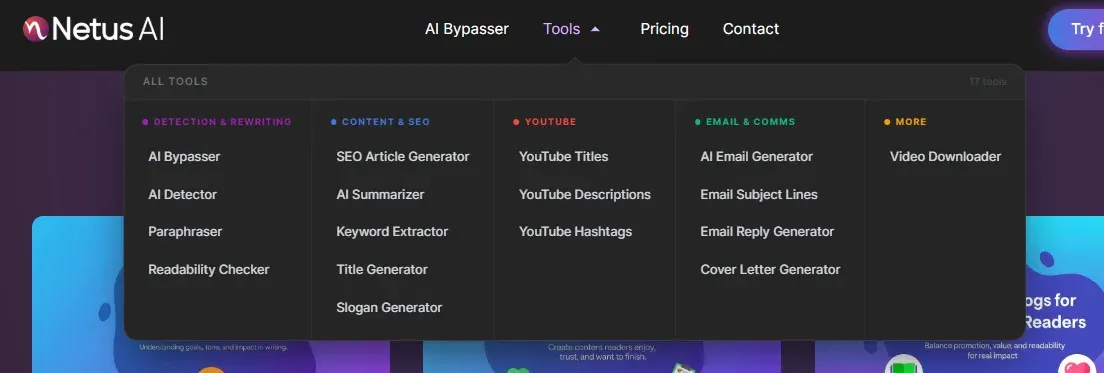
If you choose to use only a single AI detector, you solve only part of the issue; detection is not the total answer. True productivity is realized when there is a connected group of tools that tackles all parts of the content design, checking, and improvement process.
If your need is to quickly analyze a draft for AI detection signals, rewrite the found content to make it more readable by humans, or create a fully optimized SEO article from only one spot, using all NetusAI tools together removes the trouble of jumping around between different unconnected platforms. This can change the hard work of checking or optimizing content into a smooth, quick method that makes sure the result is top-quality and safe to release.
Ending thoughts
When you pick an AI detector, you need to think carefully about how accurate it is, how well it can adjust to new AI models, whether it supports various languages, and what connections are possible.
Many people just think about making AI content undetectable, but those who are planning for the future will get a system that combines capabilities for refining and creating content too, transforming a difficult compliance task into a faster and better workflow.
Tomorrow’s content depends not only on knowing what parts are AI but also on having the tools to verify that what is published is authentic and meets high human standards.
FAQs
What should people think about most when looking at an AI detector?
The part that matters most is how accurate the tool is, especially its false positive rate. When the rate of false positives is high, normal texts written by people can be mistakenly flagged, which can slow things down and even create internal trouble. It is better to search for detectors that have low false positive rates.
How often does an AI detection tool need new updates?
A really good AI checker needs frequent and constant updates. Generative AI makes progress very quickly because there are often new types and ways. If a detector does not get updates, it will not work well later because it cannot see what the latest AIs are producing.
Is it possible for AI detection to recognize content that was rewritten or “spun”?
Simple AI detectors can have difficulty with content that is highly reworded or spun. Still, better detectors, mainly those with machine learning or analysis of style, are improving at finding machine-created hints, even after someone changes wording. If you use a paraphrase tool, it might make text sound more like human writing than just simple spinning.
Is an AI bypasser able to make AI text fully hidden from all detectors?
An AI bypasser tries to make AI writing look human and less likely to be caught, but there are no guarantees that it will always remain undetected. The best idea is to use the bypasser first and, after that, let a person edit and adjust the writing so it has smoothness, an individual style, and good quality before it goes out for others to see.
Why should SEO workers use an AI detector?
SEO workers need an AI detector so they can keep their website's position and image safe. Search engines are stricter now regarding low-quality or AI-generated bulk content. If they use a detector, every piece of content can meet the necessary standards and avoid trouble with algorithms for repetitive or low-value machine writing.