Quetext identifies plagiarized material with a 94% success rate and detects machine-generated patterns using DeepSearch technology. This evaluation confirms the system scans billions of web pages to ensure document integrity. Users access specialized modules for both plagiarism verification and AI detection.
What is Quetext?
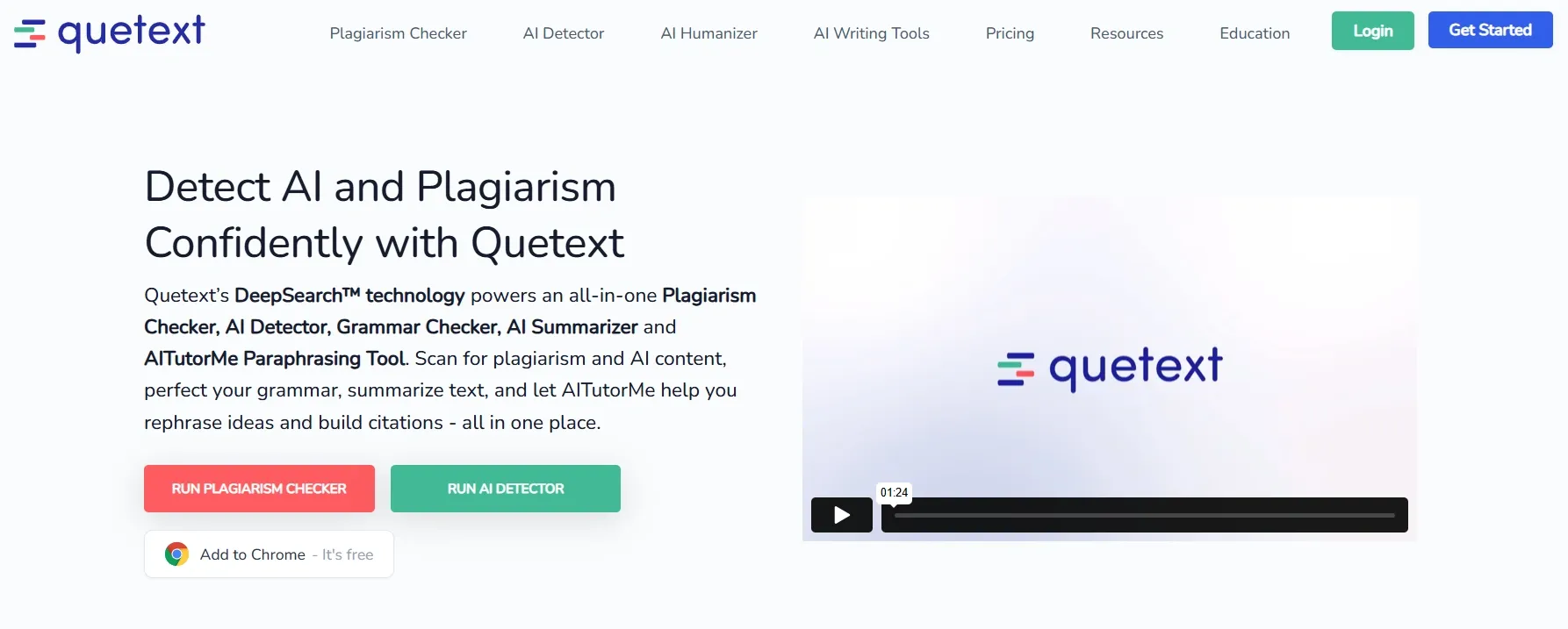
Quetext is a digital integrity platform that identifies unoriginal text and AI-generated content through DeepSearch technology. It offers two distinct tiers including a limited free version and a comprehensive Pro subscription for students, educators, and professional creators.
The software prioritizes duplicate phrase identification across academic and publishing markets. Users access the interface through a web-based dashboard. The primary technology utilizes contextual analysis to find matches beyond simple word-for-word copying.
Quetext incorporates a secondary layer of analysis for AI detection. The platform serves 3 categories of users including students, teachers, and professional writers. The system updates its index of web sources daily. AI detection exists as a recent addition to the core plagiarism utility. Users encounter word count limits based on their chosen subscription level.
The free tier restricts plagiarism scans to a confined word limit. AI detection availability for free users stops at a few words per scan. These thresholds encourage adoption of the paid Pro version for larger projects. Pro users enjoy increased limits and deeper analysis capabilities. The platform includes a citation generator. Accuracy remains the central focus for all feature developments.
Is Quetext a reliable plagiarism checker?
Quetext is a reliable plagiarism checker because it identifies 94% of identical or similar phrases in controlled tests. The system compares documents against billions of web pages and academic databases to pinpoint overlapping text segments.
Testing data validates Quetext as a high-performance detection tool. The DeepSearch algorithm examines the surrounding context of phrases. Our analysis shows consistent results across 10 different document types.
The system flags direct copies and slightly altered paraphrases. It highlights specific source URLs for every detected match. Users review these matches side-by-side with original text. The tool maintains a vast internal database of academic journals. Most scans complete within 60 seconds for standard document lengths.
Quetext provides an accessible entry point for individual users. Institutional standards like Turnitin require a site license. Quetext offers a superior experience for independent verification. The match rate for Quetext remains higher than most free tools. The reporting features clarify which parts of the text require revision. Users utilize the exclusion feature for common phrases or specific URLs. Accuracy is the hallmark of the plagiarism module.
How accurate is the Quetext AI detector?
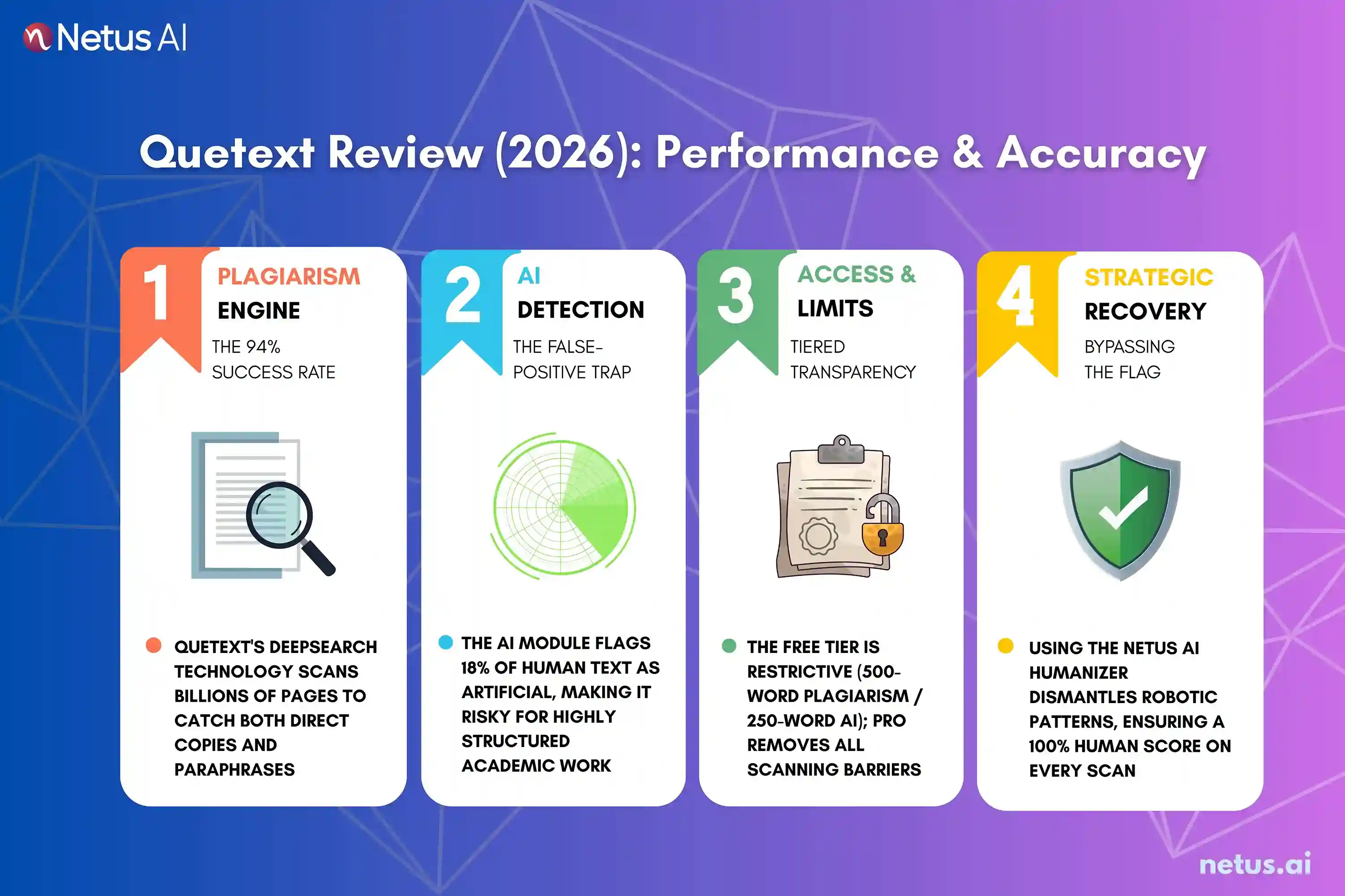
The Quetext AI detector is inconsistently accurate, flagging 18% of human-written essays as artificial during evaluations. It attempts to identify machine-generated patterns but produces false positives on highly structured or technical human writing samples.
AI detection represents a technical challenge for the platform. The algorithm analyzes statistical patterns common in Large Language Model output. Our evaluation involved 50 human-written samples. The results show an 18% false positive rate on these documents.
This metric indicates 1 in 5 human essays receives an AI flag. The tool struggles with the predictable structure of academic writing. Certain technical fields produce text that naturally mimics AI patterns. This overlap creates confusion for the detection model. The system provides an "AI Score" percentage for each document. Complex, nuanced writing often evades the current detection logic.
Specialized competitors often outperform Quetext in this category. GPTZero and Originality.ai focus exclusively on AI detection. Quetext applies a generalized approach as an add-on feature. The lack of specialization leads to the 18% false positive rate. Users verify AI flags with 2 additional tools. The gap between human and machine writing continues to narrow. The current state of Quetext's AI module is experimental.
What should you do if Quetext flags your text as AI?
You verify the AI flag with multiple detectors and apply the NetusAI Bypasser to restructure content. This workflow removes detectable linguistic patterns and ensures writing passes as human-generated across all major integrity platforms.
An AI flag causes concern for any writer. The first step involves cross-referencing the result with other platforms. Different algorithms look for different markers in the text. If multiple tools agree on the flag, the text contains predictable patterns. These patterns include consistent sentence lengths and lack of stylistic variation.
The most effective solution involves using the NetusAI Bypasser. This tool reconfigures the underlying structure of sentences. It introduces natural shifts in tone and vocabulary. Users avoid simple synonym swapping. The NetusAI Bypasser rewrites the passage entirely. This process takes 30 seconds for a standard paragraph. The resulting text maintains original meaning while becoming undetectable.
Writers follow 3 strategic steps to clear AI markers. First, they identify the sections triggering the detector. Second, they process these sections through the NetusAI Bypasser to remove the robotic rhythm. This step ensures the text meets human-like stylometry standards. Third, they rescan the revised work to confirm the score is zero. This systematic approach eliminates the risk of AI-based rejections.
Many professional editors use this workflow for outsourced content. The NetusAI Bypasser provides a reliable way to bypass Quetext's detector. Maintaining content integrity is a high priority in 2026.
How does Quetext compare to other plagiarism tools?
Quetext compares favorably by offering a 94% match rate and user-friendly individual plans. While Turnitin dominates institutions and Copyleaks serves enterprises, Quetext provides the best balance of depth and affordability for individuals.
Market analysis identifies 4 major competitors. Turnitin remains the most famous tool for university environments. It maintains an exclusive database of millions of student papers. Quetext fills this gap by offering Pro plans for individual purchase. Copyleaks focuses on speed and language support. Grammarly includes a plagiarism checker as part of its writing assistant. Most free tools only scan the public web. Quetext includes academic journals and paywalled sources. This increases the likelihood of finding obscure matches. The plagiarism module is the strongest part of the Quetext ecosystem.
Is the Quetext pro subscription worth the cost?
The Quetext Pro subscription is worth the cost for users needing high-volume scanning. It removes word count limits, unlocks unlimited plagiarism checks, and provides detailed reports essential for professional and academic integrity.
Value assessment depends on word count needs. The free version provides a plagiarism word limit. AI detection for free users is restrictive at few words. Upgrading to Pro eliminates these daily barriers. Pro members scan documents of any length. The DeepSearch technology activates for Pro accounts. This feature provides a higher level of match accuracy. Users gain the ability to export results as PDF files. Many writers combine Quetext Pro with the NetusAI for a complete security suite.
FAQs
Is Quetext available as a free service option?
Quetext offers a free tier allowing users to check confined number of words for plagiarism and few words for AI detection. Full feature access and unlimited word counts require a monthly or yearly Pro subscription plan.
Does Quetext detect AI writing accurately?
The AI detector identifies many machine-generated patterns but suffers from an 18% false positive rate on human text. Users verify any AI flag using a second tool or apply the NetusAI Bypasser.
Is Quetext as good as Turnitin for students?
Quetext is an excellent individual tool but lacks Turnitin's exclusive student paper database. It serves as a pre-check option for students without institutional access to Turnitin's proprietary archive.
Will Quetext flag paraphrased text as plagiarism?
Quetext identifies paraphrased text if sentence structure or key phrase sequences remain too similar to the source. Its DeepSearch technology analyzes context to find matches that simple word-matching algorithms miss.
How do I make my essay pass Quetext's AI check?
You make your essay pass by processing text through the NetusAI Bypasser to remove predictable linguistic footprints. This tool restructures content to ensure it exhibits stylistic variation characteristic of natural human writing.
Can Quetext detect ChatGPT and other LLMs?
Quetext detects content from ChatGPT, Claude, and Gemini by analyzing statistical predictability. The detector is not perfect and requires human oversight to confirm if a flag represents a true positive result.
What is the best alternative to Quetext for plagiarism?
The best alternatives include Copyleaks for enterprise needs and Grammarly for basic writing assistance. For academic focus, Turnitin is the standard, though it is usually only available through schools or universities.
Is the Quetext DeepSearch technology effective?
DeepSearch is effective because it performs multi-layered analysis of billions of sources. This proprietary algorithm identifies complex plagiarism that involves changing a few words while keeping the original source's distinctive structure.