AI helps speed up the whole process of creating content. But it tends to cut corners on how effective that content really is.
The issue comes from not lining things up with a solid strategy. You get all this quick output from generative AI tools these days. And a lot of it misses the mark on actual business objectives or what the audience wants.
That ends up causing results that just do not measure up. Still, this problem does not stem from some core flaw in AI itself. You can sort it out pretty easily with a more thoughtful strategic plan in place.
The gap: Generative AI produces fast content, but lacks intelligence

Generative AI quickly produces high-volume content (emails, blogs, ads), drastically reducing creation time and effort.
AI content is fast but lacks depth and the necessary refinement to truly connect with readers or drive performance.
Businesses gain quantity but miss the measurable impact (e.g., engagement, specific actions) needed for meaningful success.
Lack of feedback loop: The root cause of poor AI content
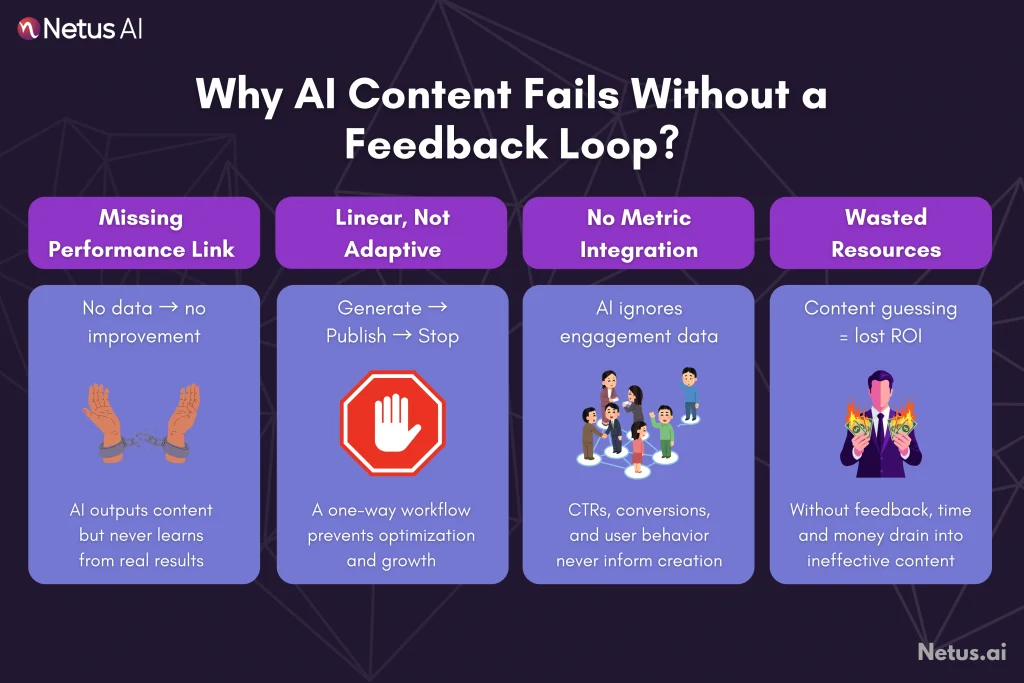
The core issue is a missing link: there is no established cycle between analyzing content performance data and using that information to refine or improve the AI-generated content.
The core flaw in most generative AI is its inability to integrate performance data into its content creation process.
This creates a flawed, linear system: AI generates content, you publish it and the cycle ends. There’s no critical feedback loop to analyze performance, adjust based on real-world results or facilitate iterative improvement.
Operating without a feedback loop, AI cannot adapt. Without linking content performance metrics (engagement, conversions, click-throughs) back to creation, businesses are left guessing, wasting time and resources on ineffective content.
Solution: Incorporate performance tracking and feedback
Implement a feedback loop: track and measure the performance of all AI-generated content.
Use this data to inform and refine future content iterations, moving beyond viewing generation as a final, isolated step.
Performance tracking turns AI content from a fast output generator into an outcome-driven strategy. For an AI email campaign with low open rates, tracking identifies weaknesses (e.g., subject line, tone, CTA).
This insight enables content refinement, further testing and continuous optimization for better results.
How does NetusAI add value in the AI content landscape?
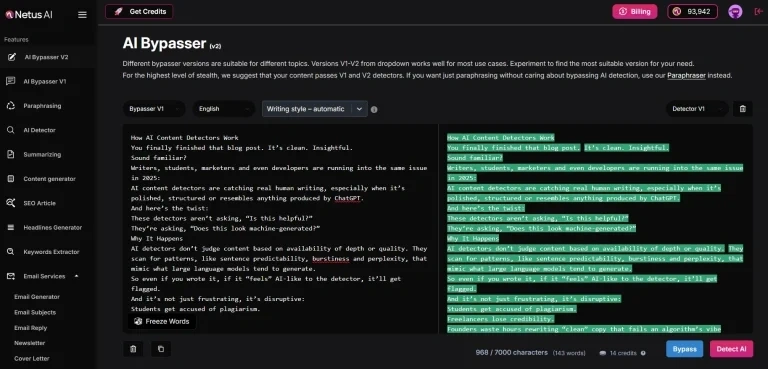
NetusAI is instrumental in navigating the dynamic environment of AI generated content. It effectively tackles the primary challenges and leverages the opportunities discussed in the article.
NetusAI plays a crucial role in tackling plagiarism and upholding originality by detecting AI generated content.
This service helps content creators and businesses identify AI generated text, protecting their intellectual property, ensuring originality, preventing copyright infringement and safeguarding their reputation.
- Maintaining user experience and quality: NetusAI’s ability to identify AI generated content allows users to proactively assess and refine their content.
- Combating misinformation: Generative AI risks spreading misinformation but NetusAI helps identify AI generated text to counter this.
- Navigating search ranking issues: Overusing AI content can harm SEO if it violates Google’s guidelines.
- Supporting transparency and regulation: NetusAI provides tools for identifying AI generated content, which aligns with potential regulations.
NetusAI serves a vital function in the expanding world of AI generated content. It provides essential oversigh, thereby guaranteeing quality, originality and trustworthiness.
Furthermore, it aids users in complying with developing ethical and regulatory guidelines.
Final thoughts
Generative AI does pick up the pace on creating content. But it runs into a serious gap in its smarts. That gap comes from not having a steady feedback loop tied to data. The whole thing works like a faulty one-way street.
AI spits out content pretty quickly. Still, it never really learns from how that content performs out there in the real world. Things like user engagement or sales conversions just get ignored. In the end, this leaves the content stuck in place and not pulling its weight. Resources go down the drain because of it.
Businesses must adopt a strategic change to move beyond the illusion of AI. They can achieve this by monitoring performance metrics and looping that information back into the system. In this way, AI evolves from a basic content producer into a results-oriented instrument that optimizes itself over time.
Platforms such as NetusAI guarantee that large volumes of AI-generated material align with rigorous criteria for quality, originality and ethical compliance. Successful AI content demands more than mere quickness. It calls for ongoing, smart refinements grounded in reliable data on actual outcomes.
FAQs
What is the core problem with most AI-generated content?
The main issue comes down to missing that ongoing feedback loop powered by real data. Generative AI systems tend to work in just one direction. They churn out content pretty fast. But they do not really assess how the content holds up out there in the world.
Think about things like user engagement or actual conversions. Then they cannot pull from that information to refine the next rounds of content in a smart way. In the end, this setup causes the material to stall out and fall short of what it could do.
Why does the speed of AI content creation often lead to ineffectiveness?
Speed does offer some clear advantages. But it tends to sacrifice things like solid strategy and real depth in the process. Those rapid content generators crank out a lot of material pretty quickly.
Much of it ends up feeling detached from actual business objectives or what the audience truly wants. The issue stems from their inability to adapt based on how the content performs over time. In the end, this leads to output that feels generic and fails to deliver strong results.
What is the “feedback loop” and why is it essential for effective AI content?
The feedback loop represents the core process in content management. It involves monitoring and evaluating performance indicators like engagement rates and conversions. These details then get looped back into the overall system for creating new material. In this way, the AI or the dedicated platform can adjust over time.
It figures out what performs best. It steadily improves and fine-tunes the next round of content to achieve stronger results.
How can businesses solve the problem of poor AI content quality?
The fix comes down to weaving in performance tracking and a feedback system right into the AI content approach. Companies have to keep tabs on how each piece of content performs.
They need to grab that solid data and let it guide tweaks, improvements and fresh tests for the next versions. In the end, that shifts everything toward a strategy built around actual results.
How does NetusAI specifically address the challenges of AI-generated content?
NetusAI really steps in to deliver some solid value. It handles crucial oversight and double-checks everything along the way. The system pushes back against plagiarism and keeps originality front and center. It picks up on AI-generated stuff right away.
That approach maintains those quality benchmarks, the kind focused on people-first content. It helps dodge the headaches with search rankings. On top of that, it takes on misinformation headfirst. It even bolsters transparency while lining up with shifting ethical standards and regulatory demands.
What is the “illusion of AI” mentioned in the article?
People often mention the “illusion of AI”. It points to this wrong idea that AI can crank out content really fast and that somehow means it has true strategic smarts.
The thing is, all that quick generation just hides a major shortcoming. There is no real system in place that learns from what it does and keeps getting better over time.