
When rewriting, writers thoroughly rework content for better performance, a necessary task in both academic and professional settings.
Unlike revisions, which adjust content for perfection, rewriting involves a complete overhaul, often due to poor performance.
What is article rewriting?
Article rewriting improves existing content. Reasons include better topic conveyance, updating keywords, phrases or complete revamping.
This is common in academic and professional settings, often done when a writer feels they could have done better, or, in SEO, to boost a poorly performing blog post.
In academic writing, if the essay or research paper is not so easy to understand, the tutor or superiors can directly request a rewrite, major or minor. However, the article rewriter can be divided into three important aspects:
Title rewriter
Title rewriting, common in professional and SEO content, involves adjusting the title for better prominence. The author then updates the article body to align with the new title.
Content rewriting
Academic contexts utilize content body rewriting more frequently than SEO blogs, primarily due to low review scores. However, SEO content auditing may also trigger a major review for improved performance.
Rephrase some elements
An author must modify plagiarized or duplicated content, usually before approval, often after using plagiarism checkers.
6 tips to make content better than the original
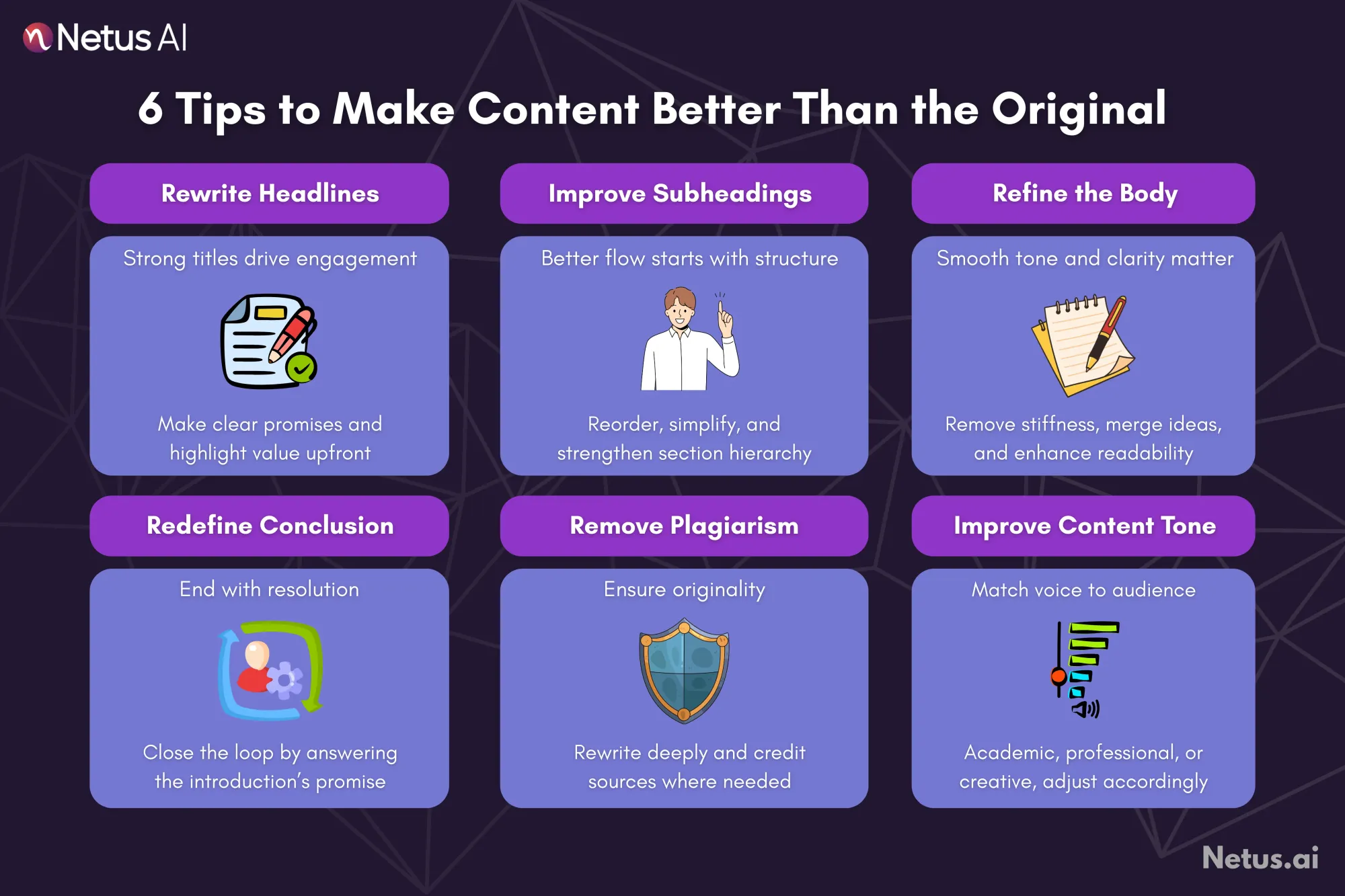
Improving content can be difficult, depending on the quality of the original. Rewriting is easy if the content has many grammatical errors.
However, rewriting high-quality content is a challenge and issues like self-plagiarism must be avoided. To simplify the process of creating superior content, we offer 7 essential tips.
1. Recreate Headline/Headings
Effective content requires strong headlines that summarize the content and hook the reader.
SEO:
When rewriting content, start by rewriting the titles. For SEO, avoid generic titles like "How To Write Better SEO Content in 4 Ways."
Instead, make a promise and be more commanding, for example: "4 Essential Ways to Help You Write Better, Ranked Content." This immediately offers the reader security and highlights the benefit.
Academic:
Academic writing needs to immediately engage and impress expert audiences. Titles for research papers should be inspiring and avoid simple phrases like "A study."
Instead of "How to Solve Traffic Problems in San Francisco: A Study," try "Solving San Francisco’s Traffic Problems: A Long Overdue Change." This new title presents the solution first, making the reader want to know the details of the change.
2. Rearrange subheadings
Using subheadings is key for breaking up content, which improves reader understanding and SEO. Poorly formatted subheadings, however, weaken an article.
When rewriting, focus on improving subheadings for better flow and impact. For example, the list:
- Optimize the content for the search engine
- Write a good headline
- Ensure the readability of your content
- Use the right keywords
is technically correct but messy. A better, rearranged list is:
- Write a compelling headline
- Use the ideal keywords
- Ensure readability, keep it simple
- Optimize your content according to SEO laws
This revised structure prioritizes the initial steps of content creation, improving fluidity and smoothness. Always improve flow, simplify where possible, use strong synonyms and arrange subheadings logically.
3. Rewrite main body
I guess the key part here is making this section really grab attention. It might mean shuffling around subtitles or tweaking the words to get a better feel overall, smoother than what was there before.
When it comes to tone and how things flow, the main thing is to work on that. Get rid of any parts that sound too stiff or sudden, like instead of saying readability matters and then repeating to make it readable for SEO, just combine it into something like make your content easy to read since that helps with SEO.
4. Redefine conclusion
A strong article conclusion must be definitive and resolve the introduction's questions, not just repeat content. An effective conclusion brings the piece "full circle." For instance, instead of merely summarizing, a rewrite like: "These four elements are essential to helping a blog stand out in the SERP rankings.
5. Remove plagiarism
The main idea for this part is to make it grab people's attention right away. Maybe shuffle some subtitles around or change a few words so it feels smoother than before.
That connects to fixing the tone and how everything flows. Like, get rid of spots that sound too stiff or jumpy. For instance, instead of talking about readability and then saying make it readable for SEO again, just put it together to make your content easy to read because that helps with SEO.
6. Improve content tone
Sometimes you have to rewrite an article just to fix the tone, even when the rest of it seems pretty good. Like, the tone could come off too basic or maybe it's overly complicated.
Academic writing needs a more advanced feel, professional but with some creativity thrown in.
NetusAI features for seamless rewriting
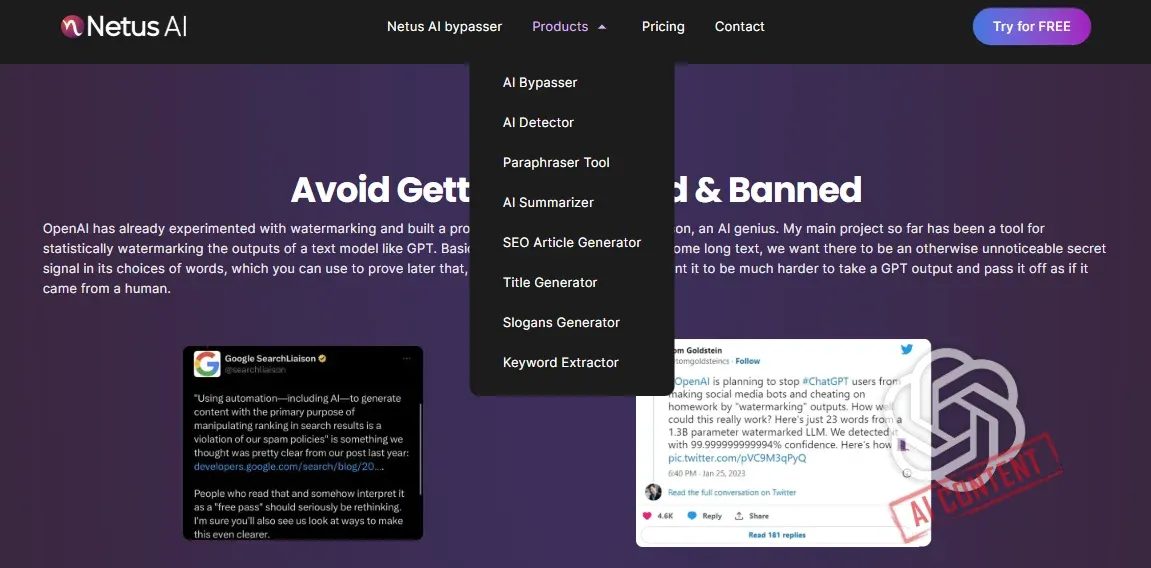
NetusAI offers a comprehensive suite of AI tools designed to assist and enhance every stage of the article rewriting process, directly addressing the seven tips discussed above.
| NetusAI Feature | Rewriting Benefit/Application | Relevant Rewriting Tip |
|---|---|---|
| AI Bypasser | Completely reworks AI-generated or existing human content to sound unique and undetectable by AI detectors, ensuring originality and flow improvement. | 5. Remove Plagiarism, 6. Improve Content Tone |
| Paraphrase Tool | Quickly rephrases sentences, paragraphs or entire sections to avoid self-plagiarism, enhance clarity or adjust tone without changing core meaning. | 5. Remove Plagiarism, 3. Rewrite Main Body |
| AI Detector | Scans newly rewritten content to verify its originality and human-like quality, preventing false positives and ensuring your article is ready for publication. | 5. Remove Plagiarism (proactive check) |
| Title Generator | Creates multiple engaging and optimized title options, helping writers start the rewriting process with a strong, promising headline. | 1. Recreate Headline/Headings |
| Keyword Extractor | Identifies and extracts high-value keywords from the original or competitor content to integrate seamlessly into the rewrite for better SEO performance. | 3. Rewrite Main Body (for SEO optimization) |
| Slogans Generator | While primarily for marketing, this tool can aid in creating powerful, memorable phrases for subheadings or the conclusion's final punch. | 2. Rearrange Subheadings, 4. Redefine Conclusion |
| SEO Article Generator | Can assist in generating high-quality starting drafts or new sections based on your updated keywords and structure, accelerating the overall rewriting effort. | 3. Rewrite Main Body (starting point) |
| AI Summarizer | Quickly distills the core ideas of the original article, helping the writer ensure the conclusion is definitive and the main body remains focused on essential information. | 4. Redefine Conclusion, 3. Rewrite Main Body (focus check) |
By leveraging NetusAI's specialized tools, writers can transform a poorly performing or plagiarized article into high-quality, undetectable and optimized content, making the challenging task of complete article rewriting seamless and efficient.
Final thoughts
Article rewriting is a rigorous process, essential for academic and professional quality. It requires completely restructuring content for better clarity, flow and effectiveness, going beyond simple editing.
The seven critical steps, recreating headlines, rearranging subheadings, rewriting the main body, redefining the conclusion, removing plagiarism, improving the tone and citing sources, transform underperforming content into a high-impact piece.
Tools like NetusAI can significantly streamline this challenging process, providing specialized assistance for every stage, ultimately ensuring the final article is original, engaging and optimized for its intended audience and platform.
FAQs
What is the main difference between article rewriting and revision?
Article rewriting involves a complete overhaul or reconstruction of content, often due to poor performance, to improve clarity, flow and effectiveness. Revision involves minor adjustments or refinements to perfect content that is already fundamentally sound.
What are the three main aspects of article rewriting mentioned?
The three main aspects are Title Rewriter (adjusting the title for better prominence), Content Rewriting (overhauling the main body) and Rephrasing some elements (modifying plagiarized or duplicated sections).
Why is rewriting the main body considered the most crucial section?
The main body needs to be captivating, highly informative and refined for smoother flow and better tone. It is where you inject specific, cited data, eliminate robotic phrasing and ensure the content sounds natural and expert.
How should a conclusion be redefined during the rewriting process?
A conclusion must be definitive and resolve the questions posed in the introduction, effectively bringing the piece "full circle." It should not merely summarize the preceding content but directly address the article's goal or promise.
How does the required tone differ for academic writing versus SEO writing?
Academic writing requires an advanced, professional and somewhat creative tone. Conversely, SEO writing necessitates a simple, easy-to-read tone, avoiding overly complex words or jargon to ensure broad accessibility.
What NetusAI tool helps ensure the rewritten content is undetectable by AI detectors?
The AI Bypasser tool completely reworks AI-generated or existing human content to sound unique and undetectable, ensuring originality and improved flow.