SEO writers must care about AI content detection because it serves as a critical trust factor. While Google accepts helpful content regardless of origin, many agencies and clients use detection tools like Originality.ai or Winston AI to verify quality. To maintain value and pass detection, writers should adopt a "Human-in-the-Loop" process, using AI for drafts and research while injecting personal opinions, brand voice, and specific information.
Why do SEO writers need to care about AI detection?
SEO writers need to care about AI detection because Google's Helpful Content Updates are designed to catch low-effort, machine-made content intended primarily for search engines. If a detector flags your text as "copy-pasted," your content may face sudden ranking losses or removal from search results. Furthermore, clients now include AI rules in agreements, and frequent flags can lead to lost trust, terminated contracts, and a damaged professional reputation.
Apart from just Google, clients have started to be tougher. Some SEO agencies now put AI rules into their writer agreements. Clients who pay for writing services look for human skills and real knowledge. If your writing sets off AI warnings many times, you could lose trust, contracts, or get a bad name and lose jobs in the industry, which is now very competitive.
Which AI detectors do clients and agencies use?
In 2026, clients and agencies primarily utilize the following AI detection tools:
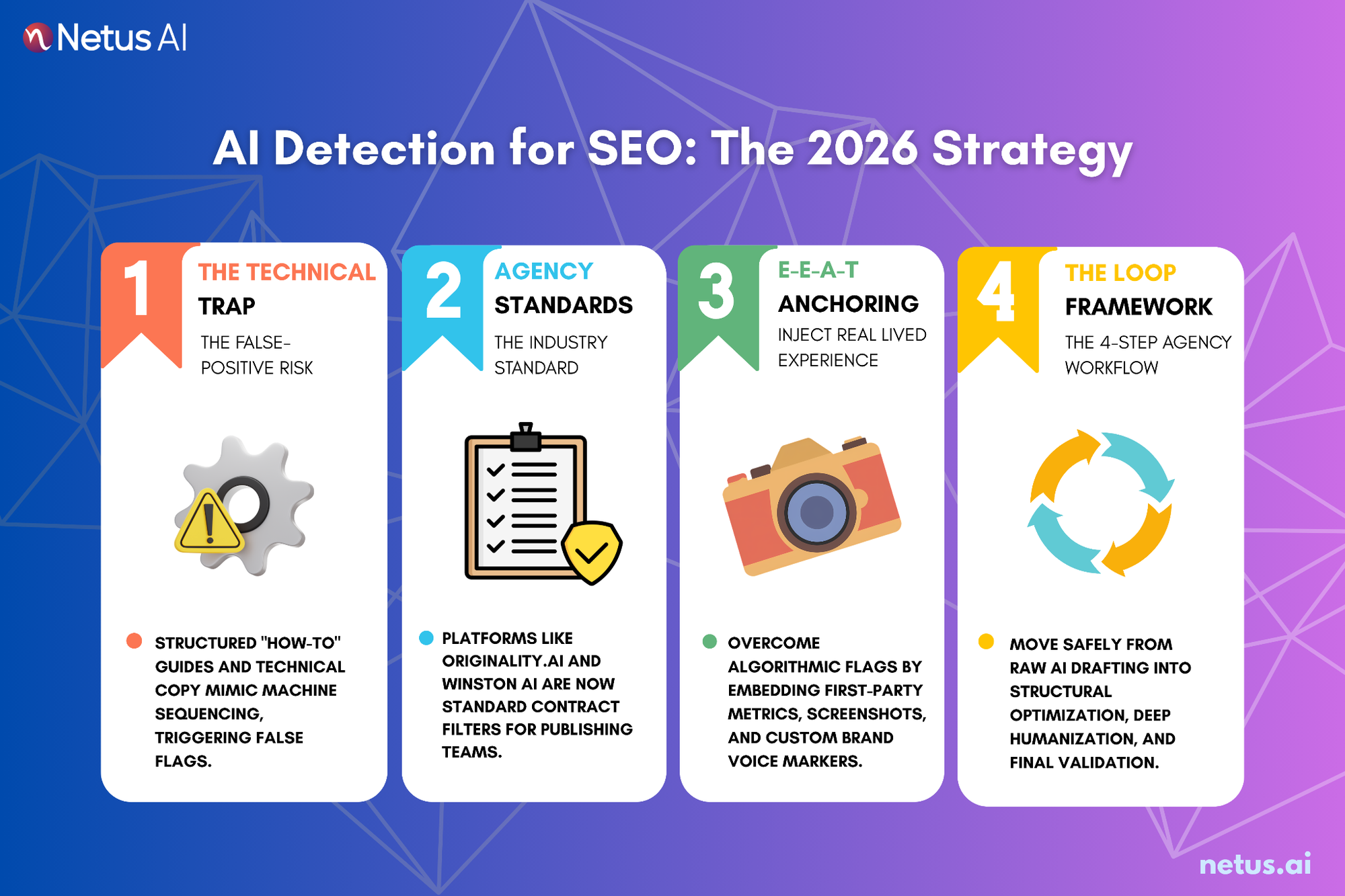
- Originality.ai is considered the main standard in high-volume agencies and is famous for catching new LLMs because it updates frequently and detects aggressively.
- Winston AI gets picked, especially in law and education areas, because its reports have a "human score" and it is very precise.
- Copyleaks is what many corporations like because it works well for their large systems. It scans for both plagiarism and AI.
- GPTZero works as a backup checker for detecting content sometimes, especially for open-source models.
How accurate are AI detectors on SEO content specifically?
AI detectors identify patterns such as low perplexity (predictability) and low burstiness (sentence variation) common in LLMs. However, they frequently produce "false positives" on SEO content, especially in technical or "how-to" articles that naturally use a dry, fact-heavy, or list-oriented style similar to AI output.
The risk: When AI flags hurt your client work
When AI flags occur, the primary risks to client work include:
- Budget Waste: Many times clients think that they pay high rates for people’s work, but it is actually machine-generated, so they start to request money back.
- Audit delays: When a check does not pass, content is sent again to writers, which makes the whole SEO process slower.
- Search Suppressions: This is not really a “manual penalty”, but many AI-focused websites have drops in traffic during the Core Updates.
The protection: Humanizing AI-assisted SEO content
To protect rankings and avoid AI patterns, writers must inject elements that machines cannot simulate:
- Anecdotes and Case Studies: Real-world examples with specific results are the ultimate proof of human authorship.
- Contrarian Opinions: AI usually defaults to the consensus. Human experts offer unique perspectives that challenge the norm.
- Varied Sentence Structure: Intentionally varying sentence length and complexity disrupts the mathematical probability detectors look for.
Workflow for SEO agencies (Generate → Optimize → Humanize → Verify)
Professional agencies in 2026 follow this four-step protocol:
- Generate: Use AI to create a comprehensive outline and a first draft based on factual prompts.
- Optimize: Layer in your NLP keywords and ensure the technical SEO requirements (H-tags, internal links) are met.
- Humanize: A human editor rewrites introductions, adds personal insight, and adjusts the "flavor" of the text.
- Verify: Run the final version through an AI detector to ensure it passes before delivery.
FAQs
Does Google penalize AI content directly?
No, they penalize unhelpful, unoriginal content regardless of how it was made.
Can AI detectors be fooled?
Yes, but "fooling" them with tools like paraphrasers often results in bad writing. Human editing is better.
Is a 100% human score necessary?
Most agencies look for a "Human" probability above 70-80% rather than a perfect 100%.
Do detectors work on non-English content?
They are improving, but accuracy is significantly lower in languages other than English.
What is "Perplexity" in detection?
It measures the randomness of text. AI text usually has low perplexity (it is very predictable).
What is "Burstiness"?
It refers to variations in sentence length and structure. High burstiness is a human trait.
Will AI detectors become obsolete?
Unlikely. They will continue to evolve alongside LLMs as part of the digital quality ecosystem.
Should I tell my clients I use AI?
Transparency is usually the best policy, focusing on how AI enhances your human expertise rather than replacing it.