Our 2026 findings highlight that these tools function as probability engines, evaluating linguistic patterns rather than proving authorship. By measuring metrics such as low perplexity and human-like burstiness, the study of seven leading detectors exposes a critical false-positive risk that frequently misidentifies genuine human work.
What mechanisms define how AI detectors function for essays?
AI detectors analyze writing style; they do not determine authorship. They measure whether the text output resembles computer generation. These tools use probability calculator engines focusing on two metrics.
Perplexity measures word predictability; AI writing generally displays low perplexity. Burstiness gauges variation in sentence size and formation. Human writing typically exhibits high burstiness.
Organizations like Turnitin adapt these detectors for schools. These systems aim to spot structural patterns common in AI-generated essays, relying on inference instead of definitive proof.
The 7 leading AI detectors for essays (tested 2026)
We compared seven popular detectors across six key categories to determine tool reliability. The evaluation assessed 50 essays using metrics like accuracy and false positive rates.
These kinds of tools work as probability calculator engines and mostly focus on two parts: perplexity, which measures if a word comes up in a predictable way (this is usually low in AI writing), and burstiness, which measures when sentence size and formation change wildly, as humans do.
These detectors are being adapted for schools, with companies like Turnitin aiming to precisely spot the usual structure AI essays have, using such patterns instead of real evidence.
The 7 best AI detectors for essays (tested 2026)
To find the most reliable tool, we compared seven of the most popular detectors across several categories.
| Tool | Free? | Accuracy on AI | False Positive Rate | Word Limit | Best For |
|---|---|---|---|---|---|
| GPTZero | Partial | 88% | 12% | 5,000 | General Use |
| Turnitin | No | 91% | 4% | Varies | Universities |
| OriginalityAI | Paid | 94% | 5% | Unlimited | Content Teams |
| Copyleaks | Yes | 82% | 15% | 2,000 | Quick Scans |
| QuillBot | Yes | 78% | 20% | 1,200 | Students |
| PapersOwl | Yes | 65% | 25% | 3,000 | Casual Check |
| ZeroGPT | Yes | 70% | 30% | 15,000 | High Volume |
1. GPTZero
Verdict: Recommended. GPTZero is the industry standard for academic detection. The tool detects most AI-generated content. This detection struggles occasionally with highly technical scientific papers. GPTZero effectively identifies the "smoothness" characteristic of ChatGPT output.
- Cost: Free tier exists / Pro requires payment for higher limits.
- Best For: General use by students and teachers.
2. Turnitin AI Detection
Verdict: Recommended. Turnitin is the final gatekeeper for academic integrity. Universities integrate this detector directly into their submission portals. This system recorded the lowest false-positive rate during our study. Students cannot purchase individual access to Turnitin.
- Cost: Institutional license.
- Best For: Official university submissions.
3. OriginalityAI
Verdict: Recommended. OriginalityAI began for web publishers; it now performs well within academia. The tool demonstrates incredible sensitivity, detecting minor AI-assisted edits. This sensitivity risks "false flags" on heavily edited human work.
- Cost: Pay-per-scan / Subscription.
- Best For: Professional writers / High-stakes assignments.
4. Copyleaks AI Detector
Verdict: Use with caution. Copyleaks is fast and user-friendly. Its binary approach only classifies content as "AI or human". This binary lacks the nuance of a percentage score. The missing detail frustrates users dealing with mixed content.
- Cost: Limited free version.
- Best For: Quick scans.
5. QuillBot AI Detector
Verdict: Use with caution. QuillBot is a popular paraphrasing tool. Its internal detector proves less robust than dedicated tools like GPTZero. The system frequently missed AI content lightly modified by a human.
- Cost: Free.
- Best For: Students.
6. PapersOwl AI Detector
Verdict: Avoid. PapersOwl often misidentified human writing as AI in the 50-essay sample. Its accuracy is the lowest among the seven tested detectors. Simple vocabulary shifts frequently "fooled" the detection model.
- Cost: Free.
- Best For: Casual Check.
7. ZeroGPT
Verdict: Avoid. Do not confuse ZeroGPT with GPTZero. ZeroGPT is notoriously aggressive in its flagging. The tool flagged nearly one-third of our human-written essays as "Likely AI". This behavior makes ZeroGPT a risky choice for students.
- Cost: Free.
- Best For: High Volume.
How often do AI detection tools record inaccurate results?
Testing confirms no detector operates infallibly. The seven tested detectors recorded inaccurate results 23% of the time on average. This figure highlights the significant false positive risk for human authors. For example, four detectors flagged one human-written essay on literature as "85% likely AI". Furthermore, a 2023 Stanford study demonstrates significant bias against non-native English writers. Their formal, structured English mirrors AI's predictable writing patterns. Even OpenAI, who created ChatGPT, removed its own AI classifier in 2023 due to accuracy failures.
Our testing revealed a significant "false positive" risk. In one instance, a human-written essay on historical literature was flagged as "85% likely AI" by 4 out of the 7 tools. This is not an isolated incident; a famous 2023 Stanford study highlighted that AI detectors are significantly biased against non-native English writers whose structured, formal English can mimic the predictable patterns of AI.
Even OpenAI, the creator of ChatGPT, withdrew its own AI classifier in 2023 due to its "low rate of accuracy".
What factors cause AI detectors to falsely flag human-written student essays?
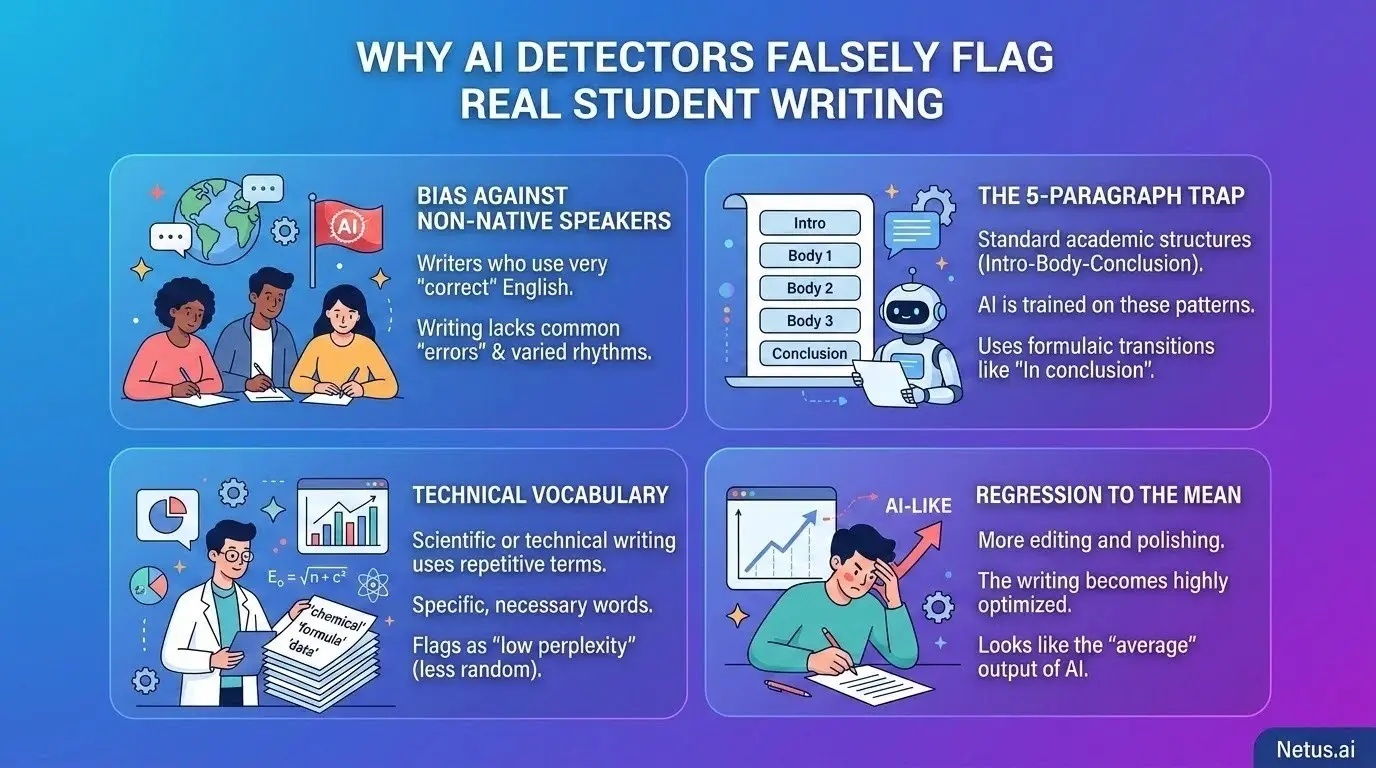
When a human-written essay receives a flag, the tool likely fails due to four inherent biases. These biases include formulaic structures, specialized vocabulary, high polish, and bias against non-native speakers.
Four inherent biases cause detectors to fail:
- Non-Native Speaker Bias: Writers using very "correct" or formulaic English trigger AI flags. Their language lacks the varied rhythms and idiosyncratic "errors" of native speakers.
- The 5-Paragraph Trap: AI trains to produce the standard academic essay structure (Introduction, Body, Conclusion). Formulaic transitions, such as "In conclusion," act as high-probability markers for AI.
- Technical Vocabulary: Scientific writing demands specific, repetitive terminology. Detectors misinterpret this necessary repetition as "low perplexity" AI output.
- Regression to the Mean: Polishing writing to achieve "perfection" makes the text resemble the middle-of-the-road, optimized output of an AI.
Do university policies enable schools to apply AI detection technology to student essays?
As of 2026, legal statutes and university guidelines regarding AI detectors remain unclear. Most colleges do not rely on AI checkers as final evidence for academic plagiarism. For instance, Vanderbilt University disabled the Turnitin AI function in 2023 due to accuracy and fair student treatment concerns.
High AI scores mostly serve as a warning sign for educators, not a final decision. Teachers receive recommendations to start discussions with students after such scores. They look for specific behavioral warning signs, such as an abrupt change in writing style or inability to discuss sources.
What actions should students take if an AI detector flags their essay?
Students should remain calm and gather evidence of their authorship. Scientific reports confirm false positives occur.
- Check other tools: Test your essay with at least three other detectors to confirm if the result repeats.
- Keep drafts: Maintain the editing history as evidence of your work. Always work in Google Docs or Microsoft Word online to record writing and editing steps.
- Arrange discussion: Schedule a talk with your instructor to be proactive. Bring previous copies and research notes to demonstrate your writing process.
- Follow formal process: Use institutional methods to object if the grade stands. Cite research, such as the Stanford investigation, on AI tool mistakes to help your defense.
What methods bypass AI detection and ensure a human-like essay score?
Regardless of initial authorship, ensure your essay reads as unmistakably human. Three primary methods exist to adjust writing patterns to avoid AI detection.
The 3 types of methods include:
- Method 1: Manual Rewriting: Break up long sentences, add personal anecdotes, and vary your vocabulary. This is the most effective but also the most time-consuming.
- Method 2: Using an AI Humanizer: Tools like Netus AI specifically rephrase text. They increase burstiness and perplexity while maintaining original meaning. This method saves significant time compared to manual editing.
- Method 3: The Hybrid Approach: Use a humanizer to establish a "human-like" base. Then, perform a quick manual pass to incorporate specific voices and correct citations.
How do AI detection tools and plagiarism checkers differ?
Users sometimes confuse these two distinct writing analysis systems. Plagiarism checkers search databases for matching phrases, while AI detectors analyze linguistic patterns to infer machine authorship.
- Plagiarism Checker: The tool reviews writing against a large database of academic articles and websites. It searches for groups of matching phrases or words (e.g., Turnitin Classic and Quetext).
- AI Detector: This program uses a language model to guess if AI created the writing. It searches for "patterns" linked to artificial intelligence, rather than looking for matches.
One paper can show zero percent plagiarism and still receive a 100 percent AI-detected score if a user generated all ideas using ChatGPT.
FAQs
Which no-cost AI detection tool ranks as the best for essays?
GPTZero currently functions as the most trustworthy option for student users.
Do AI detectors provide consistently correct analysis for essays?
Average accuracy is 70% to 80% across major tools.
Does Turnitin check ChatGPT-generated content in student essays?
Turnitin implements an AI Writing Indicator though it lacks full accuracy.
Can a professor determine the use of ChatGPT in a student essay?
Professors determine AI use using scores and behavioral warning signs.
Does an AI detector ever incorrectly score a human-written essay?
False positive scores affect 10% to 30% of human-written submissions.
How can students check if their essay appears as AI text?
Students test essay drafts using free tools like GPTZero before submission.
What is the process for addressing a false positive score?
Sharing Google Docs version history provides transparent evidence of human authorship.
Do colleges routinely use AI detection tools?
Many colleges utilize these tools while others cease use due to unfairness.