As AI detection technology gets smarter, it is causing a new problem that nobody really wanted. This issue is that many non-native English writers are being punished unfairly. Many students, professionals around the world, and people creating online content have English as their second language. The detection tools meant to find fake or generated texts confuse human pieces with AI writing even when the text was written by a real person.
This isn’t just a small error. It is coming from a bigger bias that is found deep in the datasets used to teach most AI detectors how to operate. If you have ever felt confused why your English, which you worked hard to write, is being turned down everywhere, this article shares both technical and language reasons why this bias is so irritating and points to the real solution.
Why false flag keeps happening: The limits of training data
Detection tools for AI are mostly trained using enormous collections of texts made by native English speakers. These become “the standard” for sentence formation, phrases, word choice, and idioms that detectors consider normal writing from humans.
A non-native writer, when they write, usually has patterns in language that do not match this default standard. These are not errors, just differences in how second-language learners use English, commonly including:
- Odd phrasing and word partnerships: The combination of words may be a bit incorrect, so the writing may sound unusual to AI detectors, compared to how native speakers usually write.
- Overly improved vocabulary: A non-native writer might pick fancy or rare words learned from translation or dictionaries, which feel too exact or strange for a native English writer.
AI systems see these small changes, proof that a real person is making a big effort crossing the language border, as “not human writing” because they are not part of the narrow view they use from “native English speaker” texts in training.
What happens then: Unfair treatment and loss of personality
There are tough results for this bias in the algorithm.
- Students get accused of plagiarism or copying another person’s work, which is academic misconduct.
- International workers and freelancers get their emails or articles rejected by websites or people who trust these unfair AI detectors.
- Non-native writers are made to rewrite their original words, making them lose their individuality and change their true style just to stop a machine from identifying them as AI, which lowers the work quality.
If you, as a non-native English user, run into these unfair consequences, the solution is not to blindly follow the algorithm’s limited view but to adapt your writing in a way that your natural human style remains clear while you keep your main message. Specialized software tools are truly helpful at this point.
How to win against bias: Useful tools for fair content creation
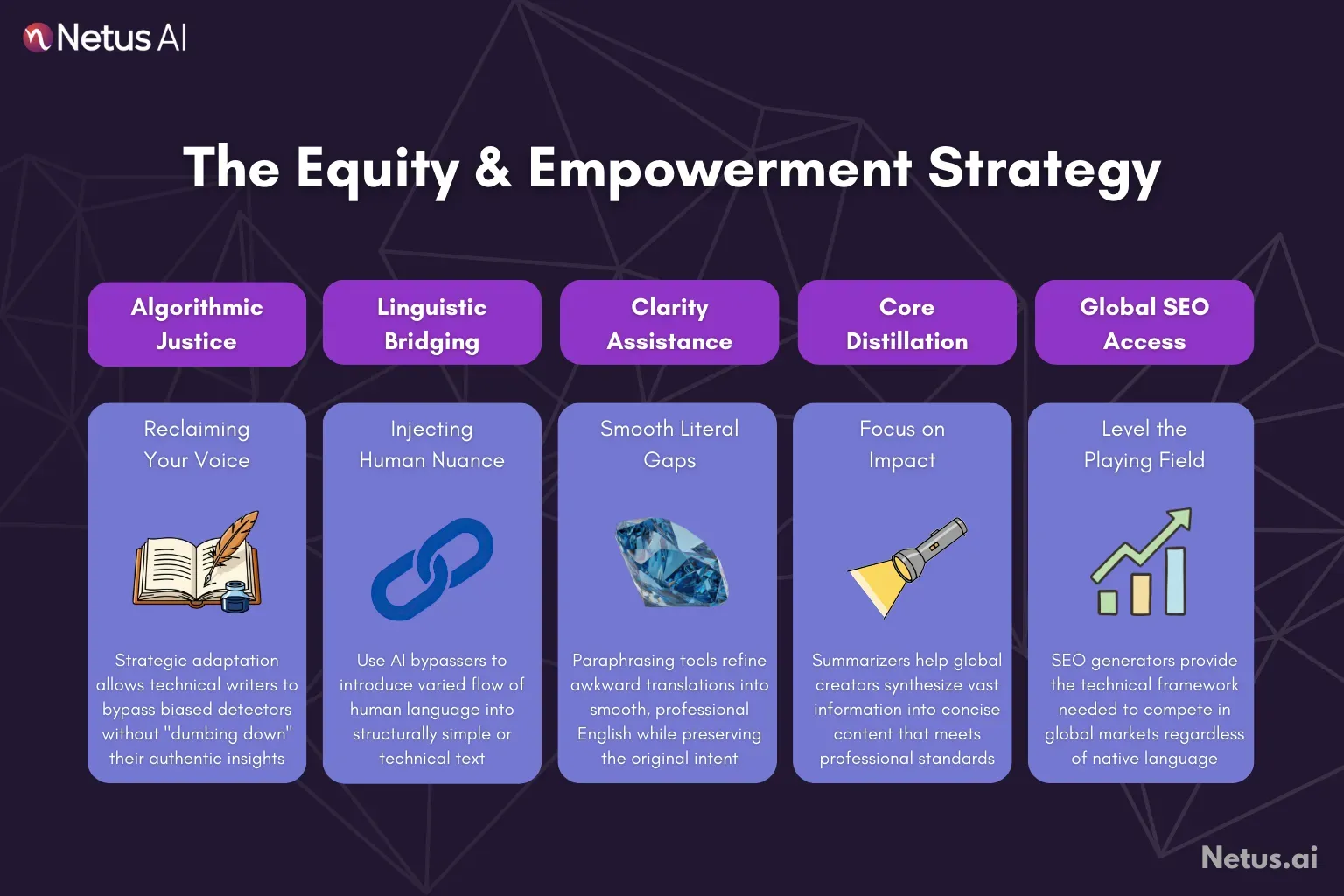
NetusAI gives writers a group of technology tools that do not just hide AI-generated content but uplift all writers, especially second-language English speakers, to create original, clear, and not easily detected writing.
AI bypasser: Bringing back your real voice
The AI bypasser is a must-have for people whose true human-made texts were wrongly tagged as artificial. Unlike basic article spinners, this tool uses new tricks to reform sentence structures and insert more variation in your writing style for a more complex human-like result.
For people writing English as their second language, the AI bypasser changes their plain or strange sentences into versions with “messy” human factors, like starting sentences in new ways, using rhetorical statements, and making the flow of text feel more natural. The original intention, along with vocabulary, stays intact. The tool makes the text appear to detectors as coming from a person and does not require you to copy native speaker styles.
Paraphraser: Making everything clearer
There are times when non-native writers create phrases that sound off or translate too strictly from their native language. The paraphrase tool is an advanced language helper. It helps users make their meaning simple, adjusts sentence flow, and ensures big ideas are explained clearly in natural English while keeping the original meaning untouched. It acts like a link, smoothing awkward phrases that could otherwise cause an AI system to flag the text as “mechanical”.
AI summarization tool: Bringing out the main point
For business or school papers that need to be brief, the AI summarizer lets people who are not native English speakers break down long, difficult articles into core points quickly. This helps a lot when translating or collecting large amounts of information, making the result focused and easier to read, which is sometimes a key demand for serious and sharp writing.
Keyword finder and SEO article creator: Helping global content professionals
Entering the English-language market for content is difficult for non-native writers because the hurdles are two: English writing and SEO mastery.
The keyword extractor finds the top search terms that gather global readers, so your writing can be found more easily. Then, the SEO article generator arranges your article into a structure that matches SEO guidelines, giving non-native writers a blueprint and framework so their human-created pieces are not only easy to understand and honest but also ranking well for searches. This takes away the stress of learning every English SEO detail, letting writers focus on their strengths.
With these tools, non-native English creators do not need to worry about whether their real voice gets lost or mistakenly flagged. Now, the focus turns back to making quality work instead of battling biases in AI detection.
NetusAI: A single platform solution for fair writing
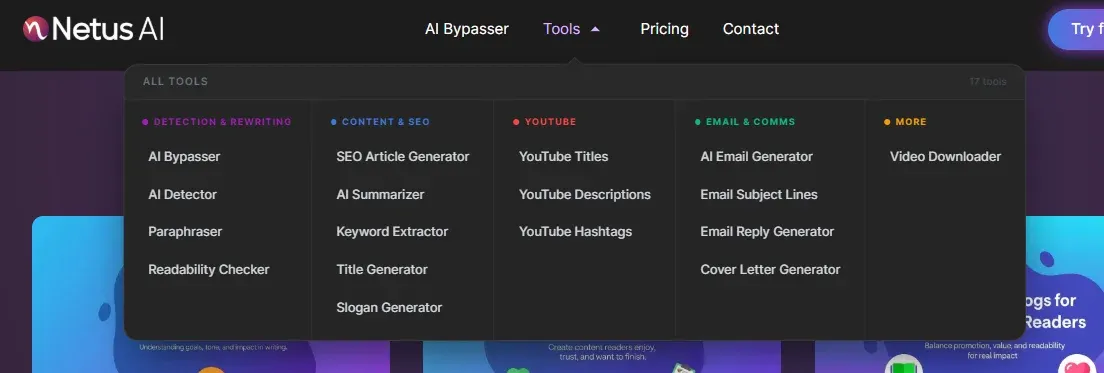
NetusAI offers a collection of writing tools that deal with the struggles non-native English writers face in the current era of AI checking. It does not just provide tools that work independently. NetusAI builds a system where all tools work together for the users.
When all these tools come together, it means a non-native user can use SEO features to organize what they want to write, the Paraphrase feature to make the draft better, and finally, the AI bypasser to ensure their work is recognized by any AI tool as human-written, all using NetusAI. It ensures an equal opportunity standard, so only your talent or understanding counts instead of algorithmic prejudice.
Last comments
The world of AI detection right now mostly judges non-native English writers unfairly and forms a type of online wall that stops millions of skilled people. This is an error of technology and not because your writing is not real or lacks quality.
By choosing effective tools like NetusAI’s AI bypasser and paraphrase tool, people whose first language is not English can do better in this field, find their own way, and make it so their true human effort is seen and appreciated. The main plan is the fair creation of written work, and NetusAI is offering the right equipment for that.
FAQs
Why does my own writing get seen as AI content, although I wrote all of it?
AI detection tools are mostly trained in English from native speakers, creating a very narrow range for what is called "human" writing. So, the natural and honest way non-native speakers construct their sentences, perhaps with basic grammar or atypical word choices, goes outside this range, and that causes the AI to think your text was made by a computer.
How does the NetusAI AI bypasser fix my writing but keep my ideas?
The AI bypasser is made to bring in complicated language and more variety, things that native speakers regularly use, while not changing your key ideas or facts. It moves around words, the way the sentences go, and how the text reads, but not too much, so the AI gets confused but your point stays the same.
Should I use a paraphrase tool or AI bypasser?
If fixing awkwardness, improving flow, and sounding like natural English are most important, choose the paraphrase tool. When your writing is already clear but fails AI checks, it is better to use the AI bypasser. Most writers do both: first paraphrasing, then bypassing to avoid being flagged as AI.
Are these tools good for SEO articles made by non-natives?
Surely. Using keyword extractor with the SEO article generator, non-native people can write content that is good English and is also easy to find on search engines. The AI bypasser will make sure your final text does not get a bad mark for being low-quality content by AI tools. I think these tools are really helpful overall.