In the SEO world, which is changing very rapidly, Artificial Intelligence (AI) for content writing is now widely used. It was just a test at first, but now it is mainstream. AI tools let you produce content quickly, but they also cause a major issue for SEO people: working around Google’s strong "Helpful Content System", which is getting smarter all the time.
SEO professionals must know how to use AI responsibly. Google created the HCS to find and lower the rank of any content, regardless of whether a human or a robot wrote it, that looks as if it were created only to rank high in search results rather than to help real people who visit the webpage.
If your content is labeled "unhelpful," the impact is severe and your entire website becomes less visible. This guide will explain the main ideas and practical steps any SEO expert needs to take to ensure their AI-created articles avoid such penalties, establish authority, and satisfy readers.
Google’s viewpoint about AI content penalties
Google has said it matters less whether a robot or human writes something and more about whether it is helpful, good, or different from other things. Some of the key problems for HCS include:
Low-effort/thin
This is the kind of content that just says well-known things without providing anything new for the reader.
Lacking originality
Looks copied or nearly the same as other pages, or even feels like it’s taken from those pages.
Untrustworthy
Has no real showing of expert power, trust, or real-life experience (E-E-A-T sign).
Misaligned intent
Titles say one thing, but the content is useless or too general and does not answer what you would expect.
A working AI plan needs to make sure these issues are fixed right away; otherwise, you will not succeed.
Main steps for avoiding AI content penalty
Ensuring original and unique text
One easy mistake is just making text with AI that is simple and sounds like lots of other Internet words. That way, your content is seen as low value.
Solution
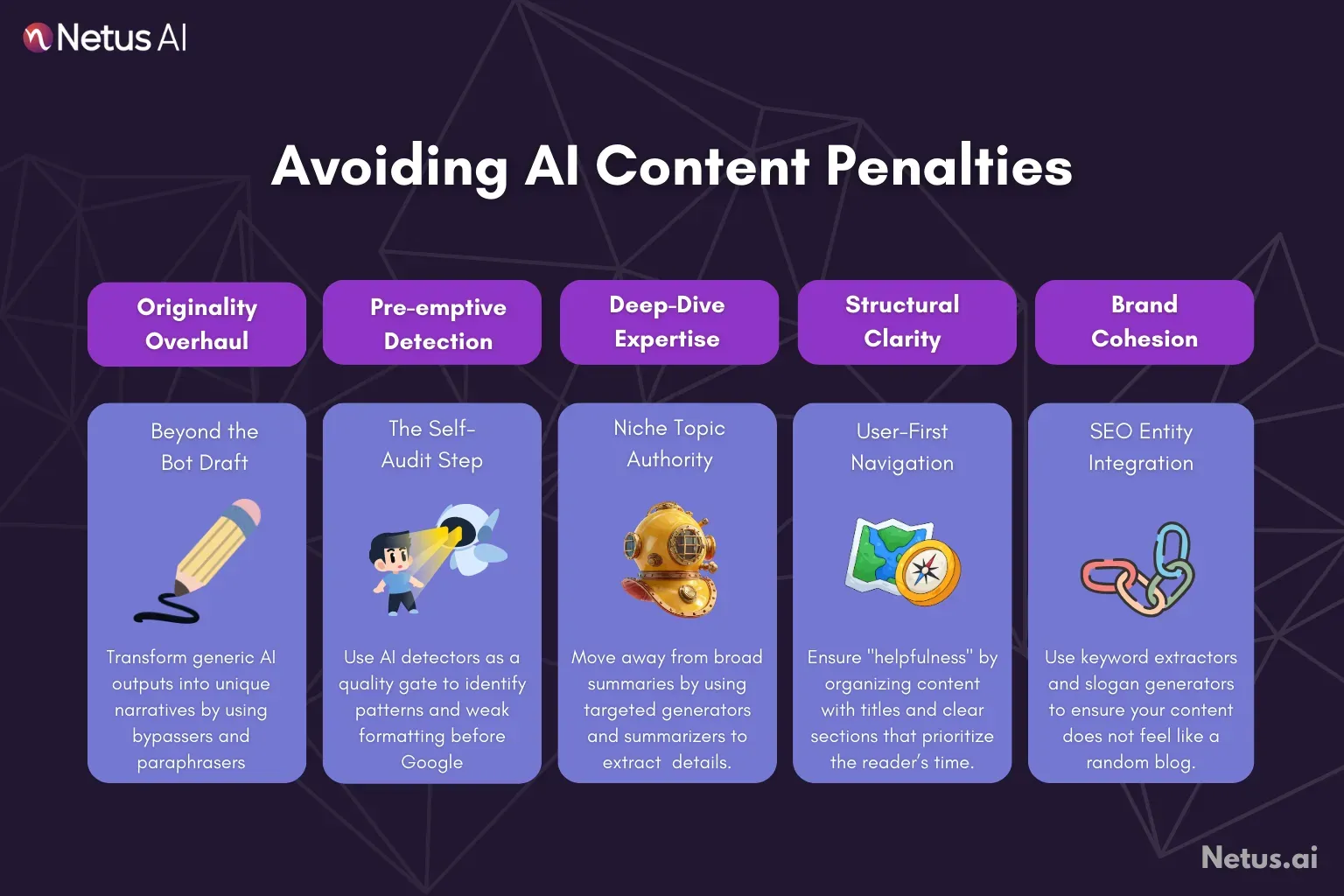
For SEO, treat what AI gives you as a rough idea. Always use some tools. First, after you make your draft, try an AI bypasser tool that carefully changes and organizes your writing. This makes your sentences harder to recognize and more like a person wrote them. The process incorporates your own voice and new ways of saying things.
One more thing is using a paraphrase tool. After you get boring portions, use a paraphraser on them to make parts that sound unique and valuable. When your AI makes a summary of an idea, run a paraphraser so it is accurate, still covering the theme but not sounding like the original, which can trigger flags.
Reducing risk of AI detection
Google claims not to have a clear "AI Detector" for issuing penalties, but HCS nearly does this because it checks if things are written in an obvious AI way. When your site has lots of obvious AI text, it looks like you did not try hard.
Solution
Before you put your writing out, use an AI detector tool on your work. If it says your text is highly machine-generated, it suggests that HCS might think your content is very formula-based. This is where you go back, change parts yourself, and add something special like facts or run it through an AI bypasser again for higher "human" ratings. This self-checking step makes sure you catch weak formats before Google does.
Making real topical expertise
Google wants to reward the experts. AI can write about many topics, but it is often unable to go very deep, and it misses details that show the E-E-A-T.
Solution
When you plan what to write, use a SEO article generator that pushes for long keywords and very detailed section titles. Don’t make a robot write about "digital marketing" in general. Tell it to do the "effect of Core Web Vitals on B2B sales funnels." This style makes your AI (and your editing after) focus more closely on specific and interesting information, not just broad answers.
Another good way is using an AI summarizer for leading articles in your topic. Find important ideas from big, complicated sources and add them into your AI draft. These points can give you deep, useful facts your AI might not have figured out.
Arranging everything for user satisfaction
People or Google do not consider content that is not well-organized helpful. If a person opens your site and is unable to quickly see what they are searching for, they consider your content unhelpful.
Solution
Always make sure the important parts are improved in your post:
- Titles: A strong title with your keywords is a must. Use a title generator to get different versions. Pick one that matches what people want and entices them to click.
- Keywords: AI makes long posts, but it does not always cover all topic parts. Use keyword extractor on the end text so it has every important topic phrase and entity included for full coverage on your theme.
- Branding: For internal links and a consistent message, use slogans generator to create easy-to-remember sentences or selling lines for every subject type. Then, your website feels connected and expert-like, rather than a random blog with many robot-written posts.
NetusAI: An all-in-one platform for smart SEO content
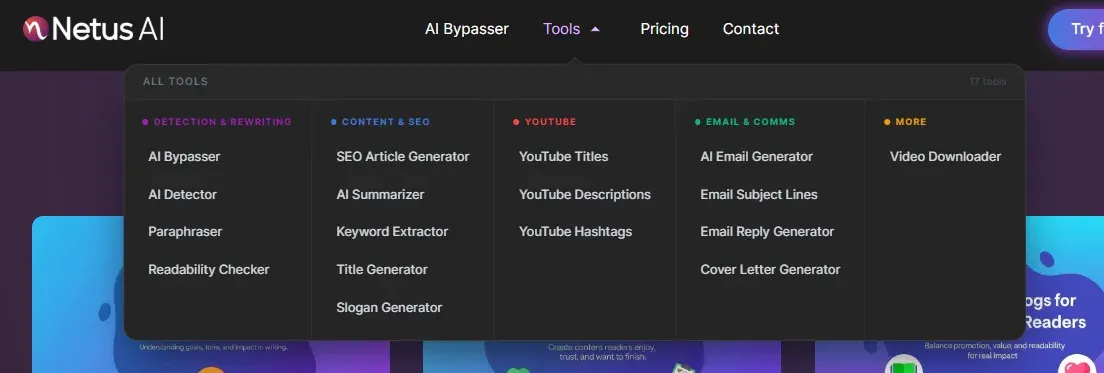
Today, there are many separate tools that SEO workers have to handle, and this can get really hard to manage.
Having a suite of tools in the form of NetusAI is a benefit since it pulls these core functions together so they can be used more easily and smoothly.
They can make sure every writing project fits what Google asks for in being helpful. A set of tools like this makes work much simpler than the old, complicated way where several tools were needed just for checking, editing, or improving AI content.
Closing thoughts
Google’s Helpful Content System was not created only to punish AI but is an improved type of quality control.
The best thing one can do to not be punished is to stop seeing AI as a replacement for actual people. It is smarter to treat AI as a fast tool that can help draft things quickly.
The work of providing expertise, making things original, editing, and staying focused on users is still firmly done by people who know SEO well.
With thoughtful use of tools that check for quality, keep language unique, and make sure the subject is deep enough, a user can use the strength of AI but not get into trouble with Google for it.
FAQ
Does Google review content by hand if it comes from AI?
Google most often uses its own automatic tools, like its Helpful Content System and the main ranking machinery, to look at the quality and helpfulness of content. Sometimes, but only in special situations, people check content by hand, but usually these systems are built strong enough to spot the kinds of patterns that show up in quickly made, low-effort articles, whoever wrote them.
Can you publish AI-written content without human editing?
It is actually very dangerous to do this. Releasing AI content with no human intervention can make it much more likely to trigger the Helpful Content penalty, as this writing misses unique points, keeps using patterns, and fails to fully show E-E-A-T. Human editing and clever use of tools, such as an AI bypasser, are important gates for quality.
How long does it take if I get hit with a Helpful Content penalty?
A site-wide penalty for HCS works as a kind of "recovery signal" and may last months before lifting. Google wants you to show big, lasting changes by either fixing or clearing out anything unhelpful everywhere on your site. The penalty does not end till the system does a new check and says the content overall is now helpful.
Should I check my things with an AI detector before I post?
It is a good idea. Using a detector before others see it helps with risk management. If it marks your text as very AI-typical, then it means you might need to fix the style by using a paraphrasing tool or just change it by hand before Google's HCS finds it; this way, you might avoid getting caught and also improve quality.