
Making a good blog post is about striking a balance. You need to create content that can truly interest readers, provide real value, and demonstrate your authority on the topic.
Also, the blog post must be liked by Google. Getting this combination is what works for content marketing success.
Corrected: Also, the blog post must be liked by Google. Getting this combination is what works for content marketing success.
No spelling, grammar, or punctuation errors found.
This instruction comes from an SEO expert’s point of view and shows how you can create blog posts that achieve good rankings and attract readers who convert.
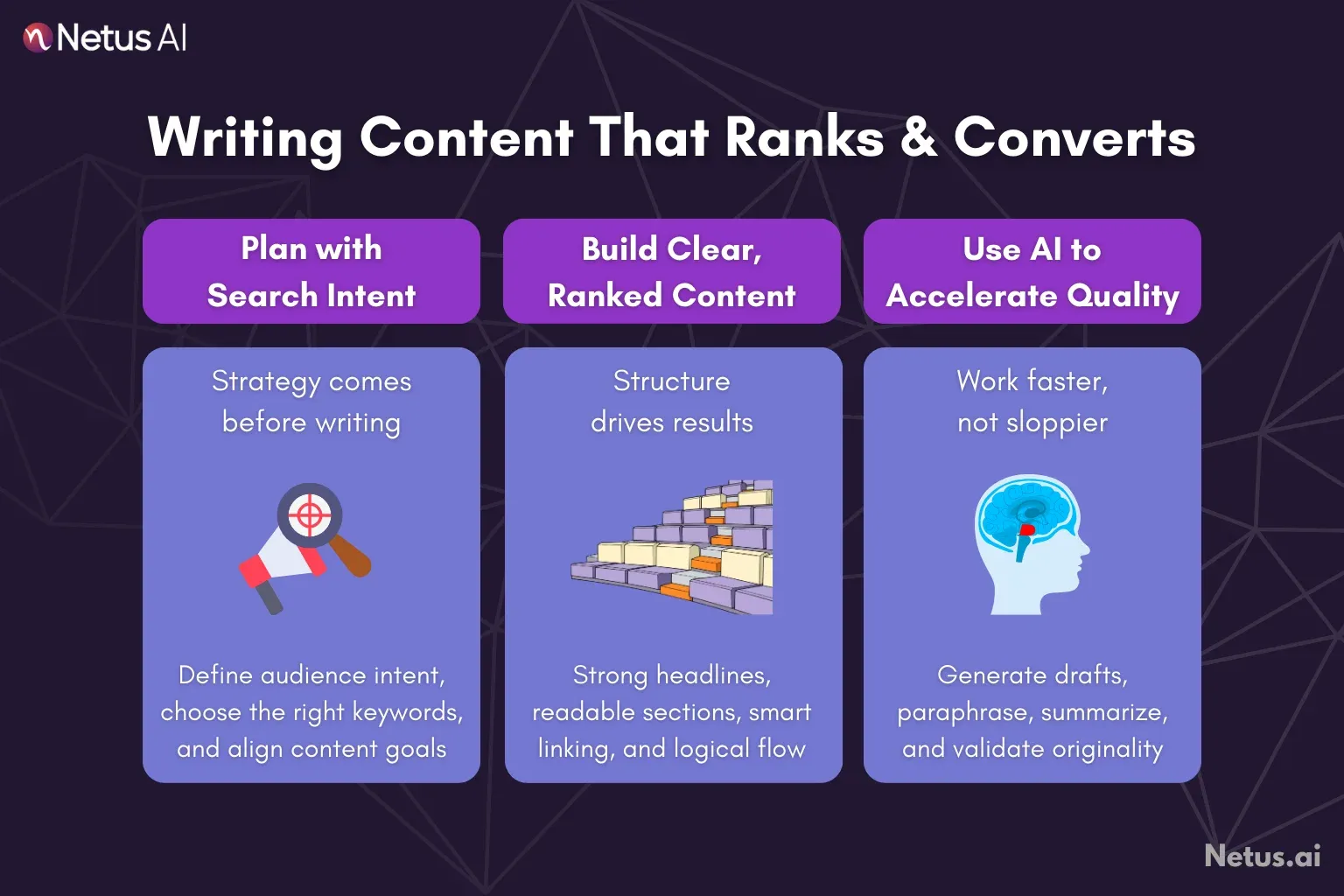
Planning as a base: Focusing on search intent
Before opening your writing program, it is necessary to decide on your content strategy. All the words you use should align with a certain search intention.
Knowing your audience and their goals
Who do you actually write for? What type of question do they want answered, and is there a problem that they want to deal with?
Informational purpose
The person reading is searching for an answer to a specific question (for example, "What is technical SEO?"). In this case, your article should provide a full and comprehensive explanation.
Navigational purpose
This person wants to reach a certain website or web page (like "NetusAI login"). Here, your own blog post is not always the main thing; however, branded words can still have meaning.
The purpose of the commercial probe
A user is studying a certain service or product (such as "best content marketing tools"). The post should provide a comparison, feedback, and explain the positives and negatives.
Transactional purpose
The reader is about ready to make a purchase or begin an action (for instance, "buy SEO article generator subscription"). The blog should have a straightforward call to action (CTA) and truly convincing writing.
Doing keyword research: The basis for SEO
Your blog post needs to revolve around one main keyword and other secondary keywords that are also useful. Use different tools to find keywords with a large search volume that are not too hard to rank for.
Main keyword usage
Put your main keyword in the heading, meta description, URL, and in the first approximately 100 words. Semantic Keywords (LSI): Google pays attention to the whole subject, not only to repeating the same word.
Using connected words enriches the text for Google (e.g., for "blog writing," related terms are "content creation," "SEO optimization," "reader engagement," and "content strategy").
Creating good content that also ranks well
If you have already planned things, now the writing stage starts. You need to pay attention to structure, make things clear, and build your authority.
Headlines and the first paragraph are important
The top headline is one of the most important SEO features and is also used to attract the reader. Make use of power words or numbers, but mainly make sure that the headline answers search intent.
The intro should grab the audience’s attention quickly and show them they’ve found the right place. State the main problem, promise a solution, and also use your primary keyword.
Organized and easy-to-read body
For SEO, your organizational style matters. For human readers, it is all about how clear it is.
Add tables and formatted text to show information, lists, and the necessary step-by-step process. This allows the search engine (Google) to understand more easily and helps readers pick out the main ideas quickly.
Improve reading experience and logic
High time spent reading and fewer people leaving quickly are key for SEO results. So, to keep readers staying:
Write paragraphs not longer than 3 to 4 sentences. Simple and clear language is necessary. Do linking inside your posts.
Using AI for better and quicker results
Even top SEO practitioners require tools that help them write more quickly. These days, AI is not just a fashion but also improves productivity.
When you cannot write easily, have little time, or need to create more posts rapidly, using AI tools is a main solution.
Tools for fast content making and boosting
For building long, SEO-correct blog drafts quickly, you can try an SEO article generator. Such tools use the target keyword and produce a good structure in the first copy, so you do not waste time on outlines and base writing.
Tools for getting past writing difficulties
There are moments when you must re-use older information or change content from other places but still be unique.
Rather than rewriting everything yourself, paraphrase tools are helpful for changing text very quickly while keeping a similar meaning and ensuring the post is fresh and not copied. This is useful if you adapt content for multiple platforms or update old blogs.
Tools for faster content improvement
When dealing with very big studies, interviews, or research papers, it takes time to get the important meaning. With an AI summarizer, you can squeeze big articles into useful main ideas and conclusions.
From this, you can quickly take the best pieces to use so that your blogs have useful points and do not repeat unnecessary words.
Tools for checking after writing is done
Because more AI writing exists now, keeping the human feeling is key to showing true experience and trust to readers (E-E-A-T: Experience, Expertise, Authority, Trust). If you write using AI, an AI bypasser or AI detector helps a lot.
If you check your writing using these, you can ensure your finished post has a more natural flow and is not marked as plain or 100 percent AI text, which maintains quality and boosts search engine reputation.
NetusAI: The all-in-one way for content
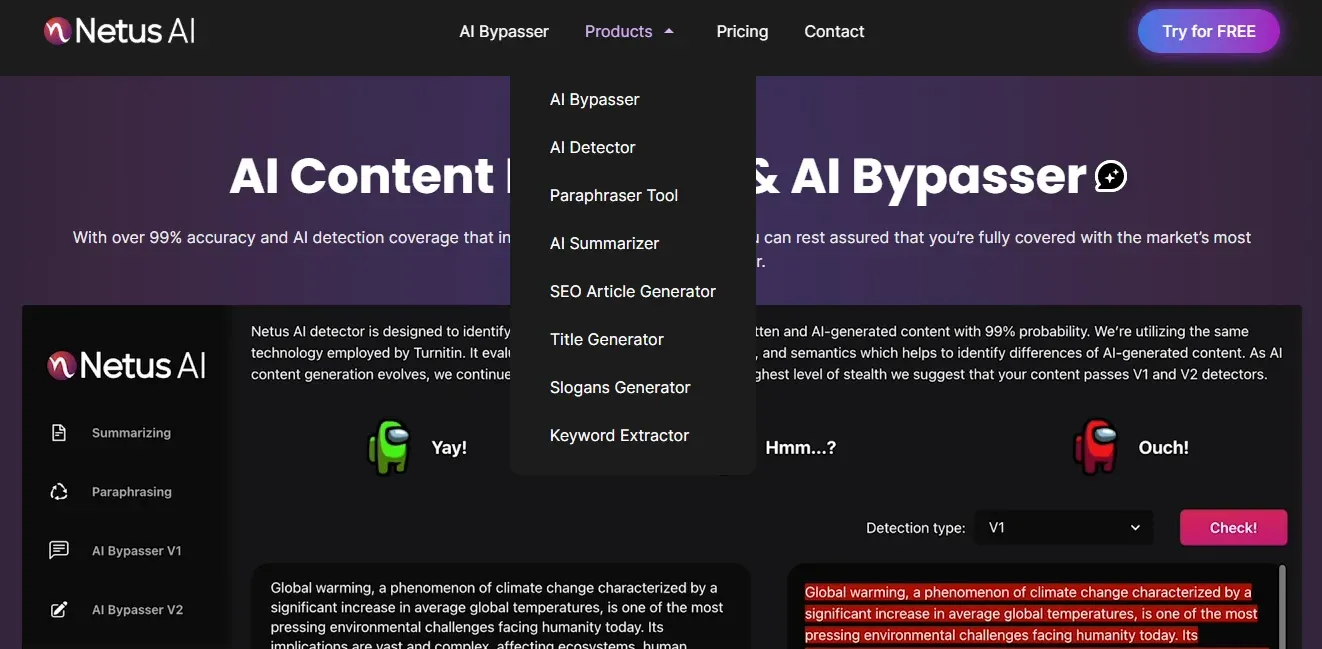
NetusAI is a platform that provides many tools, including a Paraphrase Tool, AI Summarizer, SEO Article Maker, AI Detector, and an AI Bypasser.
It solves the troubles of content marketers along with SEO experts who have to keep up with quality, make things large, and also work efficiently. The system controls the complete steps for content, starting with extracting keywords, then writing, going through improvement and optimization, and finally testing for originality as well as quality.
What NetusAI does is put all these AI-based essential tools together, so it becomes the only place you need to go for content.
Conclusion
To create blogs that satisfy both what marketing wants and what readers expect, you need to keep working on and improving them. Additionally, you should use a smart strategy and continue trying new tools.
Always think of readers first; when a blog truly helps or provides entertainment, signals will naturally follow (lower bounce rate, people staying longer, content being shared on social media), which will improve the SEO performance of the blog content.
FAQs
How regularly should new blog content be posted for SEO reasons?
It is much more about keeping consistency, not only about putting up massive numbers of posts. Go for a schedule you think you can maintain, whether it is each week or maybe every month. Google likes it when sites are updated often. Usually, if you post more, there is a greater chance to use target keywords and increase reputation, but you should not give up on quality just to have more quantity.
Is keyword stuffing working for SEO in today’s time?
Definitely not. When you put too many keywords, that means crowding a word many times in a forced or weird way, it is no longer a good thing and can also make Google give your site penalties. You should use normal types of language and make sure what you write has relevance to meaning. If a keyword does not fit, you must take it out. Have your main keyword in strong places, while you put related words across the post.
What blog length should I pick if I want good SEO?
How long to write depends on the topic and what people search for. For topics that are complicated and have very big competition on Google (usually informational ones), long articles that exceed 2,000 words usually do well, as these have a lot more information. If the subject is simple or aimed at smaller commercial keywords, sometimes 500 to 1,000 words is enough. What really matters is that the article just needs to be enough to fully answer whoever is searching.
What ways do internal links increase my blog’s ranking?
Internal links do two things for SEO. First, these links help the search bots of Google move and find extra pages on the site, then send “link juice” (which means ranking value). Second, they help people reading to go to similar or more helpful content, stay longer, and make the bounce rate fall, which is a good thing for rankings.
Should I spend time improving old blogs or is new content more important?
To refresh and update old blogs, sometimes called “content pruning” or “reoptimization” really works well. If you have a blog post from before that is ranking quite well but can be made even better, updating the statistics or fixing the writing, adding other parts, or even changing a main keyword to match new trends can really help the post perform much better and usually takes less effort than starting by making a whole new article.