AI summarization uses AI, typically large language models (LLMs), to condense large data (text, audio, video) into a shorter, coherent form while retaining core information.
Pros of AI summarization
AI summarization benefits include:
- Time saving: Reduces time for both readers (processing information) and creators (repurposing content).
- Easier consumption: Allows consumption of large amounts of text beyond human limitations.
- Consistent delivery: Ensures uniform structure and quality, eliminating human variance.
- High accuracy: An easy, grounded task for modern LLMs, based on existing, accurate text.
Cons of AI summarization
Challenges of AI summarization include:
- Misinterpretation/ misleading context
- Factual errors ("hallucination")
- Loss of important detail
- Potential for bias
- Limited creativity
How does AI summarization work?
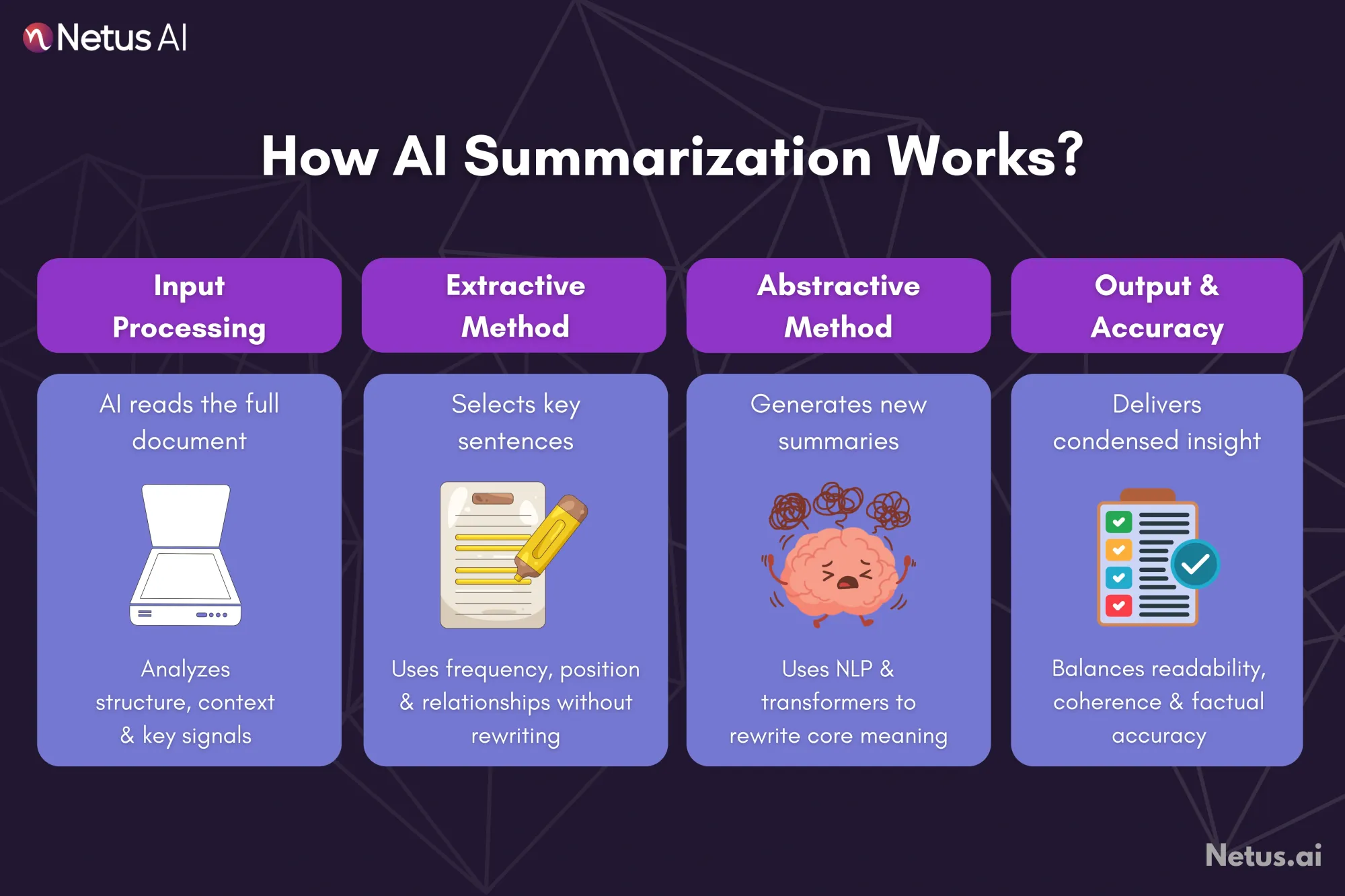
Extractive summarization
Extractive summarization selects important parts (key phrases, sentences) based on algorithms (like word frequency or placement) and combines them without alteration, maintaining faithfulness to the original.
While sometimes disjointed, it is efficient for large documents.
Abstractive summarization
Abstractive summarization uses advanced NLP and deep learning models like transformers to create fluent, human-like, original sentences. Unlike extractive methods, it captures the main points, resulting in more readable summaries.
However, challenges exist with accuracy, as the model may invent facts, particularly with complex source texts.
The evolution of summarization algorithms: From traditional ML to LLMs
Summarization algorithms have evolved significantly: from early rule-based methods (1950s-1990s) and statistical approaches like TF-IDF (late 1990s), to the deep learning revolution of the 2010s (Seq2Seq, BERT, GPT).
Since 2018, Pre-Trained Language Models (e.g., GPT-4, Gemini) have generated high-quality, coherent summaries with minimal effort.
Key use cases for AI summarization
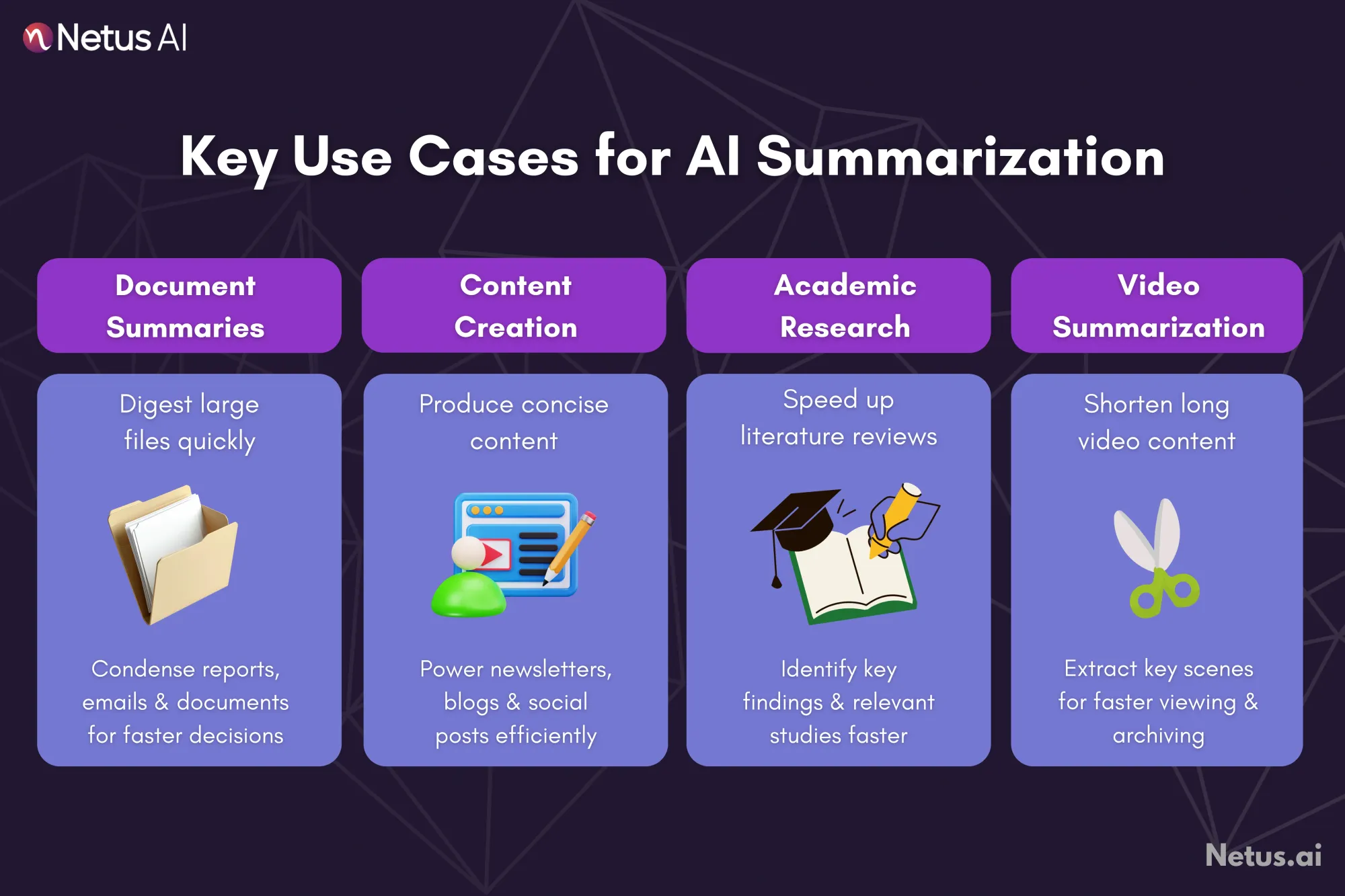
Here are some of the main uses of AI summarization.
Document summarization
AI summarization condenses corporate reports, emails and documents, helping managers and executives quickly digest high volumes of information. This facilitates faster, more informed decision-making by providing critical aspects quickly.
Content generation
AI summarizers create concise content for newsletters, reports or web. In marketing, they produce engaging social media posts, maintaining key messages and boosting productivity.
Academic research
AI summarization aids academic researchers by quickly identifying relevant studies and essential findings, thus streamlining literature reviews, improving knowledge synthesis and increasing productivity.
Video summarization
AI video summarization automatically creates brief versions of long videos by compiling key scenes. Useful in media, entertainment and surveillance, these summaries save viewing time and aid in quick archiving and retrieval.
Key features of AI summarization tools
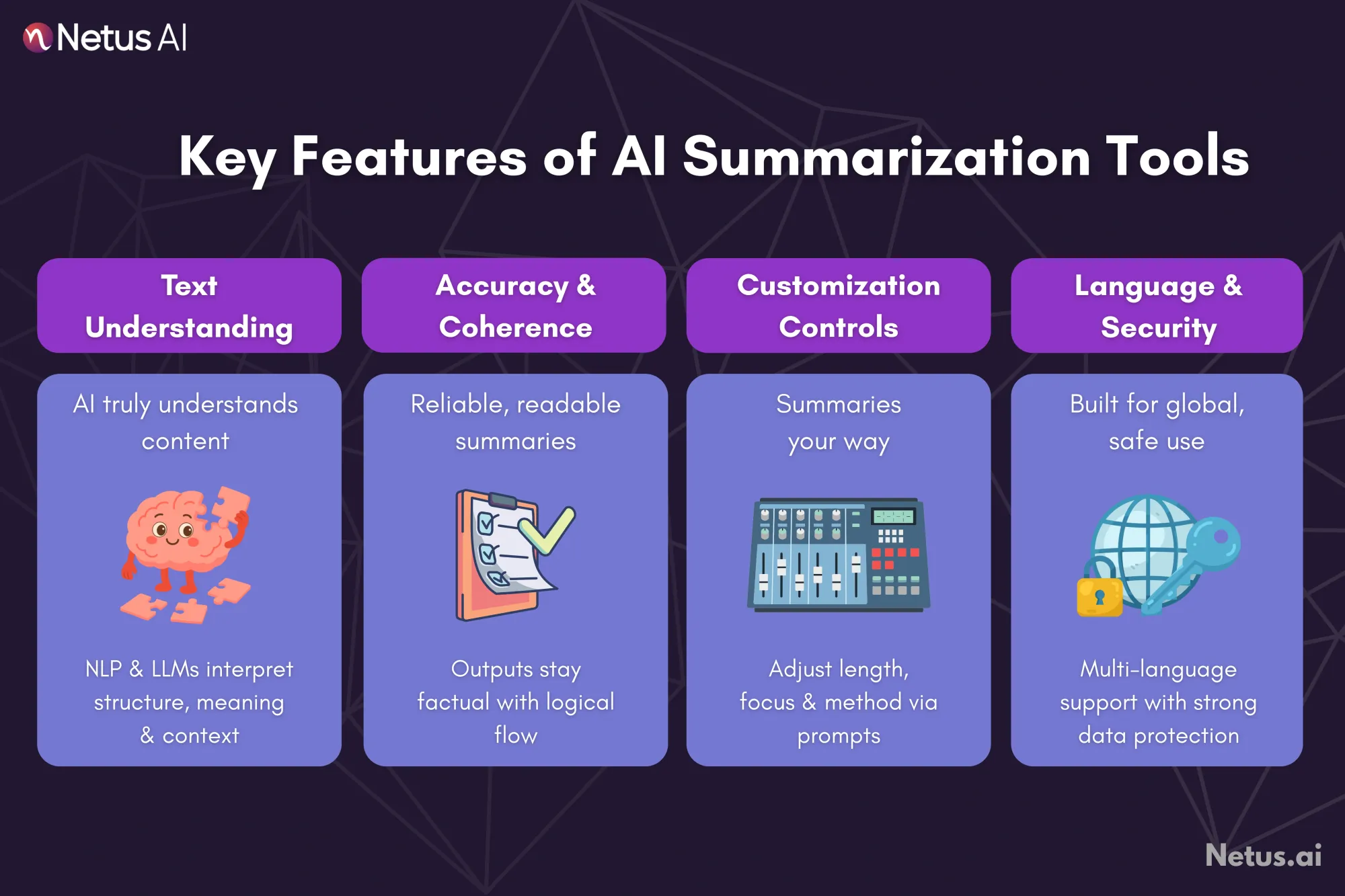
AI summarizers typical offer the following capabilities:
The core features of modern AI summarization systems include:
- Text understanding (NLP/LLMs):
These systems use advanced NLP, specifically Large Language Models (LLMs), for deep text comprehension. They interpret structure, semantics and syntax with near-human accuracy. - Accuracy and coherence: A critical measure of any AI summarization tool's effectiveness is the factual correctness (accuracy) and logical flow (coherence) of its output. These systems are engineered to produce summaries that are reliable and easy to read.
- Customization options:
Users can customize summaries with options like adjusting length, defining focus areas and choosing summarization methods (extractive or abstractive). Modern LLMs also accept detailed natural language prompts to control the summary's content. - Multi-language support:
For a global user base, many AI summarization tools offer multi-language support. This is achieved by training models on large, language-diverse datasets, allowing summaries to be generated in various languages. - Security and privacy:
Robust security and privacy measures, including advanced protocols, are essential to ensure the integrity and confidentiality of potentially sensitive data processed by these tools.
5 Tips for using AI Summarizer tools
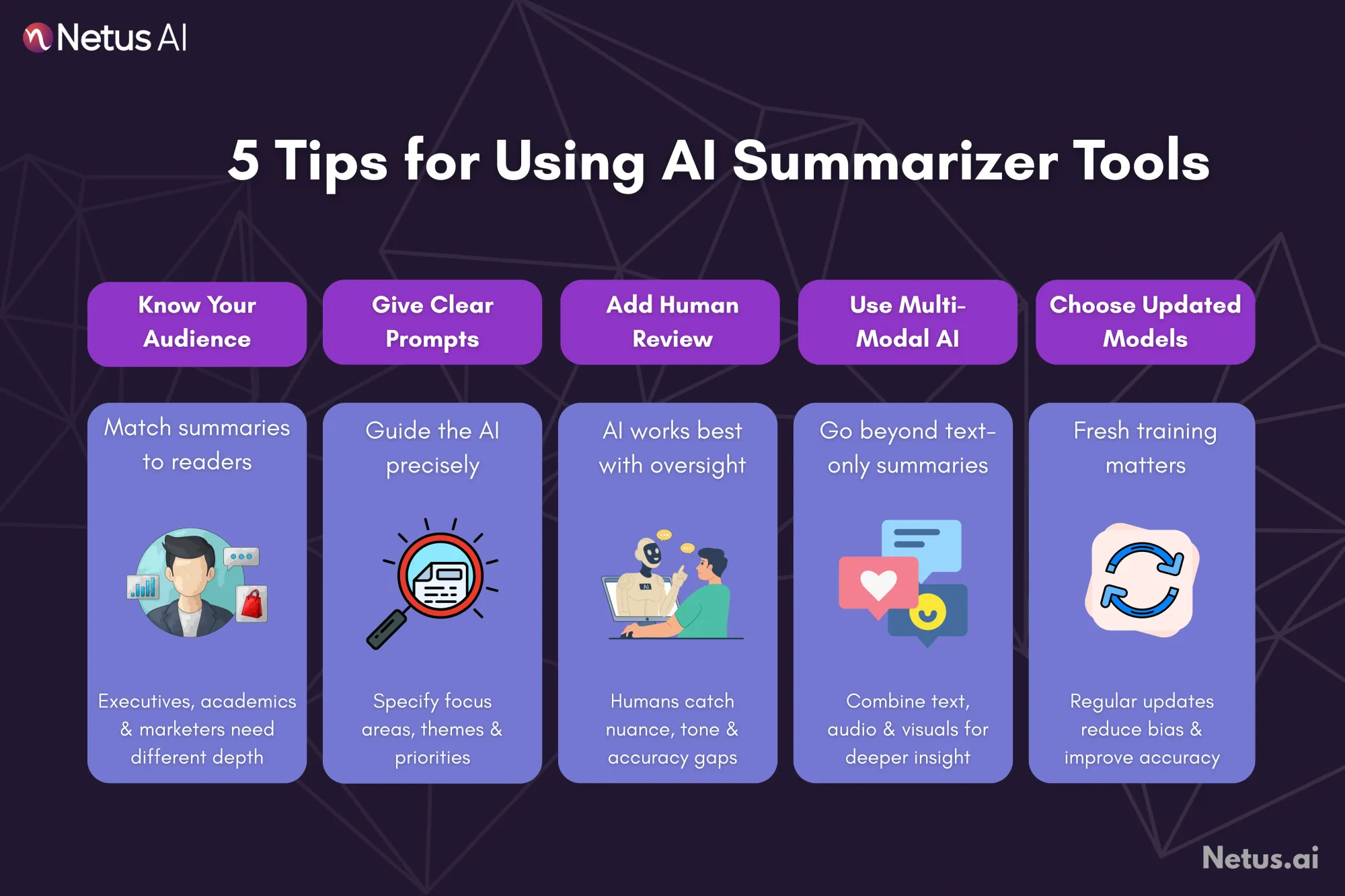
Here are some best practices to make the most of AI summarizers.
1. Adapt the summary to the audience
Tailor AI summarization to the audience. Executive summaries need decision-critical insights, while academic summaries require methodological and contextual detail. Different audiences necessitate varied approaches for the same source material.
2. Provide clear instructions
To ensure AI summarization meets user needs, provide clear, precise instructions detailing the desired emphasis, themes or data points.
3. Combine AI with human oversight
Integrate human oversight for AI summarization, especially in nuanced areas, to ensure quality, understanding and standard alignment.
4. Use multi-modal summarization for enhanced understanding
Multi-modal summarization (text, audio, visual) provides a richer, comprehensive understanding, especially for videos, webinars or meetings. Integrating these modalities boosts summary relevance and depth.
5. Use AI models that are regularly updated and trained
To ensure effective, accurate and unbiased summaries, AI summarization tools need continuous updates and retraining with the latest NLP and data. Organizations should utilize state-of-the-art tools for optimal performance.
NetusAI summarizer: A highly customizable tool
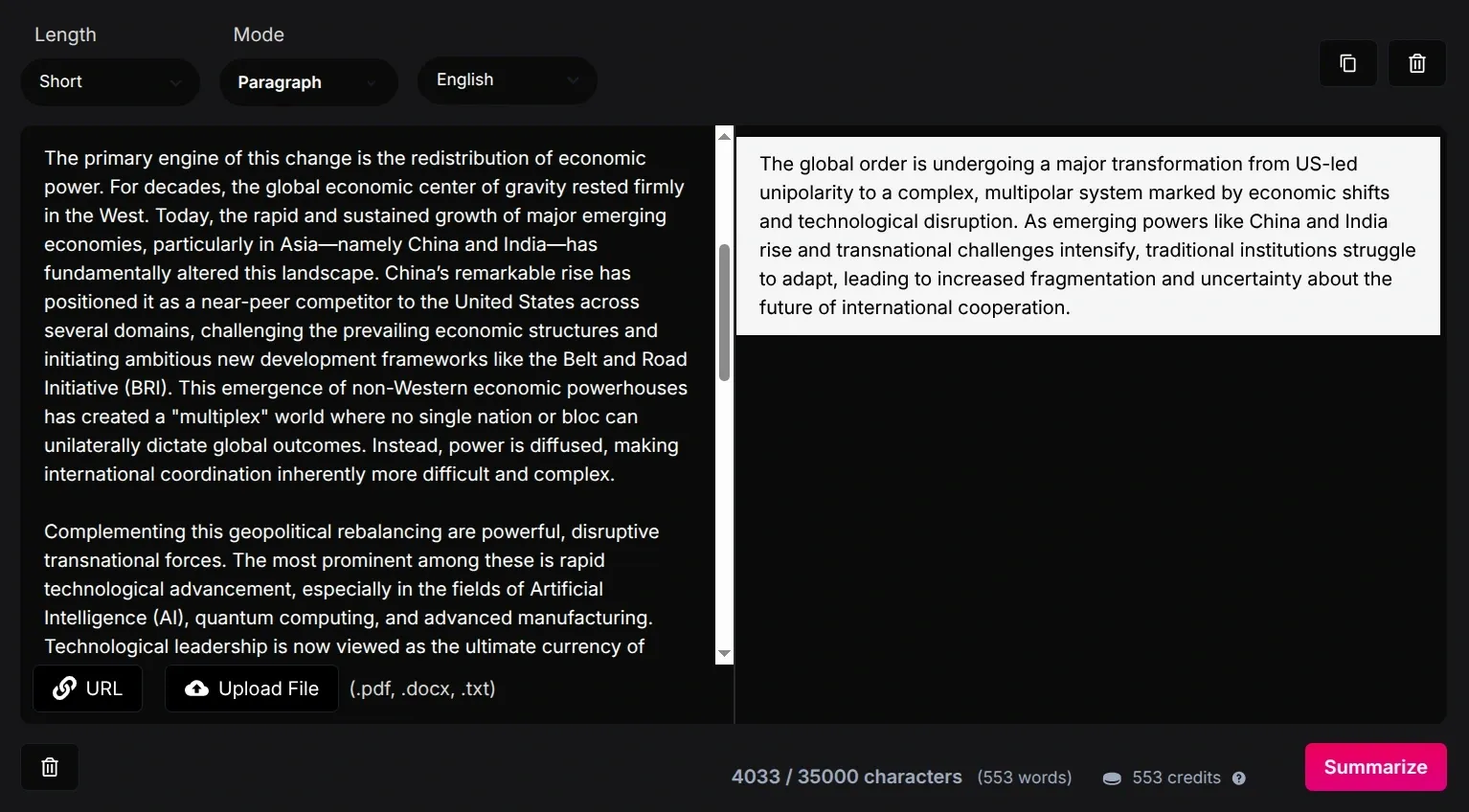
The NetusAI Summarizer is a versatile, intelligent tool for generating clear, concise and customized summaries from any content. It aligns with best practices for AI summarization through robust features:
- Customization: Users control summary length (short, medium, long) and format (paragraph/bullet points) and can provide custom summarization instructions (e.g., tone, focus) to adapt the output for specific audiences and intent.
- Flexible Input: It accepts pasted text, file uploads (PDF, DOCX, TXT) and web page URLs.
- Global Support: Offers multi-language support for over 36 major languages.
- Wide Applicability: It addresses targeted use cases for students, researchers, writers and executives, proving valuable for time saving and faster, informed decision-making.
Final thoughts
AI summarization seems like a pretty important thing these days. It uses these advanced LLMs and abstractive methods to handle all that huge amount of data out there.
The benefits are pretty clear. It saves a ton of time, makes it easier to take in info without getting overwhelmed and keeps things consistent somehow.
Things like the NetusAI Summarizer tool, they really highlight this idea of getting into fine details with customization, you know and how integrating it all lets people shift away from just basic summaries. It moves into more advanced stuff, like generating content or pulling together information in smarter ways.
FAQs
What is AI summarization?
AI summarization basically relies on these big things called Large Language Models or LLMs for short. They take all this huge amount of text or even audio and video stuff and make it way shorter while keeping the main points. It seems like it tries to stay coherent too, you know, so it doesn't lose the important bits.
What are the two main types of AI summarization?
There are basically two kinds of AI summarization.
One is extractive, which just picks out important phrases or sentences straight from the original text. It uses some algorithms to do that. The other type is abstractive. This one creates brand new sentences that sound more natural, like how a person would write. It relies on advanced natural language processing to get the main ideas across, capturing the semantic stuff without copying directly.
What are the primary benefits of using AI summarization tools?
One thing that stands out is how it saves time, for readers and the people creating the content too. That seems pretty useful. Then there's the way it helps with big amounts of text, making consuming them not so overwhelming. And for a task like this one that's grounded, the accuracy feels high, sort of reliable without much hassle.
What are the risks or challenges associated with AI summarization?
There are a few challenges that come up. Misinterpretation is one or maybe misleading context, it kind of depends on how you look at it. Factual errors happen too, like when things get hallucinated or whatever that means exactly. Loss of detail is another issue, it feels like important parts just slip away sometimes.
How does the NetusAI Summarizer align with best practices?
The NetusAI Summarizer offers customization options (length/format), Custom Summarization Instructions for user-intent alignment and Integration with other NetusAI Tools (like the Paraphraser) for human-like refinement.