By 2026, Google's algorithms will have become more advanced and will prioritize content that demonstrates real human experiences. While AI can provide structural support, ranking will require “a human soul”, elements such as direct insight, special subject-matter expertise, and author authority that AI systems are unable to produce.
Google's E-E-A-T framework (Experience, Expertise, Authoritativeness, Trustworthiness)
The E-E-A-T model is very important to Google’s Search Quality Rater Guidelines. Since they included “Experience” in 2022, the guidelines are now not just about how correct the information is but also more about whether the source can be trusted. Experience actually means direct contact or interaction with a product or service.
This aspect helps to deal with too much AI-created material; for example, even though a language model is able to say technical things about an expensive camera, it does not explain how the shutter button actually feels when touched or how low-light effects act when taking photos in rainy city areas. The “Expertise” part is about if the person who makes the content knows a lot officially.
“Authoritativeness” refers to their reputation and how the website is known, while “Trustworthiness” is the highest standard for whether they are reliable and open. If your writing is based on such real experiences, your brand can stand out from basic AI content in search results. This new approach makes content special and not just ordinary.
Why does pure AI content fail E-E-A-T by default?
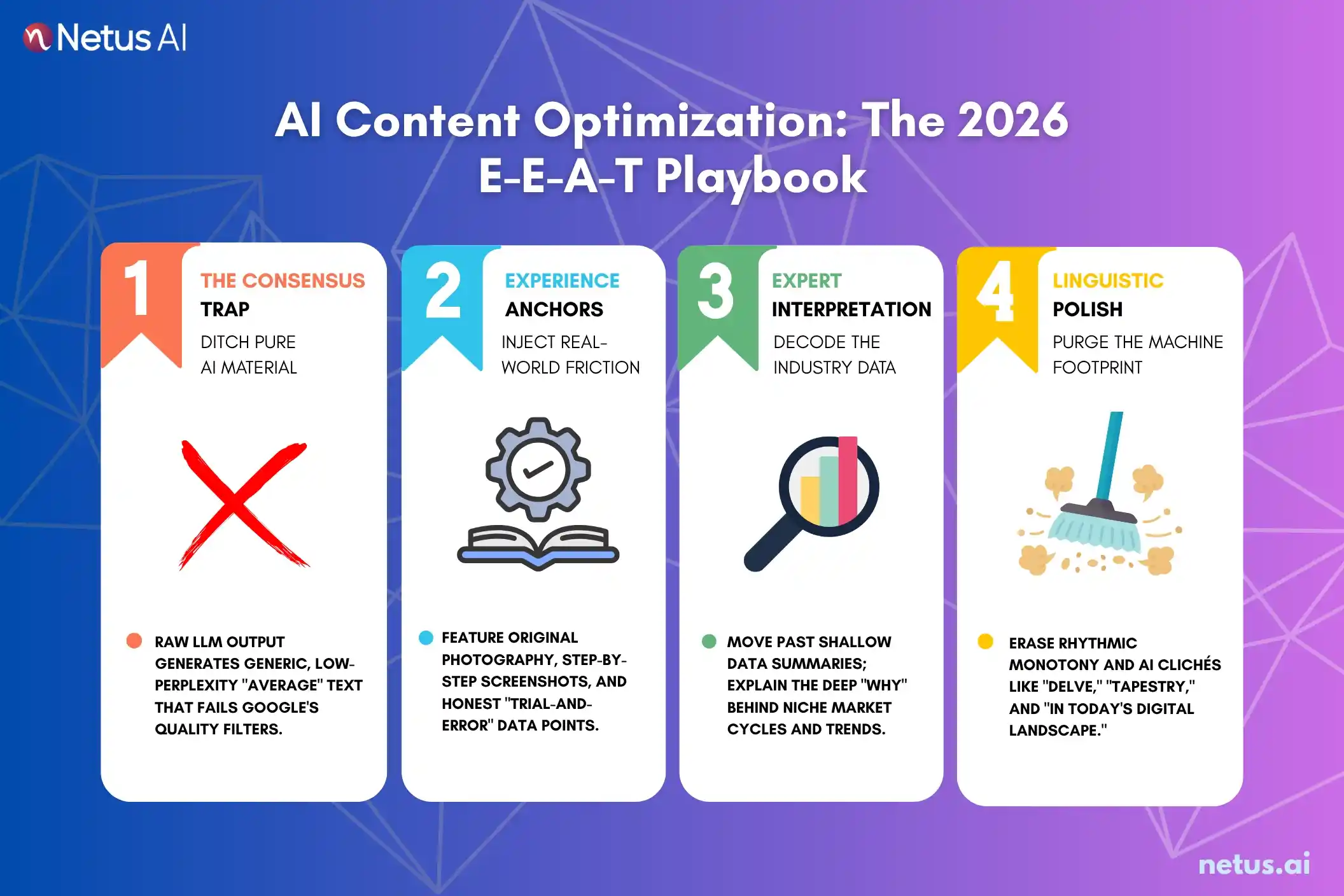
Pure AI-generated content regularly ends up being average. Because Large Language Models use training data to guess the next word, they tend to create texts which show "consensus averaging"; this makes ideas less sharp and prevents anything bold or pushing the limits. Plus, LLMs can make "hallucinations", where they display made-up facts or references as though they are valid because their method is based on probability.
Usually, AI does not have its own 'Experience,' since it has not handled real tools or felt feelings before. If people do not influence the content, AI content misses out on complex cues to show 'Expertise' or to build up 'Trustworthiness'. This can result in a poor search ranking.
Being aware of these actual technical limits is the first move for a content strategy with more strength and focus on humanity.
The "AI base + human soul" approach
The current approach to content pays attention to doing things fast while keeping quality high. Artificial intelligence works as a foundation that manages the outline, first-stage research, and forming basic drafts. Next, you are supposed to add the human element by putting in unique findings, different opinions, and sometimes your own stories. With this combined way, you do not get only random facts; you have a message that connects with people and fits what gets searched.
This organized combination lets you make more content but keep the expert feel that people and systems want.
Adding experience to AI content
To meet what is needed for the experience pillar, the content should be demonstrated instead of only explained. That means having original photos or screenshots that show the product being used.
Write a long description of special difficulties faced while doing the process. Results that are personal, data details, or inside things should also be included. But not just these visible items; there should be attention to "narrative friction" too, which refers to telling about special obstacles, errors, or trial-and-error experiences. AI possibly does not have those. If you write about a project that did not work and discuss why, it adds more honesty than only perfect writing can give.
Letting things be less organized when sharing experiences changes plain facts into learning material that feels alive. You know, it kind of makes the story more relatable and real.
Adding expertise (subject-matter signals)
Expertise can be shown by having deeper analytical thinking. Not by giving general tips, but by offering technical insights that only real industry people would have. It is essential your task is to interpret industry lingo and data, not only to summarize it. For example, avoid saying "conversion rates improved 5 percent." It is better to clarify what this improvement means for general market cycles or talk about how a technical change, like in a platform’s API, forced a shift. You must use proper terminology in the field and mention context that artificial intelligence would possibly overlook, such as the original development of a certain method, or what some relevant side trends are in a specific niche sector.
Interpreting expertise bridges credibility for the requirements of readers in practical ways.
Adding authoritativeness (links, citations, author signals)
Connect your writing to a bigger knowledge web to get more authority. Use references from credible sources, put in links to studies that are peer-reviewed, and keep a strong author biography with qualifications and work history.
The links, both inside your site and going outside, need to be used like a digital trace showing your information is supported by organizations people know. When you put this kind of trail online, your company is seen as a trusted part of the sector's network.
Adding trustworthiness (transparency, accuracy)
Trust can easily be broken. Double-checking every AI-created statistic with original sources is important. You should put up obvious contact details, make your privacy policy visible, and explain precisely the role of the AI in making the content. To be accurate in 2026, it must be more than correctness; it should be about showing proof.
When doing transparent checking, every number must have a citation and even include links to PDF documents or government portals.
Keeping this much openness is needed if you want occasional visitors to become loyal and regular readers.
The humanization layer that ties it together
The last part is tone and voice. When you work over AI drafts, take out repeating phrases and those certain "AI-isms" that make it obvious the text is from artificial generation. To improve your writing, you should cut out pieces like: "In today's digital landscape," "It is important to note," or "To sum up, it is clear that," plus words such as "delve," "mix," or "unlock the potential." An article by humans needs to sound like a chat between two people, where sentence lengths change and rhythm moves readers forward.
Improving how your content looks and sounds makes your main idea stand out without it being lost in artificial habits.
Case studies and templates
Real-life application shows E-E-A-T in action the most. We looked at multiple SaaS blogs that gained organic traffic of up to 40 percent after switching from using only AI writing to a "hybrid" style. The templates require writers to include "Personal Insight" sections in their articles every 500 words so there is always a human element throughout longer pillar content.
These examples work as a main roadmap on how to use these ideas in any content category.
FAQs
Does Google penalize AI content?
No, it penalizes low-quality content that lacks E-E-A-T, regardless of how it was produced.
What is the most important E-E-A-T pillar?
Trustworthiness is considered the most critical, as it encompasses the other three.
How do I show 'Experience'?
By using first-person pronouns and sharing personal findings.
Can AI detect humanization?
Search engines use classifiers to detect patterns, but human value is the target metric.
How much human editing is needed?
Typically, a 20-30% human intervention rate is sufficient for quality.
Should I disclose AI use?
Transparency is a key part of 'Trustworthiness'; a disclaimer is recommended.
How does 2026 SEO differ from 2024?
The bar for 'Experience' is significantly higher due to the volume of AI noise.
Is author authority still relevant?
Yes, a proven track record is a major ranking signal.
Do citations help with AI content?
Yes, they provide the 'Authoritativeness' AI often lacks.
What is a "human soul" in content?
It is the subjective, emotional, and lived experience that algorithms can't simulate.
Addressing these common concerns provides the clarity needed to fully commit to a high-E-E-A-T content strategy.