From giving recommendations tailored to individuals to machines making decisions instead of people, AI is changing how things work in society. Even so, with this much power come significant moral and social responsibilities. Responsible AI (RAI) is designed to address these issues.
Simply put, Responsible AI is the name for a set of ideas to develop, manage, and control AI agents in ways that are ethical, open, and just, and so that those who make it can be held responsible. RAI is not only about building advanced technology; it is about making machines that do good for populations and minimize damage as much as possible.
The 5 pillars of Responsible AI
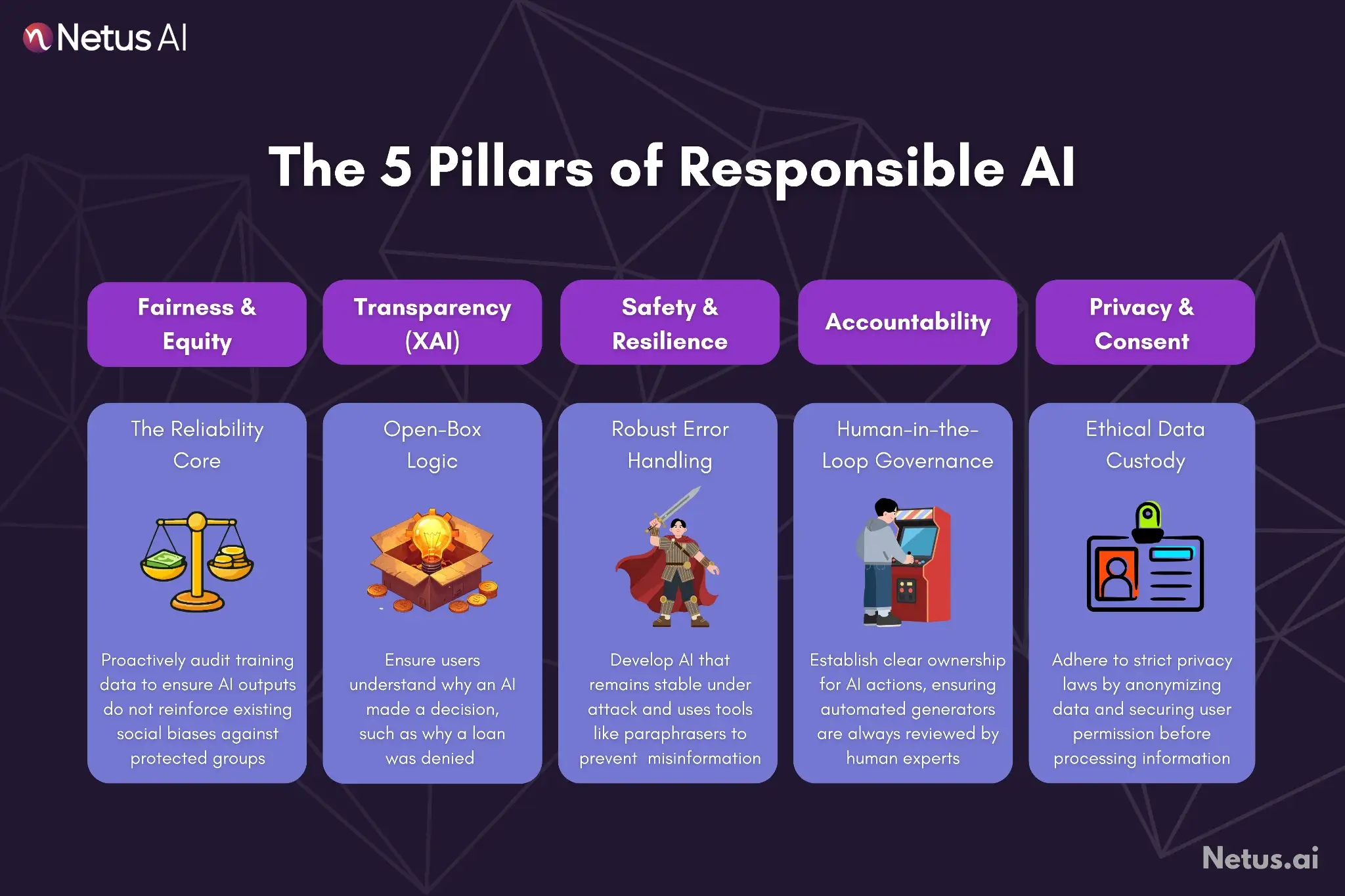
Responsible AI stands on a number of main pillars that guide its direction:
Fairness and non-discrimination
One of the most important goals of RAI is to ensure that AI programs do not perpetuate or increase the discrimination we already see in life. When AI is given data from the past that is already biased (such as in hiring, lending, or the courts), the AI will also learn and replicate these same biases.
To ensure fairness in AI, along with its future opportunities and challenges, it usually needs to look at the data used for training and its results to ensure every group is treated fairly, regardless of their age, religion, race, sex, or any other protected identity. It is not easy to define fairness in every case because ideas like “equal chance” and “equal result” do not always match and may require different ways of programming.
Transparency and explainability
For example, if a person is refused a bank loan or if their CV is turned down by an AI, they might never know the real reason if the system is not transparent. Transparency and explainability matter a lot to make AI trustworthy and make users feel safer.
Transparency is about openly sharing what the AI is for, how it is made, and where it will be used. Explainability is more about not just seeing AI’s results, but being able to show directly why the AI decides something. Sometimes, for things like an AI summarizer, this is needed to make sure a summary is telling the truth and not hiding important details or giving a wrong impression.
Safety and strength
It is important that AI is safe and works as it is supposed to. Safety is about the AI not acting in ways that could hurt people by accident. Robustness requires an AI to handle attacks or strange data without ceasing to work or making dangerous mistakes. Consider that an AI for a self-driving car must be robust against sensors that stop working properly.
For text, making sure that the content the AI generates is free from accidental plagiarism or giving users incorrect information is equally important. This is where tools like a paraphrase tool can become really useful as ethical support, helping people modify AI text for better clarity and to avoid accidental plagiarism, which assists in more responsible content creation.
Accountability and governance
If AI systems cause damage, people must be able to identify who is at fault. Accountability means identifying exactly the individual or group responsible at each step, from creating to applying to checking AI machines. So it is necessary to have governance, reviews by ethical groups, and auditing systems in place.
Governance also means not allowing the improper usage of AI. As AI starts creating text that is almost indistinguishable from human writing, tools to check if content was made by AI, such as an AI detector, must be part of rule-setting, especially in academic or professional settings. Still, for those producing a high volume of writing, such as with an SEO article generator, it should be used responsibly, with a human revising and correcting the output to ensure it meets ethical and professional standards.
Privacy and data handling
Responsible AI wants very strict rules about privacy and data handling, like those required by the GDPR, and ethical data handling. This means keeping and using user data carefully with people’s permission and removing names where possible to keep things anonymous. Keeping data safe is non-negotiable if you want people’s trust.
Responsible AI in the real world: digital responsibilities
When Responsible AI is put into action, it affects almost every task done by AI. If, for instance, you make use of a title generator or slogan generator, being responsible means checking that the results are not racist, insulting, or offensive to certain cultures, which is a job for people to perform.
For content work, the main thing is to truly know what visitors are looking for by using tools like a keyword extractor to find the important subjects in the text. Being responsible with this is about making sure these facts are used to really help people, not to trick systems for benefit.
Also, some people try to change or "humanize" AI text to bypass detection software, which is becoming more advanced. Although RAI says being open is the top priority, AI bypasser tools are in a hard-to-judge area. Using them sneakily to fool detectors is not responsible.
But using them to help non-native English speakers or to ensure that real human-checked writing is not wrongly identified as AI-generated text may, in some cases, be another part of handling output with care. The intent and transparency regarding how the final work was created are what is most important.
NetusAI: all-in-one responsible content solution
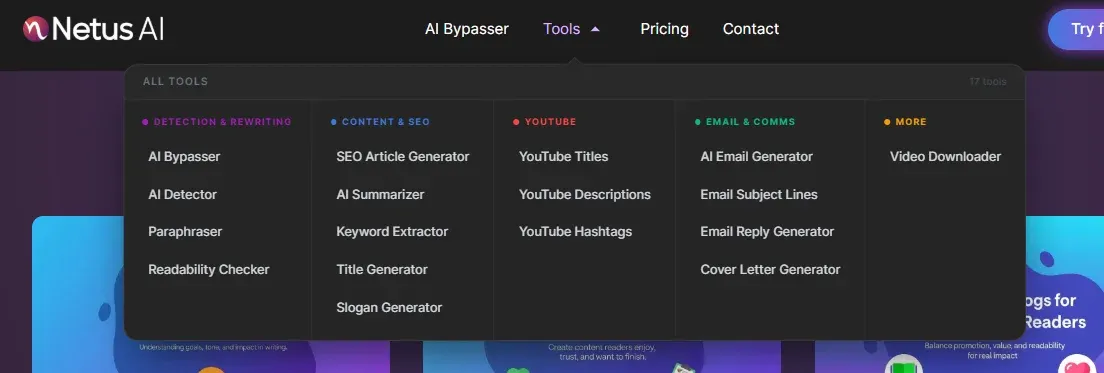
NetusAI offers many AI tools, making it an interesting single place for individuals and professionals who must handle tough questions about AI these days. Instead of putting together different and sometimes questionable products, you get everything on NetusAI, which carries features to help at any point when making and changing content.
By providing these tools together, NetusAI allows its users to work faster and with better quality and ethical consideration, making content creation more responsible in the digital age.
Final comments
Using AI in a good way is not just about a fixed group of steps, but more like a process that keeps changing.
To do it right, people like lawmakers, tool builders, and users must always work together to establish rules so AI can help without causing problems. In the future, AI will not only depend on hardware speed; instead, it will depend more on how we collectively use AI in ways that are smart, careful, and responsible.
FAQs
What separates Responsible AI from AI ethics really?
AI ethics concerns ideas and theoretical thinking about right and wrong in AI. Responsible AI means putting those moral thoughts into action (using governance, audits, and standards). RAI takes ethics and makes them real in practice.
How can bias arise in AI technology?
Bias usually arises from the material used in training (old data, lack of representation of all groups), the way it gets tagged or found (measurement problem), or the design decisions of creators (algorithmic bias).
Can models with high complexity always be explained with ease?
Full and simple answers for how big models like deep neural networks ("black boxes") work are still very difficult technical problems. So, researchers usually look for more local answers (about single choices the model makes) or general tools. These give tips, even if total logic is hard to show.
Why must people prioritize transparency with AI tools for content?
Transparency matters because it tells people if something uses AI. This way, they better understand how new and reliable the information is and who takes responsibility. Tools like the SEO Article Generator should be used openly and checked by real people who oversee the final output.