We have been hearing a lot about this debate with AI in school assignments, such as tools like DeepL that translate essays and Turnitin, which looks for plagiarism.
It seems students rely on DeepL a lot these days, particularly those whose first language is not English. They use it to get their work done more easily.
Students are using it more and more; yeah, that stands out.
In short, it can detect that kind of translated content. It's kind of worrying because it ties into all these academic integrity problems.
Understanding how these two tools work together seems important.
DeepL and Turnitin translated text detection
DeepL is an accurate AI text translation tool popular with students for its simplicity and reliability in academic assignments.
Turnitin is different, though; it's more about catching plagiarism in schools around the world. They use it to scan what you turn in, checking against all these databases full of academic writing, websites, and even other students' submissions.
These tools cross paths in a way that causes issues. DeepL makes it easy to translate languages. Turnitin, though, detects plagiarism and might go beyond just finding copied text in the original language.
Is using DeepL considered cheating?
A lot of students stress about using DeepL to translate their papers, thinking it might count as cheating somehow.
That worry comes from the fact that people are watching AI content more now, especially tools like ChatGPT that just make up whole pieces of writing, and then detectors like Turnitin catch it all.
There's a difference here between creating content from scratch and just translating what you already wrote.
Like, if a student does the work in their first language, gets the ideas down themselves, and DeepL only switches it over to another language, then the main point is still theirs.
DeepL is not really inventing anything; it just handles the translation part. Some might argue it's still too easy, but it seems the original thoughts belong to the person who wrote them first.
That happens because those detectors look at patterns in words and how often they show up, and translations can mess with that in a way that looks artificial.
Using DeepL for translation of a student's original ideas is acceptable and not considered cheating. However, students may still face unfair false alarms from AI checkers when using such tools.
False positives in AI detection
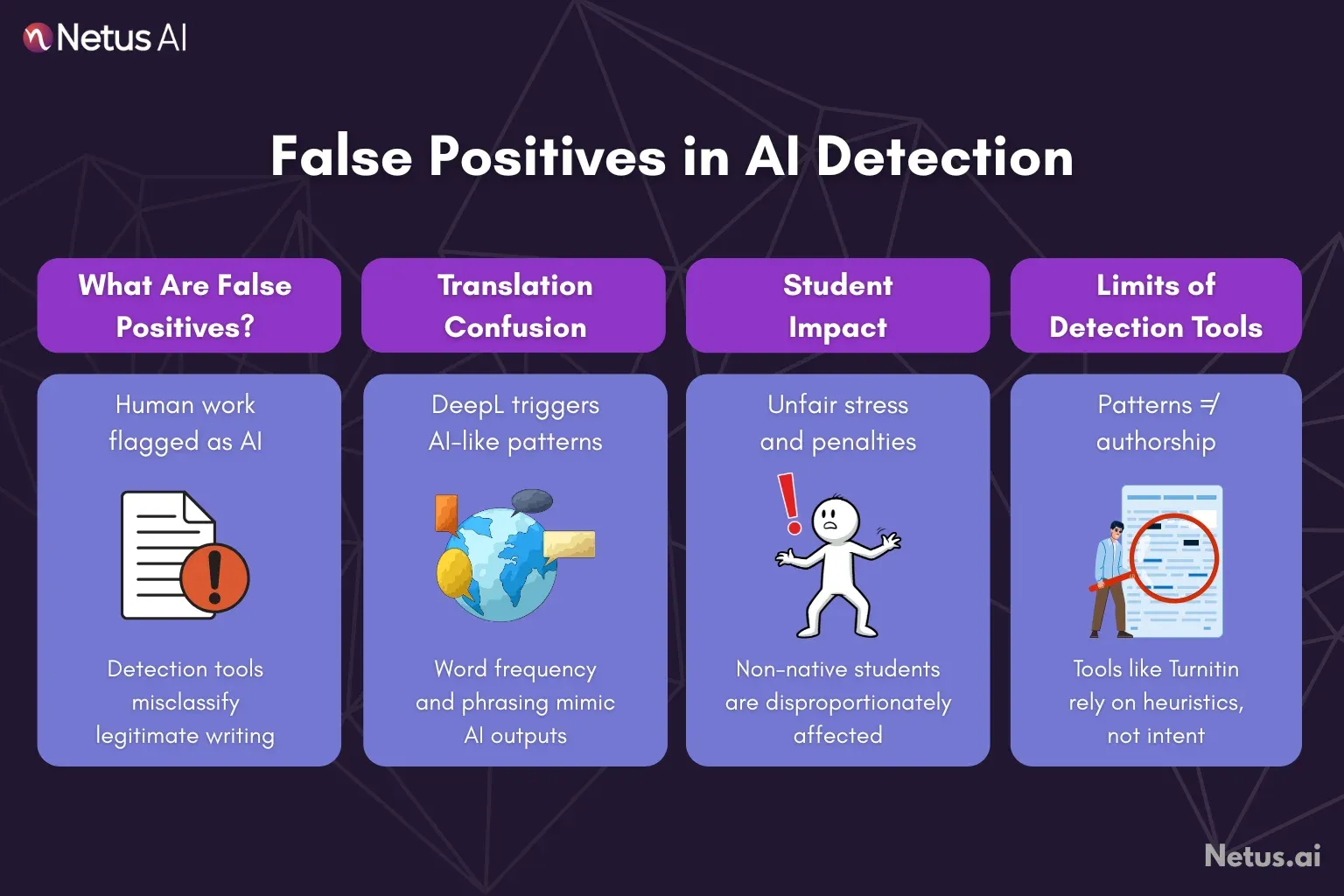
False positives occur frequently with AI detection tools when they analyze content translated by DeepL.
It seems as if these tools get confused and think the translated text came from AI just because of how words and phrases appear, such as their frequency.
This is especially important for students who write in their first language and then use DeepL to translate it into English.
Take an example: say a student writes an essay in German. They translate it with DeepL into English, and then Turnitin flags it as possibly AI-generated.
The way DeepL phrases things can end up looking a bit like what AI spits out. It is kind of unfair because the student just wants to get their ideas across in English without all that hassle.
That leads to stress for the students, and they might even get in trouble for no good reason. Patterns from translation get misread as AI signs, including by tools like Turnitin.
Can Turnitin detect translated text?
Figuring out whether Turnitin can spot translations from DeepL seems pretty complicated.
It checks everything you write against this massive database, with all sorts of things in there, like past student papers, websites, and old academic content.
Sometimes people grab some well-known text from another language, plug it into DeepL to get an English version, and if that original piece is already sitting in the database, it might flag the whole thing as plagiarism.
The algorithms are good at catching when the structure looks too much the same or the key points line up way too closely, even with the language switched around.
But that does not happen every time. For example, if what you are translating was your own original idea to begin with and DeepL just helps change the language, Turnitin is likely to miss it and not call it copied.
Using NetusAI to navigate translation and detection
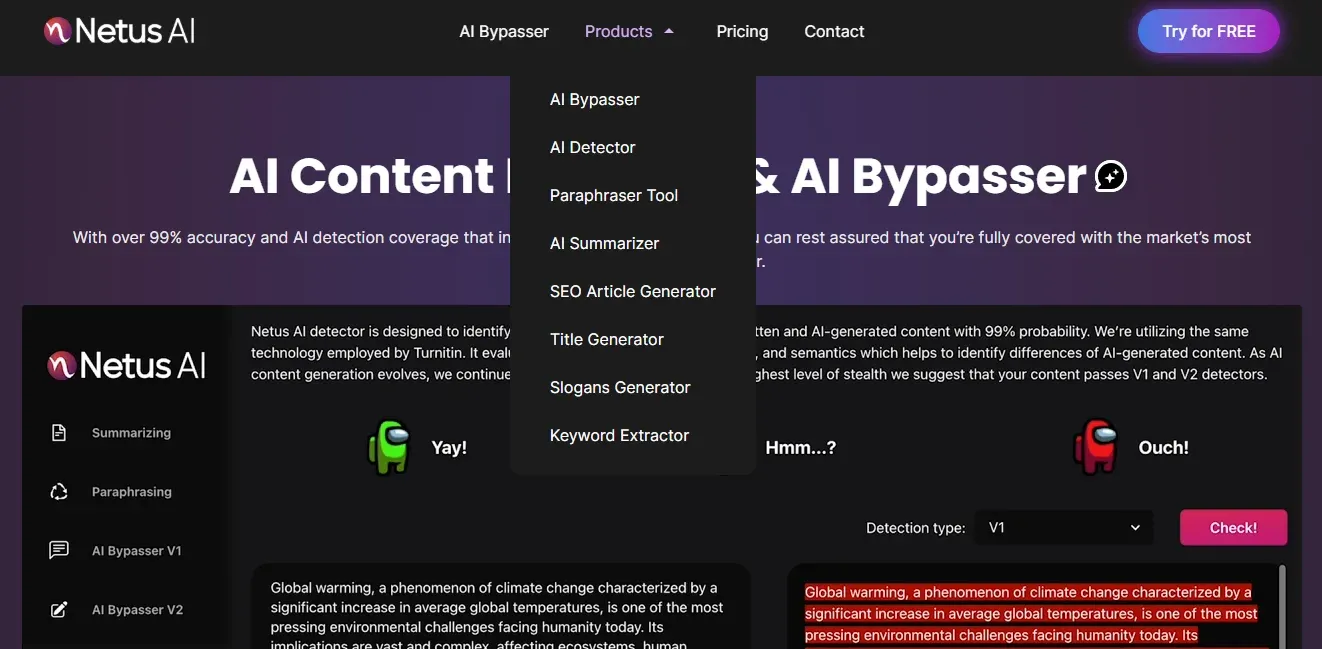
NetusAI has some tools that seem pretty useful for students and maybe professors, too.
They help deal with the tricky parts of using DeepL for translations and, at the same time, avoid getting flagged by those AI detectors or plagiarism checkers, Turnitin, for example.
The important part is making sure the end result keeps the real human idea behind it but looks like a person wrote it all along.
| NetusAI Feature. | Relevance to DeepL Translation and Turnitin Detection | Benefits for Users |
|---|---|---|
| AI bypasser | Modifies text structure and patterns to bypass AI detection algorithms (including those that might flag machine-translated text as AI-generated). | Helps avoid "false positive" flags when Turnitin misidentifies human-translated work as AI-generated content. |
| Paraphrase tool | Reworks sentence structure and vocabulary while preserving the original meaning of the text. | Useful if the source material (in the original language) is potentially close to content already in Turnitin's database, even after translation. |
| AI detector | Allows users to scan their translated text before submitting it to check for any AI-like patterns. | Provides peace of mind by identifying and fixing potential issues before the university's official check. |
These features let people start with their own content they have written, like real human content, and then they can translate it using DeepL.
After that, they refine the English version in an ethical way to ensure it fits academic rules. It helps the text pass AI detectors and plagiarism checks quite well, or at least accurately.
Final thoughts
When you use DeepL for translating, it can trip up those detectors, like Turnitin. They might think it's AI because of how uniform the writing comes out and flag it as cheating, even if it's not.
The main thing is where the ideas come from. If the student came up with them themselves, then just translating with DeepL should be fine; it's not really cheating or anything.
But schools are all about catching AI content now, so students probably need to do more, like run it through NetusAI or whatever to make it sound more human. That way, it doesn't get caught as fake.
The smart way is to use translation tools, but then tweak everything so the final paper feels original. And make sure it's ready for whatever software they use to check; that part gets a bit tricky sometimes.
FAQs
Can Turnitin detect content translated by DeepL?
Turnitin sometimes picks up on translated content. For example, with DeepL, it can detect that kind of thing. The original might be written by a real person, but when you run it through a translator, those machine patterns show up.
Is using DeepL for translation considered cheating?
AI detectors are supposed to catch certain things in writing, such as how sentences are built or which words show up frequently. Turnitin does that too, looking at patterns in language.
Why does translated content get flagged by AI detectors?
AI detectors, including Turnitin's features, look for specific linguistic patterns, sentence structures, and word frequencies. Machine-translated text often exhibits uniform or predictable patterns that can be misinterpreted as characteristics of AI-generated content, leading to false positives.
What is a "false positive" in the context of DeepL and Turnitin?
When an AI tool flags something as AI-made or copied, but it's really just a person who wrote it or translated it, like using DeepL for that, it counts as a false positive.
How can students reduce the risk of DeepL translated text being flagged by Turnitin?
Students might try out some tools to tweak their writing after they translate it. For example, there's NetusAI's AI bypasser or maybe the Paraphrase tool, something to change how the sentences are built and the way they flow. It kind of helps make the translated content feel more human, less robotic.
Does Turnitin flag plagiarism if the original source is in a different language?
Turnitin does check papers that are submitted. It looks at a huge database with academic articles, all sorts of websites, and even old student work from before.